Notes DB 94 - Theory of Peace - 2026
Sunday 28 June 2026 - Saturday 4 July 2026
[page 188]
Sunday 28 June 2026
My book has set the scene for a grand debate about the future of theology and imperialism and has suggesred a new category of pages for L4L:
Problems
1. The cosmological constant problem
2. The dark matter problem
3. The quantum gravitation problem
4. The anti-matter problem
5, The particle problem
Revise L4L index and commentary and quantocracy → NY_quantum_symmetry_Jun2026.
Monday 29 June 2026
Slow morning, RAH 1.20, lens measurement for cataract surgery
The world is looking a bit grim but I am feeling a bit smug when I feel that the evolution of the world under the influence of gravitation and quantum mechanics is a long term guarantee of the maximization of peace in the maximum entropy wilderness that characterizes the natural world and marks imperialistic, theocratic and autocratic violence as deviations from the nature of the world which are deprecated by reality. Is this true? It is fundamentally Christian: love the divine world; love your neighbour.
[page 189]
Quantum mechanics embodies freedom, agency and justice guided by the bifurcation of gravitation into a precise equivalence of potential and kinetic energy, a picture that I hope is emerging in lust for life guided by my own consciousness of my better angel, a helpful and relatively honest person minimizing my footprint as far as I can while maintaining my resources to pursue the mission from god entrusted to me by my parents.
Une idee fixe justified by the scientifically observed consistency of divine reality proved by the consistency of Aquinas’s definition of omnipotence and Hilbert’s mathematical formalism, something to stand by supported by logic and experience, the reason why I have no worries and see the reality of heaven on earth assaulted by the entropy destroying forces of human disequilibrium based on the return on capital being greater than the return of work pointed out by Piketty. We see capital as potential dangerously disproportionate to labour as concrete energy. Thomas Piketty (2014): Capital in the Twenty-First Century
Check von Neumann chapter V that QM solves problems f classical thermoidynamics,
The initial source of Piketty’s work was the collection of personal data for income tax which not only supported the government but gave it some insight into what people were doing.
Labour vs capital - particles (fermions, labourers, physical, concrete) vs potential (bosons, capital, money, abstract). Is this a universal dichotomy dating from the beginning of the world?
Tuesday 30 June 2026
Letter to Mischa Ketchell, Editor, Conversion Media Group, Tenancy B, Level 5, 700 Swanston St, Carlton Vic 3053,
[. . .]
[Transcript below: Friday 3 July 2026]
We may think of Hilbert space vectors in the initial symmetry as angels, orthogonal, meaning that each one is a discrete species and on this basis there are 61 angels (elementary particles) in the universe, all of which are observable in Minkowski space, multiple copies of each individuated by space and time, ie potential and kinetic energy.
Wednesday 1 July 2026
[page 191]
My optimism about the future seems to be based on my political interpretation of quantum mechanics, particularly the intelligence thereof, that I feel to be embedded in the eigenvalue equation, which has the effect of reducing the 2D space of complex numbers to the 1D space of the real numbers, and is the source of the “hidden information” conundrum facing the quantum information processing industry. Nielsen & Chuang (2016): Quantum Computation and Quantum Information, page 16
This is a hunch rather than a certainty and I have registered the domain moral-algebra to be devoted to exploring it when I get the skeleton of Lust-for-Life completed. The next step here in my “13 steps to the universe” is to examine the role of quantum mechanics in the linear algebra of the random Hilbert space created in the Aquinas–Einstein symmetry by my version of ‘spontaneous symmetry breaking’, transferred from electroweak theory and the Higgs mechanism down to the fundamental entropy generating process run by fixed point theory, whose first product is the primordial qubit of bosons and fermions that creates the Hilbert space in which I am sitting now listening to electrodynamics at work in the morning thunderstorm and pouring rain.
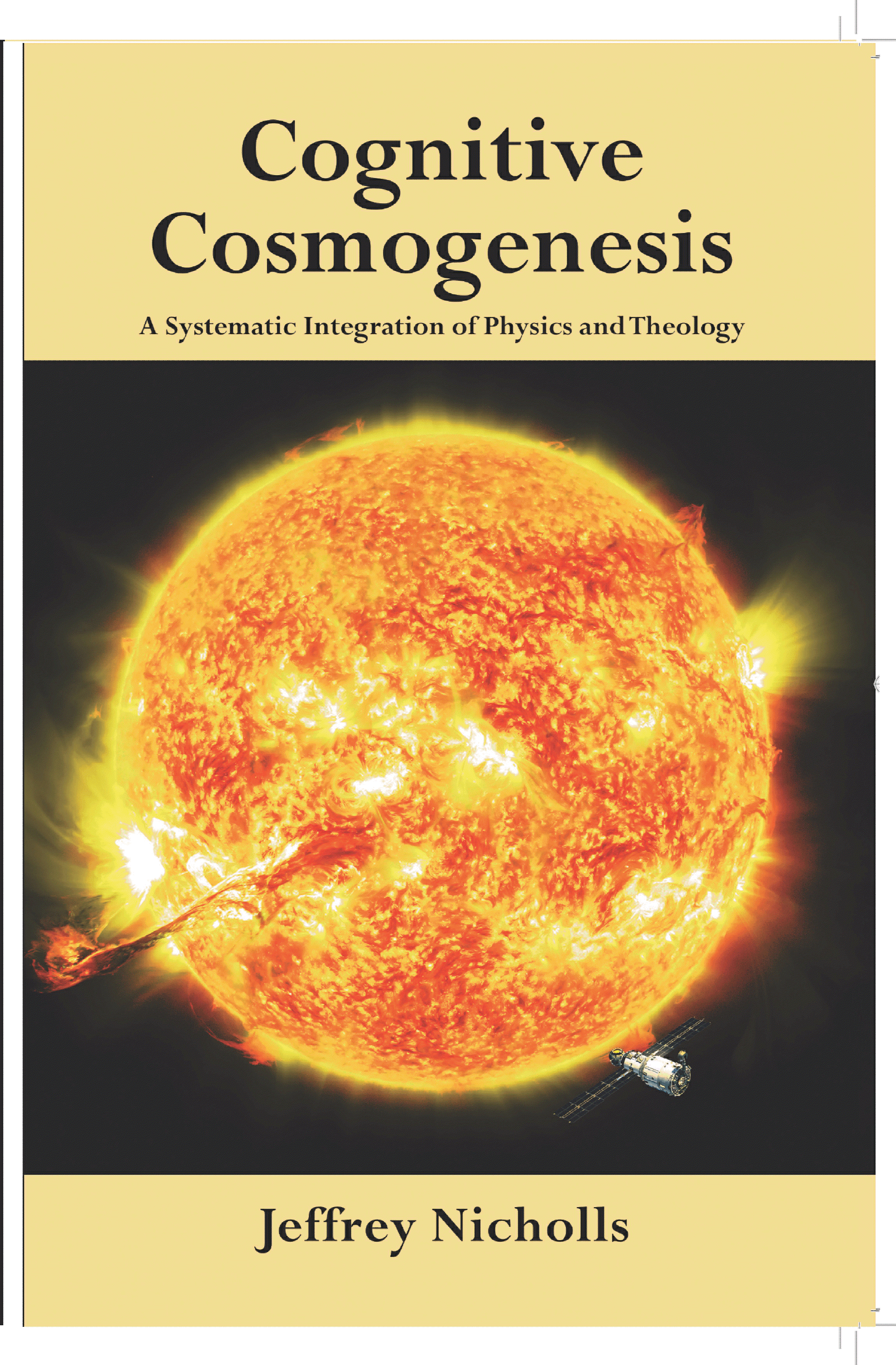
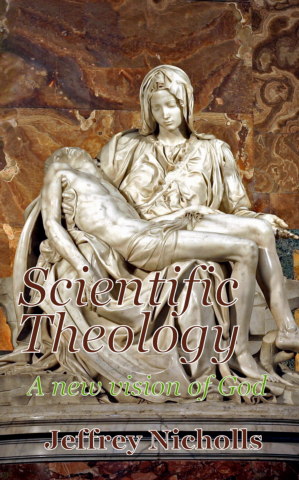
All this looks loverly, is far from the standard model and I see my mission in life, having deleted the Catholic paradigm of redemption, to develop the properties of the divine universe that has become my new faith rooted in my new Bible, the physical route to theology pioneered by Aristotle and echoed in my book of hope, Cognitive Cosmogenesis: a systematic integration of physics and theology, founded on complex linear algebra, ‘moral-algebra’. Jeffrey Nicholls (2025): Cognitive Cosmogenesis: a systematic integration of physics and theology
The theory of history I use to explain the destruction of indigenous culture by imperialism over the last 10 000 years is the technical development of lethal weapons which has enabled the wealthy element of
[page 192]
society to practise autocracy and genocide on the physically ‘naive’ indigenous populations of the world that have failed to develop nuclear weapons.
This is my version of ‘realpolitik’, violence uber alles, built into the sequence of imperia that we date to Egypt and Mesopotamia and which is now moving out of the physical domain into the cognitive domain with “fake news”. The deepest and most disastrous version of [this delusion] is the catholic history of salvation based on the celebration of the violent human sacrifice of Jesus of Nazareth, documented in Haight’s 1999 Symbol of God. Roger Haight (1999): Jesus Symbol of God
The end of autocracy may be at hand. The British Empire killed itself in the Suez Crisis; maybe we are seeing the end of the US empire in the chaotic and stupid regime of Trumpist MAGA America, a massive pseudo democracy brought to is knees by an ancient imperial theocracy whose autocracy remains impregnable, another round of the centuries old battle betwen Islam and Rome. Suez Crisis - Wikipedia
John A Tures - even the World Cup run by a semi-imperialist plutocracy. John A. Tures (2026_06_26): Does the World Cup favor democratic or autocratic nations? I did some number crunching to find out
I am enjoying my 80 yo entry into the world of light after the 60 year period of blight and bottom feeding that followed my failure in the Catholic monastery, although the normal beauties of reproduction have gifted me with a clutch of beautiful and intelligent children who will hopefully benefit from the enlightenment I have acquired after my fortunate rejection by Catholicism.
[page 193]
Feynman on how it works. The Feynman Lectures on Physics, British School of Valencia: Feynman Technique: a study method you should know about,
The Feynman Lectures on Physics are in effect the first edition of the physical bible underlying the theology presented in Lust for Life.
Thursday 2 July 2026
What have we got to say about dark matter? - energy without radiation from EM, but localized, perhaps by primitive QM, prior to 2D fermion and boson [or unaccompanied / uncharged protons??].
Corriere della Sera: Lettera al Direttore.
Piketty: What forces favour convergence, ie if the rich countries are so flush with savings and capital that there is little reason to build more housing or add new machinery (in which economists would say that the “marginal productivity of capital”. that is the additional output due to adding one unit of capital “at the margin” is very low) it can be collectively efficient to invest some part of domestic savings in poorer countries aboard. [. . .]. This optimistic theory has two major defects, however [. . .].
[page 194]
‘To sum up, historical experience suggests that the principal mechanism for convergence at the international as well as at the domestic level is the diffusion of knowledge.’ Thomas Piketty (2014): Capital in the Twenty-First Century
So let us propose that the gnostic gap is spanned by the periodic functions and the hermitian operators of complex linear algebra supplemented by the materialization of forms through the bifurcation of gravitation into kinetic (fermionic) and potential (bosonic) energy, providing the construction kit of parts and fastenings necessary to onstruct a universe.
L4L/Essays/NY_quantum_symmetry_Jun2026 [this is its proper place, will later turn it into a PDF and submit it to New Yorker with Chinese PTC Principles].
Friday 3 July 2026
Letter to Conversation. Will they listen to me? Will the Vatican?
Mischa Ketchell, Editor,
Conversation Media Group,
Tenancy B, Level 5, 700 Swanston St, Carlton, Vic, 3053
Hi Mischa,
I have been a subscriber for and donor to the Conversation since 2015. The Conversation is brilliant work which I love. It has brought hope and happiness to my old age in the knowledge that science will ultimately triumph over imperialist theocracy.
I am not an academic. I am here flogging my own book hoping that it may excite a review from one of your theologically inclined reviewers.
I posted a copy of Cognitive Cosmogenesis, a systematic integration of physics and theology to the Conversation Carlton office some time ago.
It took me 60 years to write. It began in 1963 at the time of the Second Vatican Council with an essay How Universal is the Universe. I suggested that the Church might do well to follow Thomas Aquinas by upgrading theology to a real science, a move that would imply that god is observable. This was (and is) heresy in the Order and I soon found myself on the street in a new suit.
Now I see that there is no greater example of fake news than the core message of Catholic doctrine, that we are sinners living in a world deformed by sin whose only salvation is the Catholic Church.
My book makes two points;
1: Theological: the Roman Catholic Church worships [an] imaginary god. The real creator is the universe itself which has an eternal antecedent. Aristotle knew this but his work was subverted by the medieval Christian theologian Thomas Aquinas to support the Mosaic idea (developed by Islamic theologians like Ibn Sina aka Avicenna) that the world was created by a necessary being whose essence is to exist.
2: Physical: To establish this point we must overcome the dichotomy between matter and spirit, the “gnostic gap”.
This means we must go beneath Minkowski space to the underlying abstract Hilbert space following Hugh (many worlds) Everett III. Minkowski space is therefore pixellated by its quantum source, finite particulate fermions and bosons. It seems that the spurious infinities in QFT arise from the assumed continuity of Minkowski space and have been “theory washed” by renormalization, suggesting a serious deficiency in the “Standard Model”.
In the interests of fair play, I have sent copies of my book to the President of the Pontifical Academy of Sciences, Prof Joachim von Braun, and to the Cardinal Prefect of the Dicastery for the Doctrine of the Faith, Victor Manuel Fernandez.
What are the consequences for their organization if my story touches the truth?
You may think this book is wishful thinking by a disgruntled old monk, but I suspect that it is right and could be quite effective,
Best Wishes, Jeffrey
PS: The slow evolution of my book, beginning in the 1980s is documented in the sluglike trail of sites beginning with with naturaltheology.net, continuing with cognitivecosmology.com, cognitivecosmogenesis.com and summarized at jeffreynicholls.net.
Back to Piketty
[page 195[
Saturday 4 July 2026
Revision of NY_quantum_symmetry_Jun2026 basing the development on the idea of symmetry breaking developed by Augustine of Hippo to explain the Christian doctrine of the Trinity, in which the absolutely simple and structureless symmetry of the Christian god became the Trinity, Extending the idea ad infinitum to develop a model of the divine universe.
Robert Bellingall: “A culture more tolerant of moral disagreements and less quick to reach for political powers to force others to accept what they find morally wrong would help to ease the distrust many Americans feel toward the government and one another. Until then, Americans will continue drifting away from the liberty that the US was founded to secure. Robert A. Ballingall (2026_07_02): As the US turns 250, a forgotten founding influence helps explain its current unease
Law is a safety fence, like the DNA in a body, tuning all to work together, the fundamental role of the fermions and bosons which are not so much separate particles but separate and distinct elements of every particle, actuality and potentiality, and in the equivalence of these lies justice.
Space ≡ action, time ≡ potential: Particle and wave, person and message fundamental particulate constructive symmetry.
Newton distinguished force and acceleration whereas both are united in gravitation. So the gravitational fermion and boson are united as one, undifferentiated energy [to be differentiated by quantum mehanics].
[page 196]
A lot of the effort of cognitive cosmogenesis revolves around distinguishing aspects of reality and then working out how they communicate and cooperate. This is achieved in tensor calculus by covariant and contravariant features coupled by a metric, ie a potential? Once again I realize how slow I am to understand things. Reality is unique, covariant and contravariant are intellectual / formal categories that enable us to dissect uniqueness, like the gossip that makes the whole business of art and culture. We dissect one another to find common ground. Montsquieu’s law. Montesquieu - Wikipedia
How does this fit into the agency / freedom / justice paradigm at the centre of quantocracy, ie NY_quantum_symmetry_Jun2026 [/ quantocracy] articles which are in some sense duals of one another, circling politics which is in a sense the metric joining us? Is this what Einstein capturd in general relativity, the unity underlying quantum theory which breaks the gravitational symmetry to extract the structure of the universe and shows us the simplicity of the omnipotent omniscient god, the unity built into the spirituality which bridges the gnostic gap.
I.13 The quantum source of Minkowski spacetime - fermions and bosons. How do we explain special relativity? We begin with the fact that there is no space and time in Hilbert space. All we have is the qubit
|minkowski⟩ = α|fermion⟩ + β|boson⟩
which is everywhere and nowhere. Where we are, in space and time, we are aware of vast numbers of massive fermions, stars, planets, cells, molecules, individual electrons etc. We do not see the photons moving between the fermions, only the points where they are created and annihilated, and insofar as we interrupt them with the fermions in our bodies we perceive light and warmth and may suffer damage from energies higher than UV up to
[pag 197]
gamma rays of unlimited energy which may have traveled distances of billions of light years.
|
Copyright:
You msay copy this material freely provided only that you quote fairly and provide a link (or reference) to your source.
Further readingBooks
Haight (1999), Roger, Jesus Symbol of God, Orbis Books 1999 Jacket: 'This book is the flagship of the fleet of late twentieth century works that show American Catholic theology has indeed come of age. Deeply thoughtful in its exposition, lucid in its method, and by turns challenging and inspiring in its conclusions, this christology gives a new articulation of the saving "point" of it all. . . . Highly recommended for all who think about and study theology.' Elizabeth Johnson CSJ, Fordham University.
Amazon
back |
Hooper (2026), Rowan, Togetherness; Symbiosis and the Hidden Story of Life's Greatest Collaborations, Fern Press 2025 ' From evolution to capitalism, 'survival of the fittest' has shaped our view of the world. But we got it wrong - and our mistake has brought us to the brink.
For the history of life on Earth is much more than a story of competition. The natural world has been forged and sustained by small miracles of co-operation between animals and plants, insects and fungi, fish and bacteria - these partnerships are ubiquitous, lifelong and are an essential guide for a better future.
In Togetherness, Rowan Hooper reveals the intimate connectedness of nature through these remarkable stories of symbiosis. From the female wasp venturing deep inside a fig and the intricate relationship between corals and the algae that sustain them to the symbiotic gut microbes that influence our moods, he explores how co-operation is fundamental to life itself and to protecting our shared future.'
Amazon
back |
Nicholls (2025), Jeffrey, Cognitive Cosmogenesis: A systematic unification of physics and theology, Austin Macauley Publishers 12025 ' This book is a personal narrative of those events and a defense of the belief that the universe itself is divine. The central argument is that by embracing this reality and abandoning notions of supernatural deities, humanity can resolve its problems. The universe, it is argued, is self-creating, and a proper understanding of physics leads to a plausible scientific theology. The natural intelligence inherent in the universe, from cellular organization to ecosystems, far surpasses any artificial intelligence. Comprehending this natural order, the author suggests, would make achieving world peace relatively straightforward.
The book contends that modern theologians should recognize the physical world, rather than ancient texts, as the foundation for credible theology. It also addresses the historical entanglement of religion and politics, asserting that the model of creation presented herein fundamentally rejects the imperialistic ambitions that have fueled genocidal holy wars.'
Amazon
back |
Nielsen (2016), Michael A., and Isaac L Chuang, Quantum Computation and Quantum Information, Cambridge University Press 2016 Review: A rigorous, comprehensive text on quantum information is timely. The study of quantum information and computation represents a particularly direct route to understanding quantum mechanics. Unlike the traditional route to quantum mechanics via Schroedinger's equation and the hydrogen atom, the study of quantum information requires no calculus, merely a knowledge of complex numbers and matrix multiplication. In addition, quantum information processing gives direct access to the traditionally advanced topics of measurement of quantum systems and decoherence.' Seth Lloyd, Department of Quantum Mechanical Engineering, MIT, Nature 6876: vol 416 page 19, 7 March 2002.
Amazon
back |
Piketty (2014), Thomas, and (translated by Arthur Goldhammer), Capital in the Twenty-First Century, Belknap, Harvard University Press 2014 Jacket: 'What are the grand dynamics that drive the accumulation and distribution of capital? Questions about the long term evolution of inequality, the concentration of wealth, and the prospects for economic growth lie at the heart of political economy. But satisfactory answers have been hard to find for lack of adequate data and clear guiding theories, In Capital in the Twenty-First Century Thomas Piketty analyzes a unique collection of data from twenty countries, ranging as far back as the eighteenth century to uncover key economic and social patterns. His findings will transform debate and set the agenda for the next generation of thought about wealth and equality.'
Amazon
back |
Links
Alex Lo (2026_06_28), Greenspan helped blow up capitalism. China saved it, ' De mortuis nil nisi bonum dicendum est. Since I don’t really know Latin and am not a Roman, I am going to speak very ill of Alan Greenspan, the long-reigning chairman of the US Federal Reserve, who died last week aged 100.
No one particular policymaker was entirely responsible for the real estate market collapse in the United States that triggered the last global financial crisis. But Greenspan bore more responsibility than most.
In US congressional testimony in 2008, Greenspan made a confession of sorts. “I have found a flaw,” he said. “I don’t know how significant or permanent it is. But I have been very distressed by that fact.”
We now know it wasn’t just a flaw but many flaws, which were pretty significant; some could be permanent. Not only did the monetary policy he engineered accumulate risks in the system over many years, he made sure the necessary regulations needed to contain those risks were reversed or never put in place.
For that, he provided the insidious ideological justification against financial supervision. The result has been serial bubble-blowing, leading to what we see today in the United States: the rich get fantastically richer while the poor get poorer. [. . .]
Three words – the Greenspan put. It means hands off when the market is up, but massive intervention via Fed open-market operations to put a floor to any major asset collapse. That pretty much guarantees the blowing of asset bubbles. This asymmetry would have repulsed Smith, not the least because of its blatant encouragement of moral hazard for investors – read gamblers – to take on ever more risks. The message is clear: the Fed would always have your back, if you are rich.' [. . .]
In Musk’s case, as the one-time federal cost-cutting tsar, his impact has been catastrophic. In the year since USAID was dismantled by Musk, 750,000 people in poor countries are estimated to have died as a result of the cuts. For the first time in a generation, more children died in one year (2025) than in the previous year. Meanwhile, Oxfam estimated that a 10 per cent tax on Musk’s $1 trillion fortune would generate enough revenue to end extreme poverty worldwide for a year. [. . .]
As for the last global financial crisis, influential Marxist academic David Harvey wrote in his latest book, The Story of Capital: “After 2009 and prior to the Covid pandemic, [China] contributed more than a third of global growth (more than North America, Europe and Japan combined). China, in effect, saved global capitalism from a major depression by its expansionist policies during those year".' back |
British School of Valencia, Feynman Technique: a study method you should know about, ' What are the 4 steps of the Feynman technique?
The Feynman methodology is based on four main steps: selecting a concept, explaining it in a simple way, resolving possible doubts and reviewing and simplifying it.
Step 1: Select the concept or subject to be studied
The first step is to choose the concept or subject we want to master. This involves not only identifying the subject, but also being able to define it precisely from the outset. In this way, you will be able to focus from the beginning and establish a clear framework for your study.
Step 2: Develop the subject on paper
Once you have identified the subject, the next step is to go deeper into it. Read, research and study everything related to the chosen topic. Then write down everything you can remember in a clear and simple way. As well as helping to strengthen your memory, this process will also force you to organise your thoughts in a coherent way. In this step, it may be useful to develop diagrams, sketches and other visual aids to strengthen your understanding.v
Step 3: Fill in missing information
During the explanation process, you may notice gaps in your knowledge. In this third step, you have to review and fill in any missing information. You can use different sources such as books, notes or the Internet to extend your knowledge in order to gain a comprehensive understanding of the topic.
Step 4: Rewrite and explain the subject as if you were teaching it to a child
The final step is to simplify and explain the topic as if you were teaching it to someone who has no prior knowledge of it. This forces you to refine the information into its most basic and understandable form. In addition to consolidating your understanding, it will facilitate long-term memorisation.
How does the Feynman Technique work for studying?
The Feynman Technique leverages the process of explanation as a tool for deepening and assimilating concepts. When trying to explain a subject to another person, either verbally or in writing, we are directly confronted with our own gaps in understanding. This forces us to revise and strengthen our understanding until we can convey it with clarity and confidence, which is very effective in consolidating knowledge.
But it also encourages the use of simple language and everyday examples to explain complex subjects. This promotes deeper understanding and helps to integrate what has been learned in a more useful and practical way in a variety of contexts and applications. This not only improves personal understanding, but also the ability to teach and transmit ideas to others.
back |
Chloe Loung (2026_06_30), How Empress Dowager Cixi took control of China and was de facto ruler for nearly 50 years, ' One of the most powerful and influential women in Chinese history, Empress Dowager Cixi (1835-1908) controlled Qing-dynasty China for nearly half a century, first as regent for her young son, then as the power behind another child emperor.
Not bad for someone who began her royal life as a low-ranking concubine. Cixi was born into a prominent, high-ranking Manchu aristocratic family in 1835. As a teenager, she was plucked from her childhood home in Beijing and entered into the selection of wives to the Xianfeng Emperor. In 1852, she was chosen as a concubine of the sixth rank, but she managed to improve her standing over time thanks to her unusual upbringing.
In the book Empress Dowager Cixi: The Concubine Who Launched Modern China, author Jung Chang describes how Cixi’s father treated her like a son and constantly spoke to her about topics typically off-limits to women at the time. He also deeply valued her practicality and intelligence, taking into consideration her opinions on family finances and even political affairs.
The Xianfeng Emperor frequently had her read palace memorials aloud and record his instructions upon them, which gave her intimate knowledge of the state and invaluable experience in the art of rule.
“Being consulted and having her views acted on, she acquired self-confidence and never accepted the common assumption that women’s brains were inferior to men’s,” Chang writes. [. . .]
By late 1908, she was 72 years old and her health was failing. However, the Guangxu Emperor – childless and still under house arrest – was also gravely ill. Cixi was terrified that if she died first, Guangxu would take back power, vindicate the reformers she had killed and undo her legacy.
The 37-year-old Guangxu Emperor died suddenly in November that same year. Cixi’s death followed less than 24 hours later, but not before she appointed Guangxu’s nephew, two-year-old Puyi, as the next and final emperor of China.
For a century, historians debated whether the Guangxu Emperor’s death was a coincidence or not. In 2008, Chinese scientists tested the remains of his hair and clothes – they discovered arsenic levels more than 2,000 times higher than normal. While there is no paper trail, many historians agree that Cixi ordered his assassination from her deathbed.' back |
Dana Hedgpeth (2026_06_30), Three words in the Declaration of Independence paint a cruel picture of Natives, ' McKaylin Peters, a 24-year-old Native American graduate student at Johns Hopkins University, still recalls when she first heard the words “merciless Indian savages.”
Sitting in social studies class at her predominantly White middle school near Green Bay, Wisconsin — a school that once used an image of an Indian as its mascot — she cringed when the teacher read a passage deep in the Declaration of Independence: “He has excited domestic insurrections amongst us, and has endeavoured to bring on the inhabitants of our frontiers, the merciless Indian Savages, whose known rule of warfare, is an undistinguished destruction of all ages, sexes and conditions.”
Peters said she and the six other Native students in the class looked quietly at one another.
“I was upset. It just rolled off her tongue very easily,” recalled Peters, a citizen of the Menominee Nation who is getting her master’s in organizational leadership. “It seemed like no one else was shocked except for us, the Indigenous students in the classroom. We were like, ‘Did she really just say that?’”
As the United States marks the 250th anniversary of the Declaration — a document fundamental to the nation’s founding and still revered — Peters and other Native American scholars and tribal leaders are reflecting on the Founding Fathers’ use of the derogatory description for Indigenous people in 1776. Many note that while the Declaration promises that “all men are created equal,” its ideals were not extended to everyone.
The document’s portrayal of Indigenous people helped establish a moral and legal framework that justified decades of devastating U.S. policies toward Native communities, according to historians. Celebrations of the 250th anniversary of the Declaration’s signing come amid a striking contrast: Native tribes are working to reclaim ancestral lands, revive lost languages and preserve cultural traditions, while the Trump administration has sought to remove or downplay references to slavery, Native dispossession and other dark chapters of U.S. history in parks and museums and on government websites.
“It’s not just a line in an old document,” Peters said. “It’s a reminder that this country was built by declaring us less than human. When the Declaration of Independence calls us that, it’s a message that Native youth sadly still hear today in classrooms, policy debates and in how society talks about us.” [. . .]' back |
Dennis Altman (2026_06_29_, Getting Murdoched is a fascinating study of the Murdoch media’s bullying tactics, Review: Review: Getting Murdoched: How Murdoch’s Media Wields Power and Punishment – Andrew Dodd and Matthew Ricketson (Hardie Grant)
' Rupert Murdoch is almost certainly the most globally influential Australian. That Australia has one of the most concentrated media markets in the world is, sadly, a reflection of his influence, even though he has relinquished citizenship to become a dominant media figure in the United States. There are already a number of books about him, including biographies by journalists Michael Wolff and William Shawcross.
The bitter family dispute, played out in the courts three years ago, about who would control Murdoch’s media companies after his death, could have been scripted by the writers of the successful television series Succession.
Andrew Dodd and Matthew Ricketson have not written another biography of Murdoch, but rather a forensic account of how the Murdoch empire bullies, intimidates and destroys individual citizens and governments. Both writers, now professors of journalism, have worked across the media, including for Murdoch’s local flagship, The Australian.[. . .]
In the US, Murdoch’s greatest influence comes through his establishment in 1996 of the Fox cable television network, which successfully challenged the three existing national networks. Fox News has become a platform for increasingly rabid right-wing commentators.
Murdoch apparently held Donald Trump in contempt. But once Trump’s ascendancy became clear, Fox News became a major ally. The network was a strong supporter in the 2020 and 2024 presidential campaigns. In Trump’s second administration, Fox also provided many of his key appointments, most notably his secretary of war (formerly defense) Pete Hegseth.[. . .]
n the UK, the focus of the Murdoch machine seems to be on gossip, no matter how unreliable or how it is sourced. In the US, there is more interest in political manoeuvres, even where one suspects Murdoch himself may not support what some of the more unhinged Fox commentators are saying.
In Australia, the Murdoch press combines deep hostility to the Labor Party with a series of ideological obsessions. Originally a progressive paper – it supported the election of Gough Whitlam in 1972 – The Australian has become the national voice for the right on a number of key issues. These include scepticism about climate change, unquestioning support for Israel, deep antipathy to trans people, and unrelenting hostility to any economic policy that might reduce inequality. [. . .]
The newly elected Liberal Party president Tony Abbott is a director of Fox Corporation, so Opposition Leader Angus Taylor may feel protected. Angus, please read this book. If there is one lesson from Murdoch’s career, it is that, like Trump, he has no allegiances beyond maintaining his power./ back |
John A. Tures (2026_06_26), Does the World Cup favor democratic or autocratic nations? I did some number crunching to find out, ' It is often said – by FIFA President Gianni Infantino and many others – that soccer is the “most democratic sport.” That sentiment is based in large part on the sport’s global appeal and long history of popularity across class and racial lines.
But whether that axiom applies to the quadrennial World Cup tournament is a different question.
On occasions in the past, authoritarian governments have used the tournament to boost their regimes. Italian fascist leader Benito Mussolini did so when Italy hosted the 1934 World Cup, manipulating the games and handpicking officials to boost the chances for the home team, who went on to beat democratic Czechoslovakia in the final. Likewise, in 1978, Argentina’s dictatorship used both the tournament’s hosting and the national team’s victory to “sportswash” the brutal repression that had accompanied the military junta’s seizure of power.
In each of those notable cases, the team of an authoritarian country won the tournament. But as a political scientist and soccer enthusiast, I was curious to see how countries in authoritarian versus democratic countries had fared in the World Cup over time.[. . .]
Democracy – a winning formula?
But what about the 2026 World Cup participants? Of the 48 countries represented, 43.1% are “free” nations, according to Freedom House. The “not free” group comprised 26.7% of all countries. This is a near reversal of 1974, the first World Cup year for which Freedom House data is available. Back then, free nations made up 27% of countries in the world, while not free countries comprised 41.4% of world’s nations.
And democracies are tipped for success in 2026. The top 11 FIFA-ranked countries are all “free.” For the top 19 countries, all but two — Morocco and Ecuador — are free, and those two are ranked by Freedom House as “partly free.” Of the lowest-ranked 11 countries in the tournament, more than half are unfree.' back |
Josh Gernstein (2025_06_28), The Supreme Court Is Building Its Own Massive Police Force, ' The Supreme Court cloaks its deliberations in secrecy and still banishes cameras from its ornate courtroom. Court officials are loath to discuss the security measures being undertaken to protect the justices. But the portrait of an institution straining to transform itself and its security apparatus comes into focus through an in-depth review of budget documents and videos posted on an officer-hiring website, as well as interviews with court insiders and little-noticed public comments by the justices.
With heightened security has come a slew of financial and logistical challenges for the high court, as well as a significant personal and professional impact on the justices themselves. Some of the justices have complained that the growing security envelope has complicated their lives, limiting their ability to go places and changing the way they interact with the public.
The Supreme Court has also become a lightning rod in recent years, fueling outcries over ethics controversies as well as a series of polarizing rulings that have reshaped American life. With more contentious debates over the court and more concern about security, the justices appear increasingly less likely to venture into what’s perceived as enemy territory — which only risks further cloistering them in an ideological cocoon.
With the Supreme Court’s approval rating dropping as low as 39 percent last year and now appearing to stand at about 46 percent the demand for greater oversight and accountability seems to be spreading in Washington.
Congress has granted recent requests for tens of millions of dollars in additional taxpayer funds for the justices’ security, but some lawmakers are calling for more transparency from the high court — including congressional testimony from the justices — about why its costs are spiking and how officials have decided what level of protection the justices require.
“We provide money for the Supreme Court,” Rep. Rosa DeLauro, the top Democrat on the House Appropriations Committee, said in April. “They’ve never come up and tell us what they’re doing with the money that we appropriate".'Review: Getting Murdoched: How Murdoch’s Media Wields Power and Punishment – Andrew Dodd and Matthew Ricketson (Hardie Grant) back |
Montesquieu - Wikipedia, Montesquieu - Wikipedia, the free ncyclopedia, Charles Louis de Secondat, baron de La Brède et de Montesquieu[ (18 January 1689 – 10 February 1755), generally referred to as simply Montesquieu, was a French judge, intellectual, historian, and political philosopher.
He is the principal source of the theory of separation of powers, which is implemented in many constitutions throughout the world. He is also known for propagating the term despotism in the modern political lexicon.
Montesquieu's anonymously published The Spirit of Law (De l'esprit des lois, 1748), first translated into English by Thomas Nugent in a 1750 edition, was received well in both Great Britain and the American colonies, where it influenced the Founding Fathers of the United States in drafting the U.S. Constitution.' back |
Robert A. Ballingall (2026_07_02), As the US turns 250, a forgotten founding influence helps explain its current unease, ' As the 250th anniversary of American independence approaches, many people in the U.S. are deeply concerned about the country’s future.
A recent poll by Elon University found that 69% of respondents “believe the signers of the Declaration of Independence would feel more disappointment than pride about modern American democracy.” Confidence in public institutions is historically low, and the most recent Harvard Youth Poll indicates that just a quarter of 18- to 29-year-olds “feel hopeful about the future of America. [. . .]
In “The Spirit of the Laws,” Montesquieu describes political liberty as a “tranquility of mind arising from the opinion each person has of his safety.” To be free is to believe that one is secure. But to believe as much, “it is requisite the government be so constituted as one man need not be afraid of another.”
Liberty cannot be a matter of “doing what one wants,” Montesquieu warns. What if what one person wants threatens others? Then one person’s freedom to act limits everyone else’s. No one can feel secure unless everyone lives under laws that regulate what each may do. Montesquieu understood liberty in terms of this confidence or “tranquility” because it amounts to being free from the arbitrary will of others.
When Montesquieu stresses freedom from fear of other citizens, he doesn’t just mean private individuals. He especially means those acting in a public capacity, like “magistrates” or “rulers.” If public officials’ behavior doesn’t conform to predictable norms set by law, if agents of the government can summarily arrest people, seize their property or revoke their citizenship – say, by denaturalizing and deporting them without due process – it becomes impossible to feel secure.
Even if such actions aren’t directed against me or those like me, such lawlessness is still threatening because it’s unpredictable. I might support the government’s moves against other groups in the moment, but what’s to stop the government from suddenly turning on me when the political winds change?
To prevent public officials from simply doing what they want, Montesquieu famously called for the separation of political power into branches headed by different citizens. [. . .]
According to Montesquieu, liberty depends on the kind of civic culture the U.S. seems at risk of losing. No institutions, however well designed, can preserve liberty if citizens believe their preferred cultural norms are so obligatory that political power is needed to enforce them, opposition be damned.' back |
Shannon Bosch (2026_06_29), A UN report details the ‘overwhelming’ scale of children killed in Gaza. It raises grave legal questions, ' A recent United Nations report has detailed serious allegations of Israel deliberately targeting Palestinian children during the conflict since October 2023.
The report by the UN Independent International Commission of Inquiry on the Occupied Palestinian Territory, including East Jerusalem and Israel, which has been rejected outright by the Israeli government, documents harrowing child deaths. It describes the scale of the deaths as “unprecedented”.
Legally, the report itself does not prosecute anyone, but it can have major consequences by adding to a growing record of international law evidence.
The commission is a standing investigative body created by the UN Human Rights Council in May 2021 after the escalation in Gaza and East Jerusalem that year.
Its mandate is unusually broad and ongoing. It’s tasked with investigating all alleged violations of international humanitarian and human rights law in Israel and the Occupied Palestinian Territory, identifying root causes and preserving evidence for accountability.
Since Hamas attacked Israel on October 7 2023, the commission has published several reports on the conflict, including on the deaths of Israeli children.
This latest report is significant because it focuses specifically on children, examining the impact of Israeli military operations on Palestinian children between October 2023 and March 2026. [. . .]
The commission’s report makes four highly significant findings.
1. The scale of child deaths is unprecedented
The report finds more than 20,000 Palestinian children have been killed and more than 44,000 injured since October 2023. [. . .]
2. Evidence of deliberate targeting
This is the report’s most legally explosive finding. It documents repeated incidents of children being killed by single sniper or drone shots, often in the head or upper torso, suggesting deliberate targeting rather than incidental harm. [. . .]
3. Systematic attacks on child-essential infrastructure
The report documents attacks on hospitals, schools and orphanages, which enjoy special protection under international law. The commission found these attacks have directly contributed to preventable child deaths, long-term disability and educational collapse. [. . .]
4. Arbitrary detention, torture and sexual violence
The report documents patterns of child detention, ill-treatment and abuse in custody.
The commission noted that dehumanising rhetoric by political leaders, soldiers and public figures has normalised violence against Palestinian children and contributed to an environment where such harm becomes acceptable.' back |
Suez Crisis - Wikipedia, Suez Crisis - Wikipedia, the free ncyclopdia, ' The Suez Crisis, also known as the second Arab–Israeli war, the Tripartite Aggression in the Arab world and the Sinai War in Israel, was a British–French–Israeli invasion of Egypt in 1956. Israel invaded on 29 October, with the primary objective of re-opening the Straits of Tiran and the Gulf of Aqaba as the recent tightening of the eight-year-long Egyptian blockade further prevented Israeli passage. After issuing a joint ultimatum for a ceasefire, the United Kingdom and France joined the Israelis on 31 October, seeking to depose Egyptian president Gamal Abdel Nasser and regain control of the Suez Canal, which Nasser had nationalised earlier in the year.
Shortly after the invasion began, the three countries came under heavy political pressure from both the United States and the Soviet Union, as well as from the United Nations, eventually prompting their withdrawal from Egypt.
The crisis demonstrated that the United Kingdom and France could no longer pursue their independent foreign policy without consent from the United States. Israel's four-month-long occupation of the Egyptian-occupied Gaza Strip and Egypt's Sinai Peninsula enabled it to attain freedom of navigation through the Straits of Tiran, but the Suez Canal was closed from October 1956 to March 1957.] back |
The Feynman Lectures on Physics, Caltech's Division of Physics, Mathematics and Astronomy online edition of the Feynman Lctures on Physics., Now, anyone with internet access and a web browser can enjoy reading2 a high quality up-to-date copy of Feynman's legendary lectures.
This edition has been designed for ease of reading on devices of any size or shape; text, figures and equations can all be zoomed without degradation.
Volume I: mainly mechanics, radiation, and heat
Volume II:nmainly electromagnetism and matter
Volume III: quantum mechanics
Feynman's Tips on Physics:a problem-solving supplement to the feynman lectures on physics' back |
Thomas M. Gernon et al. (2026_07_02), Continental breakup–driven uplift instigated East Antarctic Ice Sheet formation, ' Abstract
Why Antarctica became glaciated ∼34 million years ago (Ma) remains debated, as relatively warm climates and sea temperatures appear inconsistent with ice sheet formation. Although a critical decline in CO2 is considered primarily responsible, evidence suggests that other factors were important, too. We investigated whether regional topographic uplift, rooted in Jurassic continental breakup and mantle-surface feedbacks, enabled nucleation of the East Antarctic Ice Sheet (EAIS). By integrating geodynamic-topographic models with ice sheet and energy balance models, we show that progressive plateau growth in East Antarctica, including Eocene uplift of the Gamburtsev Mountains, pushed landscapes above the threshold for ice sheet nucleation by ∼45 Ma. Uplift enabled EAIS growth under warmer-than-expected climates, producing hemispheric asymmetry in early glaciation and reconciling Oligocene polar warmth with the onset of the modern icehouse world.' back |
Yih-Teen Lee (2026_06_27), What Gaudí and the Sagrada Família can teach us about leadership, ' Gaudí’s vision for Sagrada Família did not come to him as a bolt from the blue. It was the product of years of observation and reflection.
Gaudí took over the Sagrada Família project in 1883, inheriting plans to build a conventional neo-Gothic church on the site. He initially stuck to those plans while reconsidering the potential scope and purpose of the church.
By the 1890s he had envisioned something much grander: an immense basilica with 18 spires and three monumental façades. Gaudí’s vision evolved continuously over decades, as he used other architectural projects as laboratories of ideas that could be put to use in the basilica. Over time, his architectural vision – with its unique structure, symbolism, geometry and spirituality – became increasingly coherent.
The takeaway here is that Gaudí imagined boldly and refined patiently, until form and purpose aligned. Vision is rarely perfect from the start, it is crafted over time to create meaningful direction.
A vision only gains relevance when others can see what you see, when they are moved to join your quest and it becomes their mission as well. [. . .]
During Gaudí’s lifetime, slow periods in the building were used to take stock, to dream, and to design new solutions. After juggling other projects, he devoted his time exclusively to building the Sagrada Família from 1914 until his death in 1926.
The basilica is a revolutionary structure in architecture which combines beauty with mathematical principles. Its innovations include a tree-like column system instead of straight pillars, and the use of catenary arches throughout.
Equally important, Gaudí employed radically innovative forms, symbolism and the sculptural storytelling of the façades to revive faith and make spiritual meaning accessible and compelling to a society increasingly shaped by secular modernity.
While Gaudí was exceptionally creative, every innovation responded to the larger mission of bringing greater light, strength and harmony to his structures. The lesson Gaudí leaves us: innovation is meaningful when it serves a greater purpose.[. . .]
In a new team, the desire to lead is generally determined by a person’s identification with a leadership role and their intrinsic desire to lead. However, other leaders are driven by a different, more communal motive that views leadership as a duty or service to others.
These individuals are less concerned with the self and more with community. Their traits – including building trust, collaboration and empathy – do not place them front-and-centre in a new team, but they do come to matter more as a team matures. They are associated with warmth and, as our study found, with competence.
As a leader, Gaudí undoubtedly falls into this second, more subtle category. These traits were all evident in the vision, planning and work he displayed during his life. But today, 100 years after his death, they still guide the Sagrada Família construction team – which is itself 140 years old, and counting.' back |
|