Notes DB 94 - Theory of Peace - 2026
Sunday 20 July 2026 - Saturday 25 July 2026
[page 239]
Sunday 19 July 2026
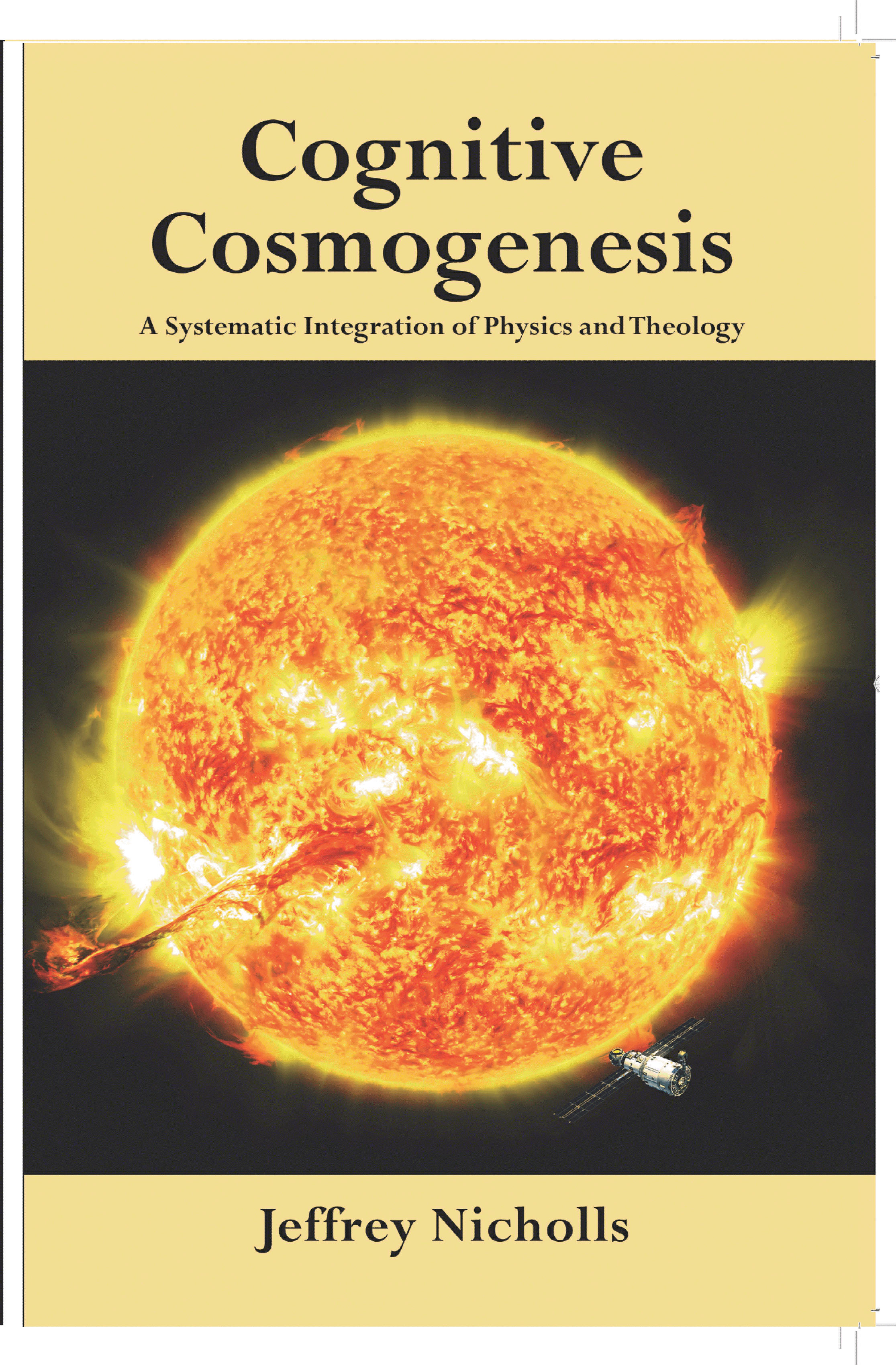
A long week of tying to understand QCD via Behiel’s 5 part video, wondering if I can make sense of it. It seems like hard work, but some of it is coming through and suiting my Lust-4-Life easy steps to a universe, which reassures me that in 18 months time I will have created a sound website reinforcing Rowan Hooper’s Togetherness on theological grounds, so I can relax and settle down to steady work hoping that Cognitive Cosmogenesis will eventually begin to bite. Rowan Hooper (2026): Togetherness: Symbiosis and the Hidden Story of Life's Greatest Collaborations, Jeffrey Nicholls (2025): Cognitive Cosmogenesis: A systematic unification of physics and theology
One must try and work steadily toward the truth. My aim is not so much to be wealthy and popular as to leave a scientific heritage that shows clearly that we are indigenous children of the true god that will lead us to peaceful salvation once scientifically based observation of our world shows us how we came to be and what we truly are, overcoming the corruption implicit in imperial theocratic autocracy. A simple universal moral goal which I would like to package formally as moral-algebra, a counterweight to the fictitious truth of institutions like the Roman Catholic Church. A simple goal. Settling into a happy and productive old age.
[page 240]
Monday 20 July 2026
The world is founded on Hilbert space, the world of waves from infinite monotones to the most complex sounds of speech and orchestra to the structure of the universe a superposition of a countable infinity of frequencies into a Cantorian transfinity of unbounded detail, a divinity of which our own bodies and minds and cultures are the elements closest to us, children of god. Pina Bausch:The Rite of Spring, Hilbert space - Wikipedia, Transfinite numbers - Wikipedia
The choreography of Hilbert music is visible to us in Minkowski space at scales ranging from the photon, the proton and the electron to the universe as a whole. Minkowski space - Wikipedia
This is for The introduction to the commentary on the home page of Lust–for– XX Steps to a Universe. Choreography uses energy to make form concrete. The key to this is the quantum of action, the logical element of energy which processes a wave to a reality by a series of quanta of action analogous to the stepwise operation of a Turing machine running up and down on its memory tape, reading and writing. Passionate execution of Stravinsky’s music created in his mind, itself a Minkowski representation of logical process, embedded in neurons, synapses and electrical connections.
Pina Bausch: The choreographer’ explanation of gesture. James Woodall / Sadlers Wells: The Singular Art of Pina Bausch
[page 241]
Tuesday 21 July 2026
Pages on commentary: Site_Toc/Commentary_Toc/Next
Writing on L4L all day and slowly getting into the groove. No mercy on Einstein and field theorists in general. Emphasize the basic boson/fermion qubit in the context of gauge theory and the integrity of quantum wave superposition, questioning the real complex index [ei θ where θ itself is said to be real] in the superposition of waves and emphasize the integrity of the quantum of action.
We imagine that the bifurcation of gravitation into positive fermions and negative bosons is the implementation of justice that maintains the integrity of the gauge, in effect acting in opposite directions to keep the system stable. We have to think that negative, ie potential, energy is something like time going backwards [since action per se is always forward?] maintaining the state of eternity which is the foundation of bosons, fermions and stability; something to do with asymptotic freedom and confinement if we get our positives and negatives right, do and undo, create and annihilate, in general, wave [like the complex exponential that always comes around to the beginning].
Wednesday 22 July 2026
Feeling weirdly confident about my scenario in L4L n steps to a
[page 242]
universe.bolstered by the heuristic of simplicity with respect to complexity and sporadic connections with the standard model and my understanding of gauge theory via Weyl and Behiel [largely ignoring the mathematics]. The result, I feel, will be good enough for a ‘second level’ theological purpose, to be perfected after about 2027 in the sites on-creation and moral-algebra, and on-a-mission-from-god, essentially just a duplicate of L4L. As I have said previously, I now feel to be securely in the groove and able to proceed with the cosmological element of L4l and then turn to The CULTRE, WILDERNESS, PROBLEM and ESSAY sections of the site, and then boil it down into a book, whose political foundation will be Piketty on Capital and Ideology and Slobodian on Popularism, and any other treasures I find in the meantime. Best place for these books is in Essays where the first, quantocracy was motivated by Slobodian and our uncle Donald.
Now to COMMENTARY/cl4l03_intelligence and pray for CLA at 0.5 cents.
First a dis-traction ,musical research on quantum mechanics, Stravinsky, Petrushka Bolshoi Ballet Russe.
FORMALISM: music as a script; reality: the music as played in Minkowsky space, [embodied in air by energy].
Layers: score; music as played; as danced; as interpreted by audience; as an element of culture; as element of universe. All these are examples of form being made concrete and our aim is to identify the primordial version of this transition built on the Darwinian evolution of quantum mechanical forms and their realization by energy, ie repeated action, quanta of action, logical events.
[page 243]
Petrushka: The dance mimics the music precisely.
LLMs map texts onto themselves, sort of quantumish, without hermitian operators [ie deletion of complex kinetic elements].
Thursday 23 July 2026
Send copy of book to Jacqueline Macnaughtan
Should be going on with cL4L03_intelligence with an essay on QM but seem to be taking the day off, but I feel the need to understand and explain the eignvalue equation and the notion that observation [collapse of wave function] only ever gives us a real particulate answer with no complex overtones. The fundamental equation is something like
|minkowski⟩ = a|fermion⟩ + b|boson⟩,
only values of a and b = 0 and 1 ever observed, and Nielsen and Chuang on hidden information is a fable, there is really nothing there, page 16. Nielsen & Chuang (2016):Quantum Computation and Quantum Information, page 16.
Friday 24 July 2026
My day off has paid off with my waking thought that quantum mechanics is the formal equivalent of the ribosome in biology. Its role is to convert the abstract structure in the vectors of quantum mechanics into the complete physical reality of Minkowski space [and its contents]. Ribosome - Wikipedia
This may be the moment I have been waiting for since I read
[page 244]
Lonergan in 1965, 60 yrs ago. Metaphysics is the integral heuristic structure of proportionate being. Closish, but write the full definition; ‘explicit metaphysics is the conception, affirmation and implementation of the integral heuristic structure of proportionate being’. Complete works, vol 3 page 416. [since then of course I have ditched the catholic rubbish so we can delete the “proportionate” since L’s category of Transcendent Being is empty and we are all divine and can understand the whole thing. We will let Hilbert space be the home of the metaphysical [pre physical, protophysics]. Bernard Lonergan (1992): Insight: A Study of Human Understanding
I have come to a standstill writing about quantum mechanics because I have said it so many times that it as become boring and I am short of something to say. I am still keen on the eigenvalue equation as an intelligent selective process picking out real values from the complex field but this does not seem powerful enough and I am tending to a more Darwinian approach of survival between competing fermions and bosons in my primordial qubit, the idea that we see only a fermion or a boson at each ‘measurement’ brings in a new dimension of competition that we should introduce the Born rule in the competition for gravitational energy. Born rule - Wikipedia
We have now introduced the Born rule through Zurek and we should try to give more meaning to it and the measure of distance implicit within it. Here is a place to introduce the hamiltonian via the idea (drawn from Feynman’s path integral) that every interaction involves just one quantum of action and the energy of the interaction is primarily a function of time. This must also be fitted to the gauge theory, so there is gradually emerging a lot more to be said about the quantum ribosome. Wojciech Hubert Zurek (2008): Wojciech Hubert Zurek (2008)
[page 245]
Saturday 25 July 2026
Amidst all of this we need to bolster the role of superposition and an essay on the role of action and something about the feedback into quantum mechanics from Minkowski space. I expect this night’s sleep to give me some direction in all this. As I write here in Minkowski space, I expect my work to have some influence on my subconscious Hilbert space working in the superposition of synaptic weights in my brain. Here is my model for quantum intelligence. Look for some articles about artificial neural networks that model quantum superposition and make myself happy.
Very busy night of dreaming. Big house party, many adults and young people, room totally rearranged, grand piano pushed into a corner, then house in the bush, lots of kids, and somewhere in the middle of it all a parking ticket although I thought I was in the correct zone! But no good ideas. Met no one interesting! Get back to Feynman story of superposition and then more on the fermion/boson qubit and mutual observation in tensor Hilbert space to establish gauge ‘equivalence’ around zero energy via Zurek.
My emphasis remains on getting the story right and then applying the mathematics to test for consistency rather than vice versa and I feel that the enormous computational load borne by field theory is a consequence of the total failure to appreciate the fundamental role of quantum mechnics whose strength
[page 246]
seems to be in the absolute simplicity of linear algebra and von Neumann’s axioms of abstract Hilbert space matched with the Aquinas/Einstein/Hilbert formalism whose only control is consistency. This feels good but it seems hard to get all the bits and pieces into a quantum mechanical Step, so lets take some of it back to Step 2 Hilbert and put more weight on the logical omnipotence of the world to get the story moving again from the fundamental formal Platonic principle that the ideas that define creation are in the mind god.
So maybe my night of dreaming paid off because I was exploring all this at the two parties, one with adults, the other with children and both so interesting that I got a parking ticket. A page from Trump’s book, no matter how stupid I am I claim a perfect win, so much winning and profit, a golden age.
The next book, whatever it is, must take the divinity of the universe for granted, cribbing much content from Lust-4-Life and beginning to celebrate the new definition of god, the revival of theology and the political consequences of the Hilbert divinity underpinning creation. This, I might imagine, would be something of a triumphant paean to religion and theology based on reality rather than the imperial theocratic autocracy marketed by many of the established religion including a discussion of creation and death and the fact that our new god is not an invisible mystery existing in some transcendent space but an everyday presence identical to ourselves and our world in intimate contact with us at every moment and comunicating a clear scientifically visible
[page 247]
picture of reality. This picture is my reason for changing the world by revising the content of the collective human mind. Ian Sample (2026_07_25): Four types of thinker have been identified. Which one are you?
Frida Kahlo Frida Kahlo - Wikipedia
|
Copyright:
You may copy this material freely provided only that you quote fairly and provide a link (or reference) to your source.
Further readingBooks
Hooper (2026), Rowan, Togetherness: Symbiosis and the Hidden Story of Life's Greatest Collaborations, Fern Press 2025 ' From evolution to capitalism, 'survival of the fittest' has shaped our view of the world. But we got it wrong - and our mistake has brought us to the brink.
For the history of life on Earth is much more than a story of competition. The natural world has been forged and sustained by small miracles of co-operation between animals and plants, insects and fungi, fish and bacteria - these partnerships are ubiquitous, lifelong and are an essential guide for a better future.
In Togetherness, Rowan Hooper reveals the intimate connectedness of nature through these remarkable stories of symbiosis. From the female wasp venturing deep inside a fig and the intricate relationship between corals and the algae that sustain them to the symbiotic gut microbes that influence our moods, he explores how co-operation is fundamental to life itself and to protecting our shared future.'
Amazon
back |
Lonergan (1992), Bernard J F, Insight: A Study of Human Understanding (Collected Works of Bernard Lonergan : Volume 3), University of Toronto Press 1992 '. . . Bernard Lonergan's masterwork. Its aim is nothing less than insight into insight itself, an understanding of understanding'
Amazon
back |
Nicholls (2025), Jeffrey, Cognitive Cosmogenesis: A systematic unification of physics and theology, Austin Macauley Publishers 12025 ' This book is a personal narrative of those events and a defense of the belief that the universe itself is divine. The central argument is that by embracing this reality and abandoning notions of supernatural deities, humanity can resolve its problems. The universe, it is argued, is self-creating, and a proper understanding of physics leads to a plausible scientific theology. The natural intelligence inherent in the universe, from cellular organization to ecosystems, far surpasses any artificial intelligence. Comprehending this natural order, the author suggests, would make achieving world peace relatively straightforward.
The book contends that modern theologians should recognize the physical world, rather than ancient texts, as the foundation for credible theology. It also addresses the historical entanglement of religion and politics, asserting that the model of creation presented herein fundamentally rejects the imperialistic ambitions that have fueled genocidal holy wars.'
Amazon
back |
Nielsen (2016), Michael A., and Isaac L Chuang, Quantum Computation and Quantum Information, Cambridge University Press 2016 Review: A rigorous, comprehensive text on quantum information is timely. The study of quantum information and computation represents a particularly direct route to understanding quantum mechanics. Unlike the traditional route to quantum mechanics via Schroedinger's equation and the hydrogen atom, the study of quantum information requires no calculus, merely a knowledge of complex numbers and matrix multiplication. In addition, quantum information processing gives direct access to the traditionally advanced topics of measurement of quantum systems and decoherence.' Seth Lloyd, Department of Quantum Mechanical Engineering, MIT, Nature 6876: vol 416 page 19, 7 March 2002.
Amazon
back |
Links
Born rule - Wikipedia, Born rule - Wikipedia, the free encyclopedia, ' The Born rule (also called the Born law, Born's rule, or Born's law) is a law of quantum mechanics which gives the probability that a measurement on a quantum system will yield a given result. It is named after its originator, the physicist Max Born. The Born rule is one of the key principles of the Copenhagen interpretation of quantum mechanics. There have been many attempts to derive the Born rule from the other assumptions of quantum mechanics, with inconclusive results. . . . The Born rule states that if an observable corresponding to a Hermitian operator A with discrete spectrum is measured in a system with normalized wave function (see bra-ket notation), then
the measured result will be one of the eigenvalues λ of A, and
the probability of measuring a given eigenvalue λi will equal <ψ|Pi|ψ> where Pi is the projection onto the eigenspace of A corresponding to λi'.' back |
Brendan Borrell (2025_07_23) , Retraction Watch: A fatal reaction: A cutting-edge gene-editing trial in China went disastrously wrong. A family wants accountability , Although news that base editing saved “Baby KJ” would soon rocket around the world—Science named the feat one of the runners-up for its 2025 Breakthrough of the Year—the story of what happened at Xinhua Hospital has remained hidden. An entry for the study posted to ClinicalTrials.gov has not been updated for more than a year. And when Qiu and his colleagues published proof-of-concept animal studies related to the trial in Nature early this year, they stripped the paper of references to the family and its financial contributions, noting only that “bridging the gap between preclinical research and clinical translation remains a significant challenge.”
That vague language glossed over tragedy: Seven days after the girl’s medical team infused trillions of viruses carrying the recipe for the base editor into her spinal fluid, she died of a severe immune reaction linked to the therapy, Science and Retraction Watch can now reveal.
According to official documents and accounts provided by the girl’s parents, the hospital had allowed Qiu’s experimental treatment to proceed under a regulatory provision that does not require approval from national regulators. After the child’s death, the hospital paid a modest fine to a local health authority but Qiu was not publicly sanctioned.'
back |
Choe Sang-Hun (2026_07_21), A Family’s Daring Escape From North Korea ‘to Live and Stand Tall’, 'Rain lashed a flimsy wooden boat as it tossed through a churning sea, its engine straining against the swell. Under the cover of a stormy night three years ago, the vessel was fleeing North Korea.
On board were nine people, including two small children and a woman who was six months pregnant. Only a couple of the passengers had seafaring experience. They eluded a patrol ship, speeding across the world’s most heavily guarded maritime border.
Through a loudspeaker, a voice boomed: “Are you lost? Engine trouble?” The North Koreans shouted: “Please help. We are defecting.”
A map showing points along the route of a family’s escape to South Korea.
The red dots remained stubbornly fixed on their chests. The South Koreans were taking no chances: The three men were clad in North Korean military uniforms, camouflage for a high-stakes escape. Desperate, the men shouted into the boat’s cramped hold for the other passengers to emerge in order to prove that they were civilians. From below, the two children, a 5-year-old girl and 3-year-old boy, were hauled up first, both pale and wasted from seasickness. Only then did the red dots drop off. [. . .]
The family, who defected in 2023, were among the few who managed to escape North Korea after its leader, Kim Jong-un, imposed a crushing lockdown during the coronavirus pandemic. They arrived in their adopted country with rare insights into a nation that had been choked off from the outside world. Some details of their escape have not been previously reported. [. . .]
During the famine of the late 1990s, their father, a railway security official, returned with grim accounts from the hardest-hit provinces: The emaciated bodies of children found outside train stations were frozen solid, thumping like frozen fish when they were tossed onto trucks headed to burial grounds. He was the first in the family to lose faith in a ruling class that was unable to feed its people.
One night after his sons reached adulthood, he took them to a hill and pointed toward a cluster of lights across the South Korean border.
“That’s where we should go,” he said. “To live and stand tall".'
back |
Elizabeth Tynan (2026_07_22), The biggest atomic blast in Australia happened 70 years ago – mysteries about its impact linger, ' One winter’s day in June 1956, Britain detonated the largest weapon ever exploded in Australia. The test, code-named Mosaic G2, was conducted at Western Australia’s remote Montebello Islands, site of the first British atomic test in 1952, over 100 kilometres off the Pilbara coast.
G2 was at least four times the size of the bomb that wiped out the Japanese city of Hiroshima in 1945 and perhaps six times as big. An earlier test held in May, Mosaic G1, was significantly less powerful.
The tests happened at a pivotal moment in the evolution of Britain’s weapons program, as it sought to match the growing nuclear arsenals of the United States (which had stopped sharing information about its nuclear technology with the UK after World War II) and the Soviet Union.
Britain was working towards developing a hugely powerful hydrogen bomb: the US had exploded its own in 1952. Operation Mosaic was made up of two tests, G1 and G2. Its devices were not hydrogen weapons, but “boosted fission” weapons, containing light elements that could potentially boost their explosive output. A component of G2, the “tamper” (a wrapping of dense material around the explosive core), was made of uranium, while G1’s was made of lead. [. . .]
We do not have all documents that show G2’s yield, specifically fireball growth and radio-chemical yield (that is, measuring the radioactive products created in the explosion to determine the strength of the blast). The British continue to maintain it was 60 kilotons, despite other documents suggesting otherwise.
Fully understanding what other nations do on Australian territory should be non-negotiable, but for some reason British nuclear tests were an exception. The British government should release all relevant documents, including those that show the exact size of G2.
The ground zeroes and the nearby marine sediments where the Mosaic bombs were detonated remain radioactive – and will remain that way for thousands of years into the future.' back |
Hilbert space - Wikipedia, Hilbert space - Wikipedia, the free encyclopedia, ' In mathematics, Hilbert spaces (named after David Hilbert) allow the methods of linear algebra and calculus to be generalized from (finite-dimensional) Euclidean vector spaces to spaces that may be infinite-dimensional. Hilbert spaces arise naturally and frequently in mathematics and physics, typically as function spaces. Formally, a Hilbert space is a vector space equipped with an inner product that induces a distance function for which the space is a complete metric space. A Hilbert space is a special case of a Banach space. ' back |
Ian Sample (2026_07_25), Four types of thinker have been identified. Which one are you?, ' An investigation into what people think about has put the spotlight on the modern mind, revealing thoughts dominated by work, the need for coffee and a strong desire to go back to bed.
It also found evidence for four distinct groups of thinkers who spend more time than most either worrying about the world; mulling on household chores and finances; focusing on the mind and body; or the work-hard, play-hard combination of career and pleasure.
The groups are not definitive and people will move between them, but the finding shows how sampling people’s thoughts at random can provide a nuanced view of human thinking patterns, according to the researchers.
Economists at Claremont Graduate University, in California, and Wuhan University, in Hubei, China, explored people’s conscious thoughts after finding a surprising dearth of work on the topic. “So much of what it means to be human is about what’s going on in our head,” said Dr Joshua Tasoff, a senior author on the study. “The fact that we haven’t really looked at that as economists is really quite extraordinary.”
For the study, 258 volunteers aged 19 to 71 downloaded an app that beeped at eight random times per day for two weeks. On each beep, they were required to write down their thoughts, what they were doing and rate their happiness level.
Part of the study tested an assertion by Marcus Aurelius: ‘The happiness of your life depends on the quality of your thoughts.’
After gathering more than 23,000 real-time responses, the economists saw that people’s thoughts flowed with the rhythms of the day, steered largely towards work in the day and entertainment in the evening. Roughly half of people’s thoughts were intentional, the rest being intrusive or accidental thoughts from mind wandering or reminders.' back |
IBM.com, AI vs. machine learning vs. deep learning vs. neural networks: What’s the difference?, ' The easiest way to think about AI, machine learning, deep learning and neural networks is to think of them as a series of AI systems from largest to smallest, each encompassing the next.
AI is the overarching system. Machine learning is a subset of AI. Deep learning is a subfield of machine learning, and neural networks make up the backbone of deep learning algorithms. It’s the number of node layers, or depth, of neural networks that distinguishes a single neural network from a deep learning algorithm, which must have more than three.' back |
Igor Stravinsky, Petrushka (Bolshoi Ballet Film), Petrushka tells the story of the loves and jealousies of three puppets. They are brought to life by the Charlatan during the 1830 Shrovetide Fair (Maslenitsa) in Saint Petersburg. Petrushka is in love with the Ballerina, but she rejects him as she prefers the Moor. Petrushka is angry and hurt, and curses the Charlatan for bringing him into the world with only pain and suffering in his miserable life. Because of his anger, he challenges the Moor. The Moor, who is bigger and stronger than Petrushka, kills him with his scimitar. The crowd watching is horrified, and the Charlatan is called to the scene as well as a police officer. The Charlatan reminds everyone that Petrushka is nothing but a puppet made of straw and cloth, and that he has no real emotion nor 'life'. As the crowd disperses, the Charlatan is left alone onstage. At that moment, Petrushka's ghost rises above the puppet theatre as night falls. He shakes his fist and thumbs his nose at the Charlatan, making him flee, terrified. Petrushka then collapses in a second death. (Wikipedia) back |
James Woodall / Sadlers Wells, The Singular Art of Pina Bausch , Pina Bausch is one of the greats. That much is known, but do we know why?
' Looking back on her first experiments, Bausch herself has said:
The words ‘to dance’ had for them [the dancers] a precise meaning. It was hard to make them understand that dance can be expressed in another form. Dance is not a single technique. It would be incredibly arrogant to disallow the title of ‘dance’ for numerous other things. But I also think that only a good dancer can make the simplest things happen. It’s very complex. I never ask of them something private, but something precise. When a dancer gives his or her response, the response concerns everyone.
In a culture like ours, where categorisation counts for much, the stagings of Pina Bausch seek in vain for an easy name, concrete meaning, rational description… none of which can be found in what she actually does. Her world is elliptical, post-rational, pre-classical. She has – and this makes her both shameless and special – the unique ability to unite on stage the flailing impulses of a child with the witty self-consciousness of adulthood. These qualities were immediately on show in these two seminal works, [2008: Café Muller & The Rite of Spring] which remain as fresh, startling and transporting as they were when first seen in another century and a smaller Germany. If anything, their originality has deepened with time.' back |
Minkowski space - Wikipedia, Minkowski space - Wikipedia, the free encyclopedia, ' By1908 Minkowski realized that the special theory of relativity, introduced by his former student Albert Einstein in 1905 and based on the previous work of Lorentz and Poincaré, could best be understood in a four-dimensional space, since known as the "Minkowski spacetime", in which time and space are not separated entities but intermingled in a four-dimensional space–time, and in which the Lorentz geometry of special relativity can be effectively represented using the invariant interval x2 + y2 + z2 − c2 t2.' back |
Nvidia Developer, Artificial Neural Network, ' An artificial neural network is a biologically inspired computational model that is patterned after the network of neurons present in the human brain. Artificial neural networks can also be thought of as learning algorithms that model the input-output relationship. Applications of artificial neural networks include pattern recognition and forecasting in fields such as medicine, business, pure sciences, data mining, telecommunications, and operations managements.
An artificial neural network transforms input data by applying a nonlinear function to a weighted sum of the inputs. The transformation is known as a neural layer and the function is referred to as a neural unit. The intermediate outputs of one layer, called features, are used as the input into the next layer. The neural network through repeated transformations learns multiple layers of nonlinear features (like edges and shapes), which it then combines in a final layer to create a prediction (of more complex objects). The neural net learns by varying the weights or parameters of a network so as to minimize the difference between the predictions of the neural network and the desired values. This phase where the artificial neural network learns from the data is called training. back |
Paige Curtis (2023_10_30), What This Gruesome Stork Taught Us About Bird Migration, '
Bird migration has puzzled people for centuries. While Indigenous communities developed rich lore around the movement of birds, knowing exactly where birds went and why was mostly guesswork in ancient times—though some came closer than others. As early as the fourth century BCE, Aristotle aptly hypothesized that “birds migrate from the steppes of Scythia to the marshlands south of Egypt,” referring to the migration of Common Cranes from Iran. But in the absence of concrete evidence, myths about birds hibernating at the bottom of lakes and journeying as far as the moon persisted—until the pfeilstorch.
In the spring of 1822, a White Stork caused a stir among the townspeople of Mecklenburg, Germany. The species commonly ranges throughout Europe during the summer, but when this particular bird landed on the property of a local landowner, something about it stuck out: specifically, a 30-inch spear—tip and all—poking vertically straight through its neck. The bird, which had somehow survived the injury, lingered for a few days before being shot down by a hunter.
According to Spektrum, a German science magazine, the stork's body ended up in the zoological collection of the University of Rostock, where botanist Heinrich Gustav Flörke performed an examination. Describing the spear as one with “a broad iron tip attached with sinews” and “very fine-veined tropical wood,” Flörke concluded that the bird was likely impaled while wintering in the “Upper Nile Region”—modern day Sudan—where such spears were commonly used in hunting and warfare. Now known as the pfeilstorch (German for “arrow stork”), the taxidermied bird remains on display at the University of Rostock. Though the most famous example, it apparently wasn’t the only White Stork spotted sporting arrow fragments, with perhaps upward of two dozen such birds observed.' back |
Pina Bausch, The Rite of Spring, Music: Igor Fedorovich Stravinsky performed by Pierre Boulez and The Cleveland Orchestra
I'll never forget the first time that we did a whole run-through of The Rite. Up until then Pina had been rehearsing the role of the 'chosen' separately in her office.
None of us had any idea how the 'chosen' would dance in order to die. At the time Marlis was dancing her. The choreography unfolded and there we were, sweaty and breathless, the whole room trembling as we watched Marlis fighting against death. It was extraordinary; it was so terrifying that I could barely watch it. I said to myself that she really was going to die. I then had to come downstage, alone. My feet were like lead. My eyes were fixed on Marlis. Then, at the end, she fell down, dead. Who knows whether she wasn't really dead? I couldn't bear it and I ran off stage sobbing – that's how extraordinary it was. The Rite is absolutely unique. [. . .] Jo Ann Endicott
Excerpt from Je suis une femme respectable, published by L’Arche (Paris), in 1999, translated into English by Miriam Heard. back |
Rhode Island Philharmonic Orchestra, The story behind Stravinsky's "The Rite of Spring", ' In his autobiography, Igor Stravinsky states that, when finishing The Firebird in 1910,
I had a fleeting vision, which came to me as a complete surprise. . . . I saw in imagination a solemn pagan rite: sage elders, seated in a circle, watched a young girl dance herself to death. They were sacrificing her to propitiate the god of spring. Such was the theme of the Sacre du Printemps.
Sergei Diaghilev, impresario of the Ballets Russes, immediately recognized the balletic potential of Stravinsky’s idea. However, in the next year came the piano Konzertstück that grew into Stravinsky’s second ballet, Petrushka. Finally, in the summer of 1911, Stravinsky could set to work on the Rite, following a scenario prepared by his associate, Nicholas Roerich. Stravinsky completed Part I by Christmas, and by the spring of 1912, about half of Part II was ready. However, since Diaghilev decided to postpone the production until 1913, Stravinsky did not complete the score until the end of March of that year, just two months before its premiere.' back |
Ribosome - Wikipedia, Ribosome - Wikipedia, the free encyclopedia, ' Ribosomes are macromolecular machines, found within all living cells, that perform biological protein synthesis (mRNA translation). Ribosomes link amino acids together in the order specified by the codons of messenger RNA molecules to form polypeptide chains. Ribosomes consist of two major components: the small and large ribosomal subunits. Each subunit consists of one or more ribosomal RNA molecules and many ribosomal proteins.' back |
Thomas L. Friedman (2026_07_21), Three World Leaders. Three Incredibly Bad Decisions., ' Donald Trump, Benjamin Netanyahu and Vladimir Putin are drastically different men, but they do have one important thing in common: Each thinks he is the smartest person in any room he enters. Alas, though, because they have all done the dumbest thing you can do as a leader — surround yourself with sycophants — they have all blundered into dead-end wars from which they can extricate themselves today only by eating a banquet of crow. [. . .]
They want Israel to do the dirty work for them. The result is that a dupe like Trump, who doesn’t know any history, assumes that because the Mossad is good at assassinating people, it is equally good at predicting what will happen the morning after they are dead. [. . .]
The even bigger tell that both Netanyahu and his intelligence agency had become drunk with power was another incredible story The Times uncovered: that Mossad had been grooming former Iranian president Mahmoud Ahmadinejad to take over Iran after the government of the supreme leader, Ayatollah Ali Khamenei, was wiped out. As my colleagues reported: “Israel’s decision to build a regime-change plan around Mr. Ahmadinejad is an extraordinary twist in the saga of the country’s relations with the former president, who was known for accelerating Iran’s nuclear program, calling regularly for the destruction of Israel and denying the Holocaust.” [. . .]
And Putin — instead of doing the hard work of making Russia a free and open society that Ukrainians actually might be attracted to — has turned what was a weak Russian democracy into a full-blown police state, with a vulnerable petro-economy. Today, Russia is nowhere to be found in the A.I. revolution. It is as if cars were just invented and Putin said he’d prefer to invest in more horses — and his 19th-century fantasy of a unified Russian Motherland.
What we have today is three leaders all now trying to bomb their way out of a blind alley.
But let us not forget the twisted, cynical, incompetent leaders who have been running Iran since 1979. They, too, are in their own cul-de-sac. Instead of empowering their talented population, Iran’s clerical dictators chose to ensconce themselves in power for 47 years by gunning down opponents, cramming puritanical Islam down the throats of their people and wasting billions of dollars trying to destroy Israel.' back |
Transfinite numbers - Wikipedia, Transfinite numbers - Wikipedia, the free encyclopedia, ' Transfinite numbers are cardinal numbers or ordinal numbers that are larger than all finite numbers, yet not necessarily absolutely infinite. The term transfinite was coined by Georg Cantor, who wished to avoid some of the implications of the word infinite in connection with these objects, which were nevertheless not finite. Few contemporary workers share these qualms; it is now accepted usage to refer to transfinite cardinals and ordinals as "infinite". However, the term "transfinite" also remains in use.' back |
Wojciech Hubert Zurek (2008), Quantum origin of quantum jumps: Breaking of unitary symmetry induced by information transfer and the transition from quantum to classical, 'Submitted on 17 Mar 2007 (v1), last revised 18 Mar 2008 (this version, v3))
Measurements transfer information about a system to the apparatus, and then further on – to
observers and (often inadvertently) to the environment. I show that even imperfect copying essential in such situations restricts possible unperturbed outcomes to an orthogonal subset of all possible states of the system, thus breaking the unitary symmetry of its Hilbert space implied by the quantum superposition principle. Preferred outcome states emerge as a result. They provide framework
for the “wavepacket collapse”, designating terminal points of quantum jumps, and defining the
measured observable by specifying its eigenstates.' back |
|