Notes DB 94 - Theory of Peace - 2026
Sunday 6 September 2026 - Saturday 12 September 2026
[page 322]
Sunday 6 September 2026
Reading the news as usual and wondering where my position fits into the overall jigsaw and how to propagate my twin projects: reform of physics and reform of theology, necessarily connected in the task of crossing the gnostic gap which appears lately as the difference between massless bosons and massive fermions. The necessary bridge [between them] becomes in formal terms embedded in the differentiation of the initial symmetry into positive and negative energy,
[page 323]
the substance of cl4l05_energy [forthcoming].
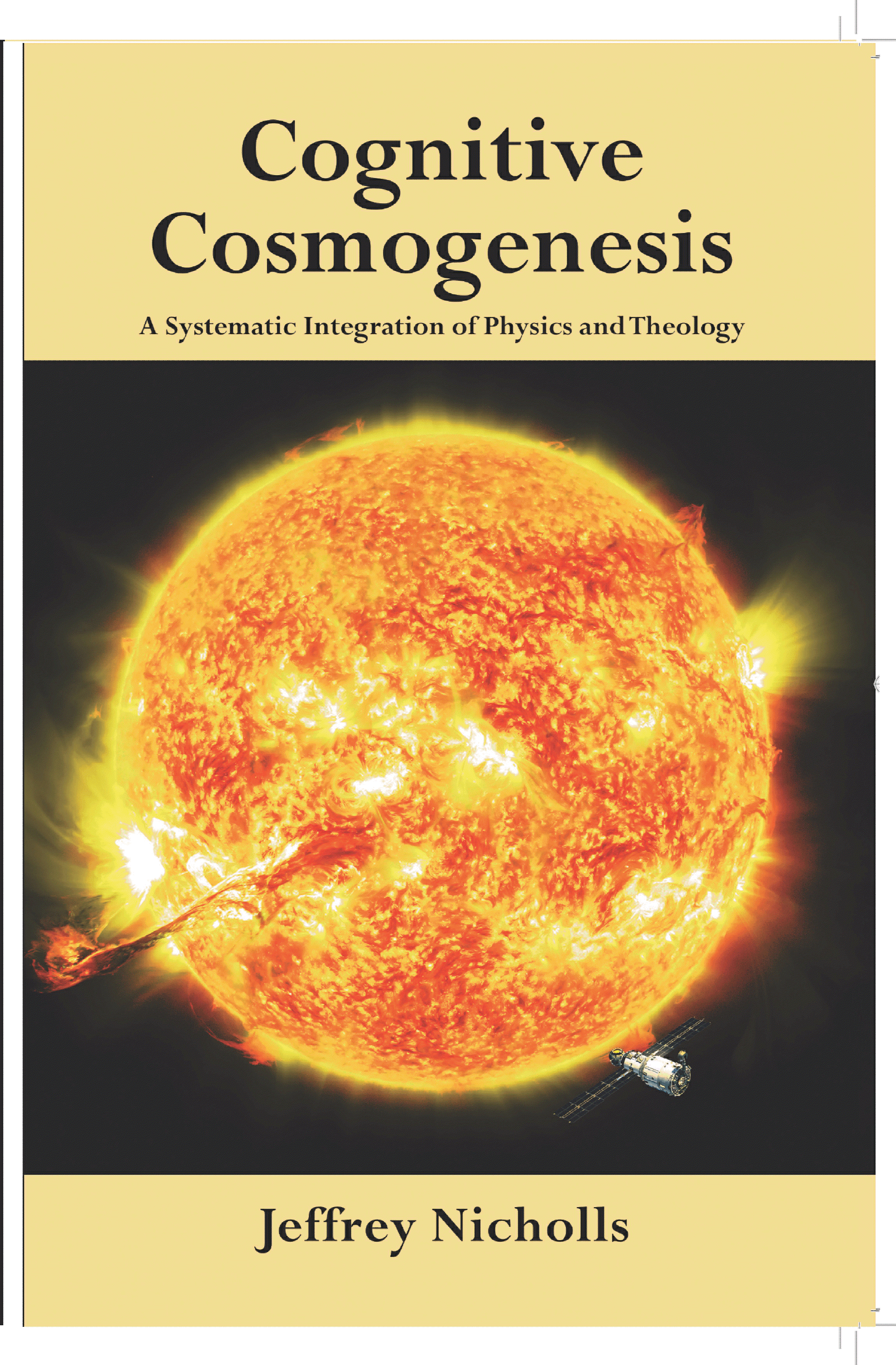
One can say this stuff but how does one prove it? By connecting it to reality with clues gleaned from Quigg and gauge theory. This story does sound very good to me and well worth developing, but will it do the job on the streets of physics and theology? In Book II? [Further, if it gets a bit of traction it will become a radical new paradigm in both physics and theology, and I have my priority established in Cognitive Cosmogenesis.] Chris Quigg (2013): Gauge Theories of the Strong, Weak, and Electromagnetic Interactions: Second Edition
Monday 7 September 2026
The Hilbert space in the initial symmetry accounts for the universe as a whole, a lesson we can take from Everett’s many worlds. Hugh Everett III, Dewitt & Graham (1973): The Many Worlds Interpretation of Quantum Mechanics
Tuesday 8 September 2026
I have been trying to hurry up my writing leading to me making too many mistakes that require backtracking and correction so I am implementing a new policy of trying to take it slow like an old man who has learnt that slow and steady wins the race. The previous policy rose from trying to emphasize too many variations.
Struggling a bit to organize the 13 steps to a universe. Step 3 is quantum mechanics selects. Step 4 is first major selection / differentiation modelled by spin 1 and spin ½. Why is th spin split? Howndo we understand fermions and bosons as the eigenfunctions of a 2D Hilbert space, represented by real numbers and complex number “filling” the gaps between them [moving into a realm of impossible fantasy to get a result, very like 2yo Trump, a world of pseudo continuity to cross the quantum jumps].
How do we relate the
[page 324]
bifurcation of spin with the bifurcation of entropy, the first bit [0/1] in the world.We assume this underlies Minkowski space - fermions and bosons are differentiated at the Hilbert level, but all actual actions are 1 quantum, ie 0 to 1 or −½ to +½, and the quantum bifurcation underlies the spin-statistics theorem rather than vice versa. The Feynman idea is that the superposition of fermion wave functions leads to a probability of 0 [where 0 implies exclusion]. Feynman, Leighton & Sands FLP III:04: Identical particles
Bosons have spin 1. The + and − is in effect the soul of a wave, the simple execution of not, the fundamental operator of the [Minkowski] universe, a creation operator and an annihilation operator, the quantum harmonic operator and the ½ℏω which looks to m like a furphy because we try to understand quantum mechanics in Minkowski space rather than Hilbert space. Quantum harmonic oscillator - Wikipedia
Here, I feel, we have a field theory killer, foreshadowed in what is now Commentary on Home page 5: Bifurcation of the zero energy symmetry creates kinetic and potential energy [forthcoming]. Possible steps toward a solution to the problems raised by Yang-Mills theory whose fundamental problem seems to be the abandonment of linearity by getting the linearity of quantum mechanics mixed up with the quadracity of the mass shell [??].
This is the region where all the problems of field theory arise and all the enormous benefits of my Ansatz might emerge if I can only get this right. The fundamental point, it seems, was spotted by Aristotle who saw that space is a fiction created by its contents and so the source of Minkowski space is the duality of fermions and bosons and not vice versa. P H Wicksteed & F M Cornford (1986): Aristotle, Physics Books I-IV
[page 325]
The 64$ question is how do we get from bosons and fermions to the Minkowski metric which is closely connected to the relativity principle and the speed of light, which both have their origin, I suspect, in some logical connection between c and zero mass. Inertial frame of reference - Wikipedia
As usual I want to go to bed and wake up with the answer which will also explain confinement and asymptotic freedom. Since there must be some principle which confines the energy in a massless kinematic wave into a massive stationary particle. This answer will make me as famous as Einstein’s gravitation and could make my theological plan a great success. I get a bit excited when I think like this. Ultimately it must be as simple as inventing the wheel [guided by the heuristic of simplicity].
A whole lot of questions solved with one idea: fermions vs bosons; asymptotic freedom and confinement; massive vsmassless; spin 1 vs spin ½; speed of light; Hilbert vs Minkowski; continuous vs jumpy; linear vs quadratic.
Wednesday 9 September 2026
[page 326]
As required, the answers to all my questions has arrived this morning and as it happens, I sort of knew it all along and Aquinas had summarized it in his own language, drawn from Avicenna’s Arabic in the de Ente et Essentia. The nature oof divinity is that it is the necessary being, that its essence is to be. This ideas is implied in the relationship between Plato and his student Aristotle. Plato the poet was concerned with absract form. Aristotle the concrete realist brought Plato’s form down to Earth. Plato thought his forms were fixed and eternal, the subject if theology. Aristotle introduced the element of time, ie change, by combining the forms with with matter and explaining change by change of thwe forn in a body ofmatter, hylp0morphism, Physics is essentially the sum of theology and time, the xistent moves by changing its form. Thomas Aquinas: De Ente et Essentia
We now move to the nineteenth century and the idea developed by Babbage to create a calculating machine. Such machines had already existed for thousands of years in the form of the abacus, a hardware memory manipulated by the actions of a human computer to execute arithmetic procedures inherent in trading goods for money. Babbage had the idea. The Platonist Alan Turing realized it with an infinite tape of symb0ls and a reader/writer that had a small suite of actions, read, write, move forward, move back, and an algorithm stored in a memory. Turing claimed that this machine could calculate anything calculable and argued that there are things that it cannot do, building on the work of G&oum;del who claimd there are decisions that cannot be made. Gödel's incompleteness theorems - Wikipedia
[page 327]
Another nineteenth century worker as also involved in studying time, Gustav Kirchhoff, in his case in the form of reversibility of processes. He arrived at a specification for the emission and absorption of radiation which led through the mind of Max Planck in 1900 to quantum mechanics and through Schrödinger, Born, Heisenberg, Dirac and von Neumann to a computational algorithm that underlies the world. This algorithm runs from irreversibility to the creation of entropy, that is the complexion of the world from a divinity whose essence is to exist to our current universe and ourselves. This screed is the introduction to on_creation.com, which is to be summarized in the thirteen steps and gauge theory.
Why did the transition from spin on (a whole quantum) ??? and massless to spin ±½ and massive? In some way this relates to the confinement of action / energy in fermions. See Qiu electron. The guess is that the photon is in effect an element of pure Hilbert space represented by complex time and fermions are the elements of Euclidean space, excluding one another so depending on 3D for movement. Qiu-Hong Hu (2005_12_29): The nature of the electron
Just booked myself a little gig at Blackfriars meeting on 9/10 by which time I will have “on-creation” written and posted.
Thursday 10 September 2026
The strings and the voice tell us all we need to know about quantum mechanics. Quantum mechanics makes me cry when I really hear it.
[page 328]
So to Step 4: Quantum computation: the qubit 2D Hilbert space, duality → energy. Nielsen & Chuang (2016): Quantum Computation and Quantum Information
Step 5: Energy
Step 6: Particles
Step 7: Minkowski space
Step 8: Relativity / Einstein
Step 9: Connection / communication / gauge theory
Step 10: Evolution
Step 11: Strong force / proton
Step 12: Electroweak force /beta decay
Step 13: Electromagnetism / the everyday world
What is the difference between adding vectors vs superposition? They are both linear. Greens function is a superposition of impulse functions (like collisions). Dirac delta = unit impulse.
It is going to be a big job to eliminate continuous fields from the nature of space and return to Aristotle’s view that the entities it contains (particles) define space. Remarkable how continuity and calculus have learned to rule the world by eliminating the logical jumps that constitute it [explained by quantum superposition in the “hilbert vacuum”], by an intuitive macroscopic view of motion. Entropy is a count of states. Boltzmann realized this but he had use the concept of continuity - the Boltzmann-Grad limit to get his Boltzmann equation [an infinite number of zero size particles]. Harold Grad - Wikipedia
Quigg page 1: “We are still searching for a missing piece, the agent of electroweak symmetry breaking” which might of course be fixed point theory in Hilbert space. Chris Quigg (2013): Gauge Theories of the Strong, Weak, and Electromagnetic Interactions: Second Edition , Higgs boson - Wikipedia
This book is devoted to an exposition of the logic, structure and phenomenology of our “standard model” of particle physics, from the experimental systematic and theoretical constraints that underlie it to the highly successful form that joins quantum chromodynamics to elecroweak theory.
[page 329]
The basic measure of creation is entropy, the count of symbols able to express the nature of the universe, the count of orthogonal entities,
The ubiquitous and deceptive Hertz quote: “One cannot study Maxwell’s electromagnetic theory of light without sometimes having the feeling that these mathematical formulae have an independent existence and intelligence of their own, that they are wiser even than their inventors, that they give us back more than we originally put into them”. They are, or course the ‘law of large numbers’ version of the behaviour of an enormous number of tiny particles like electrons and photons whose behaviour is described by the communication links between them that are described by gauge theories, the linguistics of communication built around unitarity. Heinrich Hertz (1893, 1962): Electric Waves
Gauge theories: ‘t Hooft (2008) Scholarpedia 3 (12): 7443, article in /doc/’t Hooft/renormalization.pdf, all computed in Minkowski space. The question is what does this all mean in a pure Hilbert space underlying Minkowski space? Does the renormalization problem even arise? G. 't Hooft: In In From QED to the Higgs Mechanism: A short review, G 't Hooft (1971): Renormalization of Massless Yang-Mills Fields
Change step 4 into entropy? prior to energy? Energy is real, the quantum [fermionic]; entropy is a spiritual quantity, something kinetic vs kinematic; maybe entropy is a potential, rather like bosons and fields, not real, like space formed by real particles. The increase of entropy is the work of chance. Laplace’s demon cannot create. So entropy is the source of jumps or should we say jumps and Brouwer fixed points are the source of entropy [to be realized by energy in step 5]. Laplace's demon - Wikipedia,
[page 330]
Friday 11 September 2026
cl4l04_entropy
AUKUS Inquiry ends. Maria Siow (2026_09_09): Australians question US commitment to Aukus submarine deal in crowdfunded inquiry
Call It Evil Jennifer Szalai NYT book review of Susan Neiman. Jennifer Szalai (2026_09_09): Review: Call it Evil: This Philosopher Thinks It’s Time We Call Out Evil in Our World
L4L is cruising, a revision of on-creation contrasting with Quigg’s story of continuous gauge field theory triumph over Shannon / QM digital communication. How does this relate to Boltzmann equation? Carlo Cercignani (2006): Ludwig Boltzmann: The Man Who Trusted Atoms
Susan Nieman: Evil in Modern Thought: An Alternative History of Philosophy
Accidents (ideas) become entities in their own right, Step 5: Energy/Action. Cercignani page 96: Irreversibility and the H-theorem.
Vin Neumann: Proof the the Ergodic Theorem and the H-theorem in Quantum Mechanics. Object: In particular, first, how the peculiar seemingly irreversible behaviour of entropy arises; and second, why the statistical properties of the (fictitious) micro-canonical ensemble can be attributed to the incompletely known real system.
Two classical systems: Boltzmann and Gibbs.Boltzmann fails on the assumption of disorder; Gibbs impossible without a solution to the quasi-ergodic problem. However QM can use Gibbs with simple mathematics and prove ergodic theorem and H-theorem without recourse to disorder.
[page 331]
Gibbs needs phase space but coordinate qi and momentum pi not simultaneously measurable.
page 3: Replace non-commuting operators Q and P with classical proxies Qkand Pk (ΔQkΔQk ≈ ℏ/2) whose simultaneous measurements point to states point to ψn. This hack can approximate coordinates within ≈ ℏ/2).
Operations with wave functions, inner products and norm.
page 5: (quasi)-ergodic theorem: A system’s point in phase space will come arbitrarily close to its energy surface and the time it spends there in the long time average is proportionate to the measure of that region.
In a given state the statistical properties are identical to the micro-canonical ensemble [trace of matrix is a unitary invariant].
Footnote 14: measure is not 2f-1 areas of a piece of the energy surface but the 2f D volume between neighbouring energy surfaces.
page 6: The law of energy conservation in classical mechanics asserts the conservation of the whole probability distribution of the energy, i.e. quanta per unit time. H diagonal energy surface defined as |an| = consti.
page 7: The formulation of the hypothesis of the ergodic theorem amounts to the absence of resonances between the energy terms Wn/ℏ of the system - orthogonality. The ‘quantum’ proof must be extended to the macroscopic.
page 8: i.e. re-interpreting ‘energy surface’ in a macroscopic way.
We do not need to be thinking too much about kinetic theory and heat death although we need to talk about entropy always increasing and also talk about Shannon and entropy and unitarity in communication, the qubit and the ‘hidden information’.
Saturday 12 September 2026
Keep the faith, faith in myself, a child of god.
The ‘hidden information’ story in Nielsen and Chuang is based on a complete misunderstanding of a qubit or any more complex Hilbert space. The basis states |0⟩ and |1⟩ are orthogonal and there is nothing between them. When we write |qubit⟩ = α|fermion⟩ + β|boson⟩ we re not saying the fermion and the boson are two elements of a continuum [|0⟩ , |1⟩] and that we can observe points between them as an analogue computer. The α and β are simply parts of a probability measure which simply parametrize the probability space [|0⟩, |1⟩] [α2 + β2 = 1] and there is no information there at all to tell us which one we will actually see. Everything we do see has probability in the range [o, 1].
As I rewrite these notes I add [obiter dicta] which clarify th thoughts which first occur to me, like the [“Hilbert vacuum”] onpage 328.l i am happy when I score a little win in worsds. Who am I to take on the Roman Catholic Church and the Physics Establishment. We’ll see. I have faith in my parent, the real world, not the sloppy fudge of calculus in the Boltzmann-Grad limit. The root of communication is the real output of hermitian superposition (I feel).
I am seeking a difficult target in L4L but I am hoping that it will reinforce the standpoint of my book that Hilbert space is primary and Minkowski spae is a derivative of the discrimination of bosons and fermions explaind in greater datail.
[page 333]
My basic motivation is that my feeling that the nature of the world is embodies in the vast entropy of Hilbert space rather than the rather restricted mass shell of Minkowski space gives us a vast new canvas (entropy) for the development of theory. The Plato/Aristotle foundation of this idea is that basically forms are cheap (as with genes) but provide nevertheless very precise specifications for their realization. This why I have ben writing since the 1980s to generate new ideas of the forms of the universe and how to manage them, a vast trove of information built into our divine world trillions of times more complex and detailed than the Bible.
This is an exciting plan which has in effect driven me all my adult life since I discovered Georg Cantor when I was 14-15 yo. Can on trust one’s feeling? Einstein did and ran aground at the age of 40-50 (1933). I have made it to 82 and am still afloat, although I am beginning to feel that I aging faster as a ratio of d(deterioriation)/dt. Albert Einstein (1933): Herbert Spencer Lecture 1933: On the Method of Theoretical Physics
Now my point of departure is Quigg. We can agree on Shannon/gauge theory as the unitary foundation of the linear algebra of communication which make fermionic bricks into beautiful structures as iIdid during the fireplace building phase of my Elands career.
Reading Quigg of course convinces me that my task is hopeless and I should give up and grow old gracefully.but hopelessness seems to have ben the pattern of my life very since I joined the Dominican Order in a futile effort to get to heaven. What I discovered was that billions of people, supported by a huge volume of literature, art, architecture, war, death and disaster has all been constructed on the basis of manifestly false
[page 334]
interpretations of reality and if this is true of theology and its consequences there may be similar stream of misunderstanding in physics, this time supported by an enormous of evidence and measurement which may nevertheless missing points that may be revealed by coupling physics to theology.
<.p>
Worth a try, and we can concentrate on thee idea that physics is he Bible from which we can learn a practical theology whose intimate details can be taken care of by the manufacturers and technologists. At the moment, the basic problem is the gnostic gap, the distance between matter and spirit [which is maintained by the theological powers silencing anybody who wants to dispute the difference and killing them by defining them as heretics, like all those who have been sexually abused by the powerful agents of the Church, possibly for centuries]. Selena Miles (2025): Silenced
We understand Minkowski space by Lagrangian and least action.
All this writing is in effect the same as writing mathematics where the symbols represent numbers and transformations.
|
Copyright:
You may copy this material freely provided only that you quote fairly and provide a link (or reference) to your source.
Further readingBooks
Cercignani (2006), Carlo, Ludwig Boltzmann: The Man Who Trusted Atoms, Oxford University Press, USA 2006 'Cercignani provides a stimulating biography of a great scientist. Boltzmann's greatness is difficult to state, but the fact that the author is still actively engaged in research into some of the finer, as yet unresolved issues provoked by Boltzmann's work is a measure of just how far ahead of his time Boltzmann was. It is also tragic to read of Boltzmann's persecution by his contemporaries, the energeticists, who regarded atoms as a convenient hypothesis, but not as having a definite existence. Boltzmann felt that atoms were real and this motivated much of his research. How Boltzmann would have laughed if he could have seen present-day scanning tunnelling microscopy images, which resolve the atomic structure at surfaces! If only all scientists would learn from Boltzmann's life story that it is bad for science to persecute someone whose views you do not share but cannot disprove. One surprising fact I learned from this book was how research into thermodynamics and statistical mechanics led to the beginnings of quantum theory (such as Planck's distribution law, and Einstein's theory of specific heat). Lecture notes by Boltzmann also seem to have influenced Einstein's construction of special relativity. Cercignani's familiarity with Boltzmann's work at the research level will probably set this above other biographies of Boltzmann for a very long time to come.' Dr David J Bottomley
Amazon
back |
Everett III (1973), Hugh, and Bryce S Dewitt, Neill Graham (editors), The Many Worlds Interpretation of Quantum Mechanics, Princeton University Press 1973 Jacket: 'A novel interpretation of quantum mechanics, first proposed in brief form by Hugh Everett in 1957, forms the nucleus around which this book has developed. The volume contains Dr Everett's short paper from 1957, "'Relative State' formulation of quantum mechanics" and a far longer exposition of his interpretation entitled "The Theory of the Universal Wave Function" never before published. In addition other papers by Wheeler, DeWitt, Graham, Cooper and van Vechten provide further discussion of the same theme. Together they constitute virtually the entire world output of scholarly commentary on the Everett interpretation.'
Amazon
back |
Nielsen (2016), Michael A., and Isaac L Chuang, Quantum Computation and Quantum Information, Cambridge University Press 2016 Review: A rigorous, comprehensive text on quantum information is timely. The study of quantum information and computation represents a particularly direct route to understanding quantum mechanics. Unlike the traditional route to quantum mechanics via Schroedinger's equation and the hydrogen atom, the study of quantum information requires no calculus, merely a knowledge of complex numbers and matrix multiplication. In addition, quantum information processing gives direct access to the traditionally advanced topics of measurement of quantum systems and decoherence.' Seth Lloyd, Department of Quantum Mechanical Engineering, MIT, Nature 6876: vol 416 page 19, 7 March 2002.
Amazon
back |
Quigg (2013), Chris, Gauge Theories of the Strong, Weak, and Electromagnetic Interactions: Second Edition, Princeton UP 2013 ' This completely revised and updated graduate-level textbook is an ideal introduction to gauge theories and their applications to high-energy particle physics, and takes an in-depth look at two new laws of nature--quantum chromodynamics and the electroweak theory. From quantum electrodynamics through unified theories of the interactions among leptons and quarks, Chris Quigg examines the logic and structure behind gauge theories and the experimental underpinnings of today's theories. Quigg emphasizes how we know what we know, and in the era of the Large Hadron Collider, his insightful survey of the standard model and the next great questions for particle physics makes for compelling reading. The brand-new edition shows how the electroweak theory developed in conversation with experiment. Featuring a wide-ranging treatment of electroweak symmetry breaking, the physics of the Higgs boson, and the importance of the 1-TeV scale, the book moves beyond established knowledge and investigates the path toward unified theories of strong, weak, and electromagnetic interactions.
Amazon
back |
Wicksteed (1986), P H, and F M Cornford, (translators), Aristotle, Physics books I-IV, Harvard University Press, William Heinemann 1986 ' Aristotle, great Greek philosopher, researcher, reasoner, and writer, born at Stagirus in 384 BC, was the son of a physician. He studied under Plato at Athens and taught there (367–347); subsequently he spent three years at the court of a former pupil in Asia Minor. After some time at Mitylene, in 343–342 he was appointed by King Philip of Macedon to be tutor of his teen-aged son Alexander. After Philip’s death in 336, Aristotle became head of his own school (of “Peripatetics”), the Lyceum at Athens. Because of anti-Macedonian feeling there after Alexander’s death in 323, he withdrew to Chalcis in Euboea, where he died in 322.'
Amazon
back |
Links
Albert Einstein (1933), Herbert Spencer Lecture 1933: On the Method of Theoretical Physics , ' It can scarcely be denied that the supreme goal of all theory is to make the irreducible basic elements as simple and as few as possible without having to surrender the adequate representation of a single datum of experience. back |
Bill Collins (2026_09_10), Gondwana really was a supercontinent. And it helped kick‑start life on Earth , 'Some 550 million years ago, the Earth looked very different to what it does today. The Southern Hemisphere was dominated by an enormous, single continent known as Gondwana.
This continent was first recognised by Austrian geologist Eduard Seuss in 1885 based on the presence of a unique plant fossil that was first discovered in the Gondwana Province of India. The fossils were then found in Australia, Africa, Antarctica and South America, demonstrating these land masses were once connected.
But whether Gondwana was an actual “supercontinent” has been a subject of intense scientific debate in recent years.
A new paper I coauthored, published today in Science Advances, helps settle the debate. Our team found a previously hidden part of the Gondwanan landmass that’s now buried under mountains, which shows it was much bigger than previously thought.[. . . ]
The initial measurement of Gondwana was based on five core continental fragments: India, South America, Africa, Australia and Antarctica. Subsequent measurements included landmasses extending from the Appalachian mountains in the United States, through southern Europe, to Turkey, Iran and Pakistan, then connecting to India.
Even so, the additional landmass was insufficient to increase the status of Gondwana. [. . .]
To give an example, even though some granites formed in the Himalayas only 20 million years ago, others formed at 50 million years. Still others formed at 120 million years ago. But our analysis showed that all the Himalayan granites were derived from a common continental block.
That block formed approximately 700–550 million years ago and was part of Gondwana.
We have traced the original Gondwanan fragments from India and southeast Asia, through most of China into Kazakhstan. Previously, much of this region was thought to be ancient ocean floor containing volcanic island chains like in the Pacific Ocean today.
It turns out that most of this region, which is now mountainous and covered by younger rocks, was originally part of Gondwana.
This finding expands Gondwana’s continental landmass to roughly 80%. In other words, it really was a supercontinent. ' back |
Feynman, Leighton & Sands FLP III:04, Chapter 4: Identical Particles, 'In the last chapter we began to consider the special rules for the interference that occurs in processes with two identical particles. By identical particles we mean things like electrons which can in no way be distinguished one from another. If a process involves two particles that are identical, reversing which one arrives at a counter is an alternative which cannot be distinguished and—like all cases of alternatives which cannot be distinguished—interferes with the original, unexchanged case. The amplitude for an event is then the sum of the two interfering amplitudes; but, interestingly enough, the interference is in some cases with the same phase and, in others, with the opposite phase. [. . .]
This brings up an interesting question: Why is it that particles with half-integral spin are Fermi particles whose amplitudes add with the minus sign, whereas particles with integral spin are Bose particles whose amplitudes add with the positive sign? We apologize for the fact that we cannot give you an elementary explanation. An explanation has been worked out by Pauli from complicated arguments of quantum field theory and relativity. He has shown that the two must necessarily go together, but we have not been able to find a way of reproducing his arguments on an elementary level. It appears to be one of the few places in physics where there is a rule which can be stated very simply, but for which no one has found a simple and easy explanation. The explanation is deep down in relativistic quantum mechanics. This probably means that we do not have a complete understanding of the fundamental principle involved. For the moment, you will just have to take it as one of the rules of the world.'' back |
From QED to the Higgs Mechanism: A short review, J Zinn-Justin, ' Perturbative Quantum Field Theory: General strategy
The construction of a quantum field theory generally involved three steps:
(1) Construction of the classical theory.
(2) Quantization.
(3) Renormalization.
Moreover, in gauge theories, due to the necessity of gauge fixing, an addi-
tional step is required, proving unitarity. This is specially complicate in the
non-Abelian case, owing to the presence of spinless fermions, the Faddeev–
Popov ghosts. Moreover, in presence of spontaneous symmetry breaking
and in covariant gauges, the decoupling of would-be massless Goldstone
bosons has to be demonstrated.
Only when this program is completed, can perturbative calculations be
performed. back |
G 't Hooft (1971), Renormalization of Massless Yang-Mills Fields, 'The problem of renormalization of gauge fields is studied. It is observed that the use of non-gauge invariant regulator fields is not excluded provided that in the limit of high regulator mass gauge invariance can be restored by means of a finite number of counter-terms in the Lagrangian. Massless Yang-Mills fields can be treated in this manner, and appear to be renormalizable in the usual sense.
Consistency of the method is proved for diagrams with non-overlapping divergencies by means of gauge invariant regulators, which however, cannot be interpreted in terms of regulator fields. Assuming consistency the S-matrix is shown to be unitary in any order of the coupling constant. A restriction must be made: no local, parity-changing transformations must be contained in the underlying gauge group. The interactions must conserve parity.' back |
G. 't Hooft, In From QED to the Higgs Mechanism: A short review, Two articles then triggered an enormous theoretical activity
G. ’t Hooft, Renormalization of massless Yang–Mills fields, Nucl. Phys.
B35 (1971) 173-199.
G. ’t Hooft, Renormalizable Lagrangians for massive Yang–Mills, Nucl.
Phys. B35 (1971) 167-188,
where it is argued that some models based on non-Abelian gauge theories, both in the symmetric phase and in the case of spontaneous symmetry breaking, should be renormalizable. back |
Gödel's incompleteness theorems - Wikipedia, Gödel's incompleteness theorems - Wikipedia, the free encyclopedia, ' Gödel's incompleteness theorems are two theorems of mathematical logic that establish inherent limitations of all but the most trivial axiomatic systems capable of doing arithmetic. The theorems, proven by Kurt Gödel in 1931, are important both in mathematical logic and in the philosophy of mathematics. The two results are widely, but not universally, interpreted as showing that Hilbert's program to find a complete and consistent set of axioms for all mathematics is impossible, giving a negative answer to Hilbert's second problem.
The first incompleteness theorem states that no consistent system of axioms whose theorems can be listed by an "effective procedure" (i.e., any sort of algorithm) is capable of proving all truths about the relations of the natural numbers (arithmetic). For any such system, there will always be statements about the natural numbers that are true, but that are unprovable within the system. The second incompleteness theorem, an extension of the first, shows that such a system cannot demonstrate its own consistency.' back |
Harold Grad - Wikipedia, Harold Grad - Wikipedia, the fre ncyclopdia, ' In statistical mechanics he had developed in his thesis new methods for the solution of the Boltzmann equation. He derived the Boltzmann equation from Liouville equation using BBGKY hierarchy under certain limits, known as Boltzmann–Grad limit. Harold Grad was the founder of the Magneto-fluid Dynamics Division of the Courant Institute and served as its head until shortly before his death. From 1964 to 1967 and 1974 to 1977 he was a member of the Advisory Committee for Fusion Energy at Oak Ridge National Laboratory.' back |
Heinrich Hertz (1893, 1962), Electric Waves, The reader of the present volume will be interested in comparing it with the title of Hertz's Eleventh Paper ; but I cannot refer to this paper without expressing the admiration and delight with which I see the
words " rectilinear propagation," " polarisation," " reflection,"
" refraction," appearing in it as sub-titles.
During the fifty-six years which have passed since Faraday
first offended physical mathematicians with his curved lines of
force, many workers and many thinkers have helped to build
up the nineteenth -century school of plenum, one ether for
light, heat, electricity, magnetism ; and the German and
English volumes containing Hertz's electrical papers, given to
the world in the last decade of the century, will be a per
manent monument of the splendid consummation now realised. KELVIN back |
Higgs boson - Wikipedia, Higgs boson - Wikipedia, the free encyclopedia, ' The Higgs boson, sometimes called the Higgs particle, is an elementary particle in the Standard Model of particle physics produced by the quantum excitation of the Higgs field, one of the fields in particle physics theory. In the Standard Model, the Higgs particle is a massive scalar boson that couples to (interacts with) particles whose mass arises from their interactions with the Higgs field, has zero spin, even (positive) parity, no electric charge, and no color charge.[13] It is also very unstable, decaying into other particles almost immediately upon generation.'
The Higgs field is a scalar field with two neutral and two electrically charged components that form a complex doublet of the weak isospin SU(2) symmetry. Its "sombrero potential" leads it to take a nonzero value everywhere (including otherwise empty space), which breaks the weak isospin symmetry of the electroweak interaction and, via the Higgs mechanism, gives a rest mass to all massive elementary particles of the Standard Model, including the Higgs boson itself. The existence of the Higgs field became the last unverified part of the Standard Model of particle physics, and for several decades was considered "the central problem in particle physics". back |
Inertial frame of reference - Wikipedia, Inertial frame of reference - Wikipedia, the free encyclopedia, ' In classical physics and special relativity, an inertial frame of reference (also called inertial space, or Galilean reference frame) is a frame of reference not undergoing any acceleration. It is a frame in which an isolated physical object—an object with zero net force acting on it—is perceived to move with a constant velocity or, equivalently, it is a frame of reference in which Newton's first law of motion holds. All inertial frames are in a state of constant, rectilinear motion (straight line motion) with respect to one another; in other words, an accelerometer moving with any of them would detect zero acceleration. It has been observed that celestial objects which are far away from other objects and which are in uniform motion with respect to the cosmic microwave background radiation maintain such uniform motion.' back |
Jennifer Szalai (2026_09_09), Call it Evil: This Philosopher Thinks It’s Time We Call Out Evil in Our World, ' Susan Neiman has noticed a paradox. “As the world drifts toward disaster,” she writes in her new book, “our language has become more cautious.” Yet this tentativeness has been remarkably asymmetrical. President Trump loves to use hyperbole (“nasty,” “sleazebag,” “vermin”), while establishment Democrats have, at least until recently, mostly hewed to the language of decorous risk aversion.
In “Call It Evil: Understanding the Trump Era,” Neiman argues that widespread misapprehensions about what evil is make people too reluctant to use the word. Despite her willfully provocative title, she categorically states: “This is not a book about Donald Trump.” An American-born moral philosopher now based in Germany, Neiman wrote an incisive history of evil in modern thought in 2002. Her new book is less a philosophical exploration than a polemical guide to the current moment. She believes that people are so attached to understanding evil in terms of individual monstrousness — the gleeful villain, the depraved sadist — that they lose sight of how evil more typically works.' back |
Laplace's demon - Wikipedia,, Laplace's demon - Wikipedia, the free encyclopedia, ' In the history of science, Laplace's demon was a notable published articulation of causal determinism on a scientific basis by Pierre-Simon Laplace in 1814. According to determinism, if someone (the demon) knows the precise location and momentum of every particle in the universe, their past and future values for any given time are entailed; they can be calculated from the laws of classical mechanics.
"We may regard the present state of the universe as the effect of its past and the cause of its future. An intellect which at a certain moment would know all forces that set nature in motion, and all positions of all items of which nature is composed, if this intellect were also vast enough to submit these data to analysis, it would embrace in a single formula the movements of the greatest bodies of the universe and those of the tiniest atom; for such an intellect nothing would be uncertain and the future just like the past could be present before its eyes".'
back |
Maria Siow (2026_09_09), Australians question US commitment to Aukus submarine deal in crowdfunded inquiry, 'Dissent voiced in an ongoing inquiry into Australia’s most ambitious nuclear submarine pact has laid bare growing uncertainty over US commitment, amid questions about the clarity of Canberra’s explanation of the Aukus deal to citizens.
Under the trilateral security pact between Australia, the United Kingdom and the United States, Canberra will get eight nuclear-powered submarines at an estimated cost of up to A$368 billion (US$266 billion).
Three used Virginia-class nuclear submarines will initially be bought from the US and delivered from between 2032 and 2038. Australia will also work with the UK to build the new Aukus submarines locally, with the first delivery expected in the early 2040s.
At an Aukus public inquiry in Canberra last week, one of Australia’s leading submarine experts, retired Rear Admiral Peter Briggs, called the plan “flawed and undeliverable”.
Australia scrapped an agreement for France to supply Attack-class submarines in favour of the Aukus sale in 2021. Briggs said the French deal was the better option, arguing that US shipyards, already struggling to meet the domestic demands, could not deliver the promised nuclear-powered submarines on time.[. . .]
The 12-week inquiry, which ended on Thursday, was crowdfunded as Canberra refused to hold a formal parliamentary inquiry. It was led by former ministers, parliamentarians, senior officials, public servants and retired military officers.
Demand for the inquiry showed the lack of transparency and public debate surrounding Aukus, according to Manoj Harjani, a research fellow at the S. Rajaratnam School of International Studies.
“Uncertainty regarding the US’ commitment to Aukus, particularly since Donald Trump took office, has been a thorny issue,” he said. “This will not be the last time you hear about a review of Aukus. It is a substantial commitment in more than monetary terms and deserves the level of scrutiny it is receiving.”
Questions about US commitment to the pact stem mainly from the slow pace of production in US shipyards and American policy reviews questioning if transferring high-end military assets abroad aligns strictly with US interests.' back |
Qiu-Hong Hu (2005_12_29), The nature of the electron, ' Through investigating history, evolution of the concept, and development in the theories of electrons, I am convinced that what was missing in our understanding of the electron is a structure, into which all attributes of the electron could be incorporated in a self-consistent way. It is hereby postulated that the topological structure of the electron is a closed two-turn Helix (a so-called Hubius Helix) that is generated by circulatory motion of a mass-less particle at the speed of light. A formulation is presented to describe an isolated electron at rest and at high speed. It is shown that the formulation is capable of incorporating most (if not all) attributes of the electron, including spin, magnetic moment, fine structure constant, anomalous magnetic moment, and charge quantization into one concrete description of the Hubius Helix. The equations for the description emerge accordingly. Implications elicited by the postulate are elaborated. Inadequacy of the formulation is discussed.' back |
Quantum harmonic oscillator - Wikipedia, Quantum harmonic oscillator - Wikipedia, the free encyclopedia, 'The quantum harmonic oscillator is the quantum-mechanical analogue of the classical harmonic oscillator. Because an arbitrary potential can usually be approximated as a harmonic potential at the vicinity of a stable equilibrium point, it is one of the most important model systems in quantum mechanics. Furthermore, it is one of the few quantum-mechanical systems for which an exact, analytical solution is known.' back |
Selena Miles (2025), Silenced, ' Jennifer Robinson, Amber Heard and Brittany Higgins have all experienced the full force of weaponised defamation laws – but these indomitable activists and survivors of gendered violence won’t keep quiet.
>
In 2017, #MeToo replaced the social stigma of discussing gendered violence with public solidarity and support for victim-survivors. The re-silencing was swift, vicious … and legalistic. Alleged perpetrators now used defamation lawsuits as cudgels to punish survivors for speaking out, and to deter journalists from exposing prominent people to public scrutiny. As a barrister who famously stood up for Amber Heard in a long-running, all-too-public defamation case in the UK, Jennifer Robinson has dedicated her career to fighting against these attacks, witnessing firsthand how such actions drag survivors through emotionally, professionally and financially ruinous legal proceedings.
In her incendiary exposé that premiered in Sundance’s World Cinema Documentary Competition, Selina Miles (Martha: A Picture Story, MIFF 2019) gives voice to experts like Robinson and Sibongile Ndashe who – in their work as lawyers and activists – doggedly pursue procedural justice, as well as women like Higgins, Heard and Colombian journalist Catalina Ruiz-Navarro who’ve been the targets of or caught in defamation lawfare pursued by alleged perpetrators. This furious, urgent documentary indicts a misogynist status quo: as Ndashe says, “The law is designed not to believe women".' back |
Shlomi Eldar & Ruth Yuval (2026_09_08), https://www.haaretz.com/israel-news/israel-security/2026-09-08/ty-article-magazine/.highlight/netanyahu-got-an-explicit-warning-before-oct-7-he-didnt-brief-security-chiefs/000001a0-7a3b-d7d5-a9fc-7eff3d0f0000, ' These were the final days of September 2023. Terrorist attacks inflamed the West Bank, masses of Gazans regularly protested at the border fence, and the country was reeling from internal conflict over the judicial coup laws. Anyone watching the events with clear eyes could sense that an escalation was lurking around every corner.
UAE President Sheikh Mohamed bin Zayed – known as MBZ – was particularly concerned. "He spoke with me about this often in the months leading up to the war," recounts President Isaac Herzog, who maintains friendly relations with bin Zayed. "He constantly conveyed messages that the situation needed to be defused. He even sent a special envoy to Israel who met with the prime minister. The emir seemed to sense that the area was on the verge of explosion."
Bin Zayed would also speak directly with Prime Minister Benjamin Netanyahu. These conversations followed a standard procedure: A representative from the Emirati embassy would come to the prime minister's bureau, bringing a special phone device that ensured the confidentiality of the call.
But this time, the call initiated by bin Zayed was unusual. A week and a half before October 7, 2023 the Emirati ruler called Netanyahu from the Presidential Palace in Abu Dhabi and spoke with him for 45 minutes.
In that conversation, bin Zayed warned that Hamas' leader in Gaza, Yahya Sinwar, was planning a major operation against Israel. Bin Zayed expressed concern that the event in question would not only lead to bloodshed but also destabilize the entire region and undermine the Abraham Accords.
Three foreign senior sources are familiar with the contents of the conversation, the existence of which is revealed here for the first time. Its disclosure is the result of extensive research based on dozens of sources in Israel and worldwide, including very senior officials, as well as recordings, internal documents and correspondence. The research was conducted for the new book "Hostages: 843 Days of Abandonment" 'f back |
Thomas Aquinas, De Ente et Essentia, Latin text of one of Thomas Aquinas early works.
Textum a L. Baur Monasterii Westfalorum 1933 editum
emendatum a J. Koch ac translatum in taenias magneticas a Roberto Busa SJ. denuo recognovit Enrique Alarcón atque instruxit<
[69871] De ente et essentia, pr.
Quia parvus error in principio magnus est in fine, secundum philosophum in I Caeli et Mundi, ens autem et essentia sunt quae primo intellectu concipiuntur, ut dicit Avicenna in principio suae metaphysicae, ideo ne ex eorum ignorantia errare contingat, ad horum difficultatem aperiendam dicendum est quid nomine essentiae et entis significetur et quomodo in diversis inveniatur et quomodo se habeat ad intentiones logicas, scilicet genus, speciem et differentiam. Quia vero ex compositis simplicium cognitionem accipere debemus et ex posterioribus in priora devenire, ut, a facilioribus incipientes, convenientior fiat disciplina, ideo ex significatione entis ad significationem essentiae procedendum est.
back |
Turing machine - Wikipedia, Turing machine - Wikipedia, the free encyclopedia, ' A Turing machine is a hypothetical device that manipulates symbols on a strip of tape according to a table of rules. Despite its simplicity, a Turing machine can be adapted to simulate the logic of any computer algorithm, and is particularly useful in explaining the functions of a CPU inside a computer.
The "machine" was invented in 1936 by Alan Turingwho called it an "a-machine" (automatic machine). The Turing machine is not intended as practical computing technology, but rather as a hypothetical device representing a computing machine. Turing machines help computer scientists understand the limits of mechanical computation.' back |
Wendy Tuohy (2026_09_11), Judges with ‘horrendous views on women’ harming families, commissioner says, ' Some Family Court judges still hold horrendous views about women and believe children should be forcibly removed from parents they want to remain with, says the nation’s domestic violence commissioner.
“There are judges who think that at the moment, and they are not accountable to anybody; there is no way to shift that,” Micaela Cronin, the national commissioner for Domestic, Family and Sexual Violence Commission, said.
Speaking to this masthead, Cronin said that, while the reform agenda “is shifting the attitudes and culture of ‘the middle’ of the judges who are making these decisions ... but [regarding] the outliers, it’s not. It’s the outliers who do hold some of the horrendous views about women”.
As federal MPs, including Allegra Spender, Monique Ryan and Zali Steggall, call for more scrutiny around how the court system can be weaponised, Cronin said examining how the Family Court handles children’s wishes and the impact of its decisions is one her two top priorities. The other is focusing on how to reduce record rates of sexual assault.
Releasing the commission’s 2026 report to parliament on Wednesday, Cronin described the Family Court system as often “another source of harm” (for women and children).
“When people seek protection, accountability and support, the systems around them should help keep them safe. Too often, that is not what is happening,” she said. [. . .]
Janine Rees, co-founder of the victim-survivor advocacy group the Family Court Accountability Network, said women were being driven to despair by protection orders being overridden by Family Court judges and forced contact being imposed, and that the parliamentary committee must recommend Family Court involvement is considered a risk factor in suicide-death reviews.'
back |
|