Notes DB 95 Cognitive Cosmogenesis - 2026
Sunday 1 November 2026 - Saturday 7 November 2026
Sunday 1 November 2026
[page 48]
Getting deeper into theology and the divinity of the Universe via the 14 steps [14: Darwin - Having taken care of elementary particles, we turn the job over to evolution, at the universal scale, atoms, molecules, stars, black holes, plants, life etc, all built on the properties of the elementary particles, may be another 14 steps]
In the first instance a particle is a logical entity, and we may consider the first particle as the universe as a whole [“quantized” from the very beginning]. It is eternal and omnipotent, meaning that its sphere [or space] is anything that is logically consistent, like Hilbert’s formalism. To go outside consistency is to go outside the universe [although inconsistencies may take a long time to manifest themselves]. The theorems of Gödel and Turing are consistent and they also show that randomness, the consequence of incompleteness and incomputability, is also within the power of omnipotence. We may be able to apply the same idea to [seeking an understanding of] asymptotic freedom and confinement in hadrons. Formalism (philosophy of mathematics) - Wikipedia, Gödel's incompleteness theorems - Wikipedia, Turing's Proof - Wikipedia
The theological story is getting more radical and exciting as we go along so it may become, if properly captured in writing, a model for a new human world based on the nature of the divine world [revealed through physics, the study of god’s body language] that creates us. What is the title: ‘love, spirit, matter’ or equivalent - Infinite Trinity. Mary Sirridge (1999): Quam videndo intus dicimus: Seeing and Saying in [Augustine’s] De Trinitate XV
Kim Novak, Vertigo biopic SBS: “Its not easy getting old”. Alexandre O. Philippe (2025) Director & Narrator: Kim Novak, Vertigo
The divine universe is so much more exciting than any of the old gods — I am the captain of my own ship. If you want to do something do it.
I was brought up on a dud damaged [Catholic, vale of tears] universe.
[page 49]
A quantum of action is a formal thing, a pure act, actus purus. Energy is a sequence of actions, distinguishd by order, made real. E = hf = mc2. Mass-energy equivalence - Wikipedia
Physics and theology unite in Hilbert space [through] the doctrine of the Trinity. God is a omnipresent in the universe in the form of quanta of action, orthogonal Hilbert basis states.
Wilkinson (2016) Writings from Ancient Egypt. Toby Wilkinson (2016): Writings from Ancient Egypt
Khinchin: ‘a point of spirituality:’ the property of the self-adjoint operator depends in an essential way on the imaginary unit in the definition of the operator. A real operator is not self adjoint. Khinchin (1960, 1998): The Mathematical Foundations of Quantum Statistics
Khinchin: We now consider how statistics are established when a self adjoint operator for the given quantity has been chosen.
If the linear self-adjoint operator a corresponds to a physical quantity U then the mathematical expectation of U in the state U is EU = (aU, U)
The spirituality of quantum mechanics lies in the complex numbers, the mysterious cause that manifests in reality.
Kim Novak: Dancing with fate and letting fate take me – certainty, painting and writing.
[page 50]
The mathematics of quantum mechanics, particularly the complex numbers, takes us through the looking glass into the spiritual/formal world behind the scenes. Our inverse task is to go from the mathematics to the Minkowski space and the key to this space is that it comprises a large interacting populations of fermions and bosons each of which has a quantum Hilbert mind or soul which determines its spacetime behaviour in terms of the real communication revealed by the self-adjoint operators which extinguish the complexity and make it real. Behnid eery point (particle) in spacetime lis a quantum operator which does not per se exist in space and time but is in a sense carried by the particle which it has realized by splitting the formless energy of the actus purus / Aquinas—Einstein symmetry into positive and negative energy, this physiology being revealed by the surfacing of quanta of spin [in Minkowski space] which are associated with the realization of the state vector so that it becomes physically involved in the construction of the mass shell represented by the Dirac and Klein-Gordon equation. A lot of words trying to paint a picture of the Hilbert/Minkowski interface. Dirac equation - Wikipedia, Klein-Gordon equation - Wikipedia
We can imagine this in terms of a physical computer running on memory [fermions] and photons. W can see here the weakness of AI which has both detrministic and probabilistic behaviour churning around in a fixed body of data free of externally verifying input which is like an unhinged imagination with no epistemological foundation other than determinism, rather like kinetic theory. We should be able to cook up a proof that AI is bound to be wrong, rather like Gödel’s proofs.
[page 51]
[Some medical history]
Monday 2 November 2026
The field theory story is that elementary particles are structureless but have discrete personalities electron, photon, neutrino etc so where is this information held? Maybe they say in the field, so how does the field identify individual particles? In quantocracy each particle is a free agent with a personality within it corresponding to the eigenvectors of its nature with corresponding eigenvalues, eg a photon is the object with the eigenvector of a photon and the eigenvalue of its energy or frequency, ie its rate of execution of quanta, E = hf. We are taking properties out of a magical field creatd by some god in a Minkowski spacetime dotted with an infinity of hermitian operators, one at each point [of the continuum] communicating through bosons? - being themselves fermions.
The Hamiltonian is a linear self adjoint operator, a square matrix which can operate on a vector qn, pn with 2n dimensions. How does this work? By putting out some measurable statistics.
[page 52]
Khinchin page 67, working from Schrödinger equation concludes: “In order for a physical quantity U to be an integral of the motion it is necessary and sufficient that the corresponding operator a commute with the total energy operator of the system, H, i.e. aH = Ha
Lemma: Let a and b be two linear self adjoint operators with discrete spectra and let ab = ba. Then there exists a complete orthogonal system of eigenfunctions of the operator a such that all the functions of this system are simultaneously eigenfunctions of the operator b.
Proof via eigenvalue equation.
Tuesday 3 November 2026
The standard morning blues. The feeling of a nobody trying to change the world, bouyed up by knowledge that it is worth a try because there is a lot of falsehood in circulation and my universal answer is, and has been for the last 60 years scientific theology, and as I learn more about it my love for my new god and for myself grows, gradually recovering from a sadly misguided childhood. This nevertheless set me on my current slightly hopeless path whereas I probably had the means to become a success in the conventional sense and would now be happily wallowing in a mountain of cash and be looking back over a radically successful life. Khinchin is unsettling me a bit because he has a very conventional view of quantum mechanics as an overlay of Minkowski space which is not really helping me. I remain convinced that the first thing I wrote after my book came out, Quantocracy: The universal quantum mechanical foundations of democracy and freedom, is the beginning of a deeper understanding of my notion that physics leads us to the mind of god, a Bible. Rowan Hooper (2026): Togetherness: Symbiosis and the Hidden Story of Life's Greatest Collaborations
On reading more Khinchin I do not think quantum statistics are a necessary part of th 14 steps. We are simply using the distinction between fermions and bosons to help us cross the border between Hilbert and Minkowski. [details] Step 7: Minkowski Space.
Ever since I bought my second copy of Khinchin (left the first in Elands) I have been thinking it would help me but my simple [theological] picture is ok without statistics and measurement. These are essential for [the certainty of modern data] but they do not dictate the evolutionary sequence of events that the 14 steps intend to describe. The core idea is that by getting quantum mechanics behind the constraint of energy in Minkowski space we open the field to the entropy of the infinite trinity of Hilbert space to give the whole space of possibility to the world to find itself, the Hilbert Dreaming. See Ten Canoes (2006). You have to know the structure before you can apply the mathematics. Ten Canoes - Wikipedia
Time passed. He was possessed by a bad spirit. His proper soul was taken from him. Bad spirit lived in his head, escaped. That bad spirit make biggest trouble of all. Justice had been done. Only way to fight sorcery. Learning to be patient.
Whar goes into Commentary cl4l07_Minkowski?
What new features appear when Hlbert space becomes Minkowski space?
1. All the elementary particles.
2. Inertial/Minkowski space snd the Minkowski metric, which carries the whole of classical physics with it.
3. The Lagrangian, which comes with the conservation bifurcation and conservation of energy.
4. The appearance of energy in the observable world.
5. The observability of gravitation and the quantum of action, already present but
[page 54]
unobservable in the symmetry.
6. Observers, and observability itself, already present in superposition.
7. Null geodesics.
8. ‘Real’ evolution, beginning with atoms and thermonuclear reactions in stars, going all the way to the present state of humanity
Wednesday 4 November 202
So we imagine both a countable infinity of fermion and boson Hilbert basis vectors each reprsented by orthogonal quanta of action available for conversion into real particles by the zero-sum bifurcation of the initial symmetry like the infinite trinity. This zero-sum bifurcation maintains gauge (phase) invariance among the formed particles that contributes to the Lagrangian in Minkowski space and accounts for the mass shell. This is cl4l07_minkowski and then (per page 35) we turn to cl4l08_relativity and cl4l09_einstein. I struggle along one insight at a time. We have a countable infinity of Hilbert bases in the initial symmetry corresponding to the fact that there are a countable infinity of computable functions available to the Brouwer fixed point theorem.
Maybe the new book: “Sex, Religion and Reality” (???) “Religion the Spirit of Politics” (???)
Thursday 5 November 2026
Collect new teeth. Pay $4400.
Finish cl4l06_particles.html
What springs to mind? Repeated my comment to Leifer on the Haaretz editorial today. Haaretz Editorial (2026_11_04): Israel Is Alone in the World. There Is Only One Way Out
[page 55]
Do I trust myself enough to become an advisor or a politician?
Used to do this in the building trade. Why not now?
Science can underlie an infitity of technologies.
What is my religious advice? The world is divine, believe the world.
Quigg: Lagrangian is relativistic because 4 components of spacetime enter symmetrically. Chris Quigg (2013): Gauge Theories of the Strong, Weak and Electromagnetic Interactions page 25.
Friday 6 November 2026
When I was building I felt the need to be very careful because of the precious theological knowledge I was carrying won by a somewhat stressful attempt to be a Catholic priest. I was happy when I got the book published that made my case so in a sense I could die happy, but very disappointed by what appears to have been negligible sales in the first year so I feel that I need to gain a bit of notoriety but do not want to waste my time on the ‘socials’ when I am working on the website for the next book. Now my teeth are bought and paid for I just have to get my eyes right and then life will be plain sailing and I can put a bit of time into green politics which is in effect exactly what my book is about, the divine universe.
Housekeeping:
Download: MacOSHighSierra.iso.
support.apple.com/en-us/102662
See my filemaker #224286: Mac Support.
Download High Sierra 10.13 - install macos High Sierra.app
[page 55]
We need a game changing ad for my book!
Thinking of the 14 steps in film making terms we need to introduce a bit of controversy and drama, calling out the ‘mistakes’ of modern physics.
The emphasis must always be on the credibility of a well tested universe, particularly that out of a countably infinite number of [orthogonal] state vectors in a Hilbert space only about 61 have been chosen to form the group of elementary particles. Elementary particle - Wikipedia
This could be in the last section of cl4l06_particles and touted a consequence of going behind Minkowski space into the region of antisymmetric and symmetric statistics that give us fermions and bosons whose conservation of energy/frequency/time is a consequence of the zero sum bifurcation of the symmetry.
Saturday 7 November 2026
Green Annual Conference Saturday #1: NT First Nation horror: Imprisonment of 10 year olds; #2: Green Institute - survey research and forth coming report.
The political venue, reflected in the Green party, involves developing and solidifying the minds of members around a policy, made manifest by the observable opinions expressed by members. The scientific task is similar, seeking consistent union of the states of the universal mind revealed by physical observations ranging from everyday experience to the deeper behaviour revealed by SLAC, LHC and similar instrumentation; beginning perhaps with Galileo’s pendulum which revealed to us the roles of kinetic and potential energy in local Minkowski space insofar as it is consistent with the initial symmetry.
[page 57]
The fundamental role of writing since it was invented is to make dreams physically real. This is what I am and have been doing in my own way since I was a virgin 18yo beginning my dive into philosophy and theology with Plato, Aristotle, Augustine and Aquinas all topped out with Galileo, Newton, Planck and von Neumann. My most recent coherent product is Quantocracy: The universal quantum mechanical foundations of democracy and freedom, witten as a coda to my book Cognitive Cosmogenesis and my first step toward my next version of my theological dream Lust-for-Life. See Johanna Cosgrove. Johanna Cosgrove (2026_11_07): I have flung myself headfirst into Sarah J Maas’s romantasy universe and I find myself a changed woman
Book Tok Book Tok
Running a political party is a bit like running your own mind, trying to organize every days input into a coherent story to carry into the next day. This morning I heard two sessions of the Green conference [see above] This inspired me to go to the session tomorrow afternoon workshop 13 “Understanding and teaching the concept of privilege without judgement” a situation in which I can explain my book and the proposition that we are all indigenous which was destroyed by military power and imperialism, and genocide as a theological virtue, a matter for historical research in the section of L4L on Wilderness.
A potted history of genocide as a theological vice.
[page 59]
I started studying theology when I was 18, 64 years ago. I have finally concluded that the fundamental green platform is to become indigenous again [in a divine universe]. We ran of the rails when we became too independent using the world instead of working with it, but now we see that we have to go back to living with the world. Our period of independence has given us some advantages, We have massively increased our population and created many problems with our demand for energy to ease our lies, burning forest, coal and oil and heating the planet, but it is open to us now to live on renewable energy and move down the food chain to become more vegetarian. Climate change - Wikipedia
At the same time our health and wealth make it unnecessary to have many children and our means of transport and communication meanthat we can run a global economy without war and economic stress. Some ideas like this can be developed by the studying the economy and togetherness of life, dropping survival of the fittest and “red in tooth and claw” as our fundamental algorithms, all to be derived from scientific theology acting in parallel to scientific biology and physics.
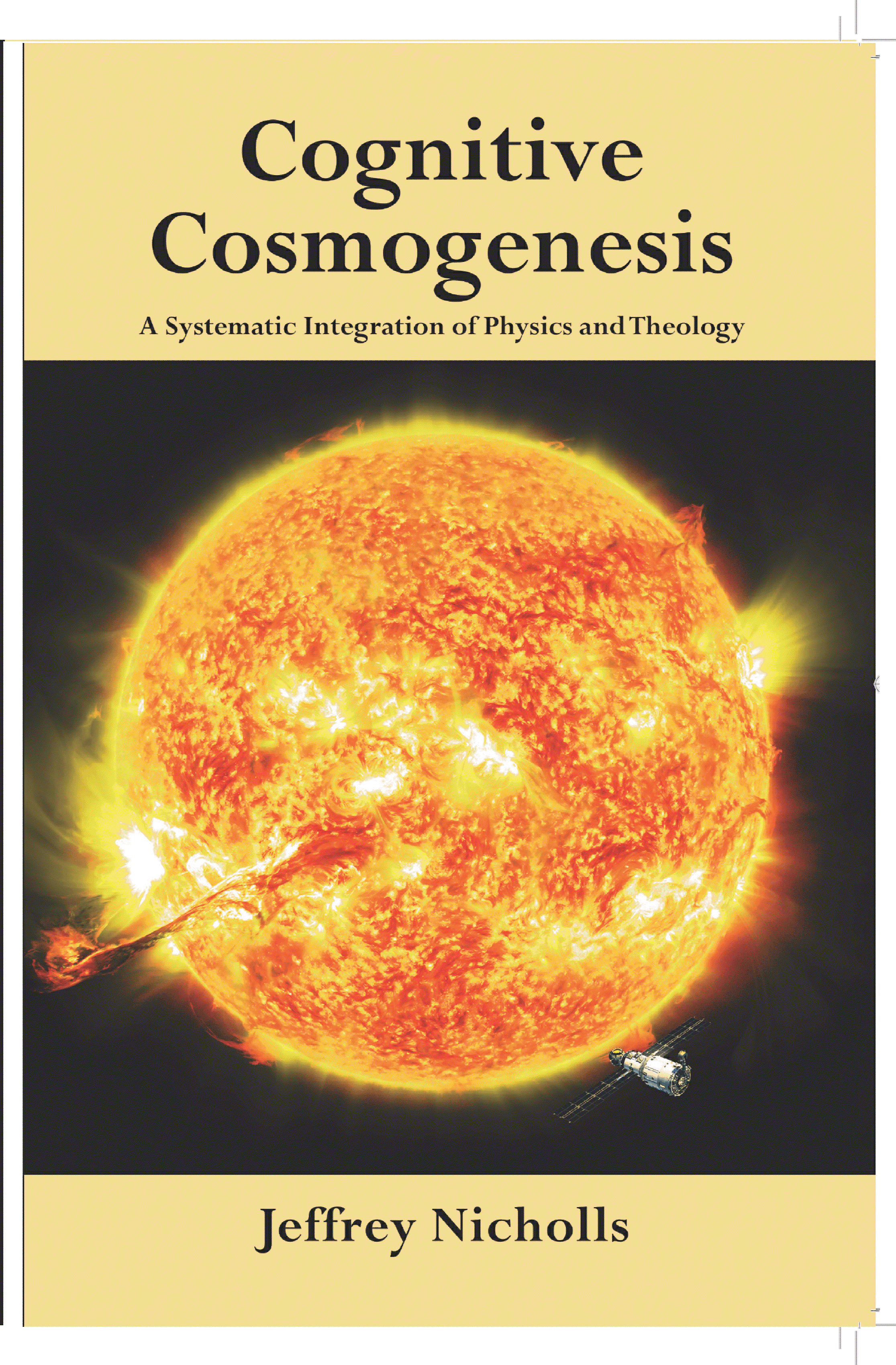
This line of thought can be embraced in my new Summa Theologiae Lust-for-Life, based on the eternal omnipotent entropy driven lust for life of the initial symmetry. Deep in the heart of this tale is the divinity of money developed as a reliable conserved quantity, like energy, the basic process of selection. All of this is to be embedded in the 14 steps to creating a universe, the conclusion based on the economic work of Piketty. Ultimately imperialism is built on energy and energy is built on banking as the world is. The downside of imperialism is black holes. Jeffrey Nicholls (1992): An essay on the divinity of money , Jeffrey Nicholls (2025): Cognitive Cosmogenesis: A systematic unification of physics and theology, Thomas Piketty (2020): Capital and Ideology
|
Copyright:
You may copy this material freely provided only that you quote fairly and provide a link (or reference) to your source.
Further readingBooks
Hooper (2026), Rowan, Togetherness: Symbiosis and the Hidden Story of Life's Greatest Collaborations, Fern Press 2025 ' From evolution to capitalism, 'survival of the fittest' has shaped our view of the world. But we got it wrong - and our mistake has brought us to the brink.
For the history of life on Earth is much more than a story of competition. The natural world has been forged and sustained by small miracles of co-operation between animals and plants, insects and fungi, fish and bacteria - these partnerships are ubiquitous, lifelong and are an essential guide for a better future.
In Togetherness, Rowan Hooper reveals the intimate connectedness of nature through these remarkable stories of symbiosis. From the female wasp venturing deep inside a fig and the intricate relationship between corals and the algae that sustain them to the symbiotic gut microbes that influence our moods, he explores how co-operation is fundamental to life itself and to protecting our shared future.'
Amazon
back |
Khinchin (1960, 1998), Aleksandr Yakovlevich, The Mathematical Foundations of Quantum Statistics, Dover 1998 'In the area of quantum statistics, I show that a rigorous mathematical basis of the computational formulas of statistical physics . . . may be obtained from an elementary application of the well-developed limit theorems of the theory of probability.'
Amazon
back |
Nicholls (2025), Jeffrey, Cognitive Cosmogenesis: A systematic unification of physics and theology, Austin Macauley Publishers 2025 ' This book is a personal narrative of those events and a defense of the belief that the universe itself is divine. The central argument is that by embracing this reality and abandoning notions of supernatural deities, humanity can resolve its problems. The universe, it is argued, is self-creating, and a proper understanding of physics leads to a plausible scientific theology. The natural intelligence inherent in the universe, from cellular organization to ecosystems, far surpasses any artificial intelligence. Comprehending this natural order, the author suggests, would make achieving world peace relatively straightforward.
The book contends that modern theologians should recognize the physical world, rather than ancient texts, as the foundation for credible theology. It also addresses the historical entanglement of religion and politics, asserting that the model of creation presented herein fundamentally rejects the imperialistic ambitions that have fueled genocidal holy wars.'
Amazon
back |
Piketty (2020), Thomas, Capital and Ideology, Harvard University Press 2020 ' Our economy, Piketty observes, is not a natural fact. Markets, profits, and capital are all historical constructs that depend on choices. Piketty explores the material and ideological interactions of conflicting social groups that have given us slavery, serfdom, colonialism, communism, and hypercapitalism, shaping the lives of billions. He concludes that the great driver of human progress over the centuries has been the struggle for equality and education and not, as often argued, the assertion of property rights or the pursuit of stability. The new era of extreme inequality that has derailed that progress since the 1980s, he shows, is partly a reaction against communism, but it is also the fruit of ignorance, intellectual specialization, and our drift toward the dead-end politics of identity.'
Once we understand this, we can begin to envision a more balanced approach to economics and politics. Piketty argues for a new "participatory" socialism, a system founded on an ideology of equality, social property, education, and the sharing of knowledge and power. Capital and Ideology is destined to be one of the indispensable books of our time, a work that will not only help us understand the world, but that will change it.
Amazon
back |
Quigg (2013), Chris, Gauge Theories of the Strong, Weak and Electromagnetic Interactions, Princeton UP 2013 ' This completely revised and updated graduate-level textbook is an ideal introduction to gauge theories and their applications to high-energy particle physics, and takes an in-depth look at two new laws of nature--quantum chromodynamics and the electroweak theory. From quantum electrodynamics through unified theories of the interactions among leptons and quarks, Chris Quigg examines the logic and structure behind gauge theories and the experimental underpinnings of today's theories. Quigg emphasizes how we know what we know, and in the era of the Large Hadron Collider, his insightful survey of the standard model and the next great quest.'
Amazon
back |
Wilkinson (2016), Toby, Writings from Ancient Egypt, Penguin Classics 2016 Jacket: In ancient Egypt words had magical power. Inscribed on tombs and temple wals, coffins and statues, or inked onto papyri, hieroglyphs give us a unique insight into the life of the Egyptian mind. . . . 'back |
Links
Alexandre O. Philippe (2025) Director & Narrator, Kim Novak's Vertigo:, Actress Kim Novak discusses her life and career, including her iconic role in Alfred Hitchcock's Vertigo, revealing a haunting, resilient journey of art, identity and authenticity. back |
Alison Flood (2021_06_25), The rise of BookTok: meet the teen influencers pushing books up the charts, ' Young TikTok users are sharing their passion for books with millions – bringing titles they love to life online and reshaping the publishing world, all in under a minute
In August 2020, Kate Wilson, a 16-year-old from Shrewsbury, posted on the social media video platform TikTok a series of quotes from books she had read, “that say I love you, without actually saying I love you”. Set to a melancholy soundtrack, the short video plays out as Wilson, an A-level student, holds up copies of the books with the quotes superimposed over them. “You have been the last dream of my soul,” from A Tale of Two Cities. “Whatever our souls are made of, his and mine are the same,” from Wuthering Heights. “Every atom of your flesh is as dear to me as my own,” from Jane Eyre. It has been viewed more than 1.2m times.
Wilson’s TikTok handle, @kateslibrary, is among the increasingly popular accounts posting on #BookTok, a corner of TikTok devoted to reading, which has clocked up 9.6bn views and counting, and has been described as the last wholesome place on the internet. Here, users – predominantly young women – post short videos inspired by the books they love. Those that do best are fun, snappy takes on literature and the experience of reading. “Books where the main character was sent to kill someone but they end up falling in love,” from @kateslibrary. “Things that bookworms do,” from @abbysbooks. “When you were 12 and your parents caught you crying over a book,” from @emilymiahreads. back |
Andrew McLachlan (2026_11_02), Conservatives like me embrace conservation. Why the Coalition’s chainsaw approach to climate? , ' The Coalition is repudiating its longstanding policy positions on climate, even to the extent of disowning many of the structures it created when in government. Such thinking is not from the conservative tradition and has more in common with the radical. In my view, it is an abandonment of the Liberal traditions and values that have long sustained the party’s success.
The Coalition wants to remove net zero targets from Australian law, abolish the Net Zero Economy Agency, reform (read diminish) the Australian Renewable Energy Agency and the Clean Energy Finance Corporation as well as remove the electric vehicle tax concession, battery rebates and Scope 3 emission reporting requirements. It intends to cancel the annual Climate Change Statement to Parliament and remove the statutory mandate of the Climate Change Authority to advise on future targets.
The good news for those of us who want to hand over a better world to the next generation is that many of these extreme measures will have to navigate the Senate. Depending on the Senate’s disposition, the Coalition is unlikely to find much support.
The unabashed assault on longstanding measures to drive down emissions and facilitate decarbonisation seems almost pathological rather than rational. More concerning, it is implicit that a future Coalition government will not want to even understand the environmental impact of its policies.[. . .]
Sadly the longstanding tradition of conservation in the right in Australian politics has now been abandoned. It has been replaced with a deep dislike, even hate in some quarters, of all things considered “environmental”. The past achievements of the Liberal party in the environmental portfolio are now looked upon with embarrassment.' back |
Ben Soodavar (2026_07_15), Why Iran shut the Strait of Hormuz after decades of holding back, ' But amid this cycle of tit-for-tat strikes, a key question is why Iran has decided to menace the strait in the current conflict when it has possessed the capacity to do so for decades.
For four decades, the threat to close the Strait of Hormuz represented a match that was never lit. Even at the height of the Iran-Iraq war in the 1980s, where more than 400 vessels were attacked in the Gulf, Tehran demonstrated conspicuous restraint. [. . .]
Back then, Tehran’s logic dictated that closure of the strait would undermine its own oil revenue and invite retaliation. As political scientist Caitlin Talmadge put it in 2008: it would amount to “the military equivalent of cutting off its nose to spite its [enemies] face”.
The Strait of Hormuz served as a key instrument of Iranian coercive diplomacy. Tehran leveraged the prospect of closure as a deterrent and bargaining tool, without resorting to its implementation. [. . .]
This about-turn speaks to a shift in Iran’s psychological risk perception, rather than material capability alone. Here, prospect theory offers a compelling answer. The theory holds that decision makers do not weigh risks consistently or rationally.
People are less likely to accept risk when operating within a frame of gains – preferring the certainty of what they hold over any gamble. But when leaders read a situation as one of loss, the logic reverses and they take greater risks to recover those losses.
The clearest window into this shift is the first statement attributed to the new Iranian supreme leader, Mojtaba Khamenei. In a March 12 statement, two weeks after the assassination of his predecessor Ali Khamenei, he declared:
"The revenge we have in mind is not just because of the martyrdom of the illustrious leader of the revolution. Every member of the nation martyred by the enemy is a separate case that demands we seek revenge … the leverage of closing the Strait of Hormuz must definitely continue to be utilised."
The statement presented each death not as a tragic cost of war, but a sacred debt that the US and Israel owe through retributive action. And the Strait of Hormuz was presented as the answer. Khamenei’s insistence that its leverage “must definitely continue to be utilised” transformed the strait into the mechanism through which accumulated losses are regained. .
back |
Book Tok, Book Tok, back |
Climate change - Wikipedia, Climate change - Wikipedia, the free encyclopedia, ' Present-day climate change includes both global warming—the ongoing increase in global average temperature—and its wider effects on Earth's climate system. In a broader sense, climate change also includes previous long-term changes to Earth's climate. The modern-day rise in global temperatures is driven by human activities, especially fossil fuel (coal, oil and natural gas) burning since the Industrial Revolution. Fossil fuel use, deforestation, and some agricultural and industrial practices release greenhouse gases. These gases absorb some of the heat that the Earth radiates after it warms from sunlight, warming the lower atmosphere. Earth's atmosphere now has roughly 50% more carbon dioxide, the main gas driving global warming, than it did at the end of the pre-industrial era, reaching levels not seen for millions of years.' back |
Dirac equation - Wikipedia, Dirac equation - Wikipedia, the free encyclopedia, 'In particle physics, the Dirac equation is a relativistic wave equation derived by British physicist Paul Dirac in 1928. In its free form, or including electromagnetic interactions, it describes all spin-1⁄2 massive particles such as electrons and quarks, for which parity is a symmetry, and is consistent with both the principles of quantum mechanics and the theory of special relativity, and was the first theory to account fully for special relativity in the context of quantum mechanics. It accounted for the fine details of the hydrogen spectrum in a completely rigorous way.' back |
Elementary particle - Wikipedia, Elementary particle - Wikipedia, the free encyclopedia, ' In the Standard Model of particle physics, an elementary particle or fundamental particle is a subatomic particle that is not composed of other particles. The Standard Model recognizes seventeen distinct particles—twelve fermions and five bosons. As a consequence of flavor and color combinations and antimatter, the fermions and bosons are known to have 48 and 13 variations, respectively. These 61 elementary particles include electrons and other leptons, quarks, and the fundamental bosons. Subatomic particles such as protons or neutrons, which contain two or more elementary particles, are known as composite particles.' back |
Ezra Klein & Quinn Slobodian (2026_10_30), Elon Musk trying to make the world more dependent to his infrastructure. , ' If Republicans keep the Senate, if they perform better in the House than people expect, a lot will come down to one man, and that man is not Donald Trump. It’s Elon Musk.
At this point, Musk has given around $450 million to the Republican campaign effort. That makes him the single largest donor in any election cycle ever.
Musk’s contributions are now one-quarter of all campaign donations Republicans have received. And yet the size of this, and what it throws into relief, is how hard it is to conceptualize how much money he really has.
Because for Musk, with a net worth of around a trillion dollars, giving $300 million, $400 million, is like the median American household giving, like, $100. It is for him nothing, and yet it is reality warping for the rest of us.
But his money is not Elon Musk’s only source of power. There’s his control of X, of Starlink, of SpaceX, of Neuralink, of Tesla. He has power over wealth, attention and critical infrastructure that no human being has ever had at this level, at least once you’re outside the range of, say, a Donald Trump or a Xi Jinping — somebody who controls a superpower as a state.
That’s not what Musk has, and yet he has this almost statelike thing that is completely pursuant to his whims.
So what does he want to do with it? What is he doing with it? What is this world he is flexing his power and taking real risk to build?
Quinn Slobodian is a professor of international history at Boston University. He’s the author of several books, including “Globalists,” “Hayek’s Bastards,” and very relevant here, “Muskism,” which he co-wrote with Ben Tarnoff.' back |
Formalism (philosophy of mathematics) - Wikipedia, Formalism (philosophy of mathematics) - Wikipedia, the free encyclopedia, 'In the philosophy of mathematics, formalism is the view that holds that statements of mathematics and logic can be considered to be statements about the consequences of the manipulation of strings (alphanumeric sequences of symbols, usually as equations) using established manipulation rules. A central idea of formalism "is that mathematics is not a body of propositions representing an abstract sector of reality, but is much more akin to a game, bringing with it no more commitment to an ontology of objects or properties than ludo or chess."
A major figure of formalism was David Hilbert, whose program was intended to be a complete and consistent axiomatization of all of mathematics. Hilbert aimed to show the consistency of mathematical systems from the assumption that the "finitary arithmetic" (a subsystem of the usual arithmetic of the positive integers, chosen to be philosophically uncontroversial) was consistent (i.e. no contradictions can be derived from the system). back |
Gödel's incompleteness theorems - Wikipedia, Gödel's incompleteness theorems - Wikipedia, the free encyclopedia, ' Gödel's incompleteness theorems are two theorems of mathematical logic that establish inherent limitations of all but the most trivial axiomatic systems capable of doing arithmetic. The theorems, proven by Kurt Gödel in 1931, are important both in mathematical logic and in the philosophy of mathematics. The two results are widely, but not universally, interpreted as showing that Hilbert's program to find a complete and consistent set of axioms for all mathematics is impossible, giving a negative answer to Hilbert's second problem.
The first incompleteness theorem states that no consistent system of axioms whose theorems can be listed by an "effective procedure" (i.e., any sort of algorithm) is capable of proving all truths about the relations of the natural numbers (arithmetic). For any such system, there will always be statements about the natural numbers that are true, but that are unprovable within the system. The second incompleteness theorem, an extension of the first, shows that such a system cannot demonstrate its own consistency.' back |
Haaretz Editorial (2026_11_04), Israel Is Alone in the World. There Is Only One Way Out, ' The current memorandum of understanding governing this [military] assistance is scheduled to expire only at the end of 2028. But what's important is the statement itself. The U.S. president's decision to trumpet ending military aid to Israel, even if only for electoral purposes, and even if the prime minister ostensibly agreed to it – a ridiculous attempt to spin the announcement – shows just how toxic Israel has become in American public opinion.
It's no accident that Trump found it urgent to announce the end of this aid on Election Day. He understands quite well that Israel's image among Americans, including Republicans, has been badly damaged, and that ending aid to it could help him politically. In his view, it turns out, this is effective electioneering.
Nor is America alone, of course. Trump's comments come on top of the emerging trend in the European Union. After countless warnings, discussions, hesitations and toothless condemnations, it seems the EU is now close to taking steps that could harm Israel. [. . . ]
Israel cannot afford to leave Netanyahu in power, since he would continue to deepen the country's isolation. The heads of the "bloc of change" must do everything in their power to establish a government that could move Israel in a different direction, stop the deterioration of its international standing and begin repairing the damage that has already been done.' back |
Jeffrey Nicholls (1992), An essay on the divinity of money , ' The rise of science questioned revelation and the churches as sources of truth, but they have remained in existence because science still lacks the power to ask or answer the fundamental questions of life and death that concern theology.
Here I outline a new scientific theology whose model of god derives not from ancient text but from the mathematical theory of text and communication itself. I propose that this model describes the universe of our experience, which is therefore fittingly called god.
I then interpret this model using elements of current physical theory. These ideas are then applied to money.
The movement of money is an abstract representation of the the activity of society as a whole, just as the flow of momentum in space-time is an abstract representation of the physical universe. My hypothesis is that proper understanding and political control of public cashflows is necessary and sufficient to obtain peaceful civilisation.' back |
Johanna Cosgrove (2026_11_07), I have flung myself headfirst into Sarah J Maas’s romantasy universe and I find myself a changed woman, back |
Klein-Gordon equation - Wikipedia, Klein-Gordon equation - Wikipedia, the free encyclopedia, 'It is the equation of motion of a quantum scalar or pseudoscalar field, a field whose quanta are spinless particles. It cannot be straightforwardly interpreted as a Schrödinger equation for a quantum state, because it is second order in time and because it does not admit a positive definite conserved probability density. Still, with the appropriate interpretation, it does describe the quantum amplitude for finding a point particle in various places, the relativistic wavefunction, but the particle propagates both forwards and backwards in time. Any solution to the Dirac equation is automatically a solution to the Klein–Gordon equation, but the converse is not true.' back |
Mary Sirridge (1999), "Quam videndo intus dicimus": Seeing and Saying in De Trinitate XV, ' What is being asserted is that thought has the same form as seeing or speaking respectively, i.e., that it works essentially like seeing or speaking, that thought is a formal and functional isomorph of seeing or speaking.' back |
Mass-energy equivalence - Wikipedia, Mass-energy equivalence - Wikipedia, the free encyclopedia, ' In physics, mass–energy equivalence is the concept that any mass has an associated energy and vice versa. In special relativity this relationship is expressed using the mass–energy equivalence formula E = mc2 where E is the energy of a physical system m is the mass of the system, and c = the speed of light in a vacuum . . . ' [. . .]
Mass–energy equivalence arose from special relativity as a paradox described by the French polymath Henri Poincaré (1854–1912). Einstein was the first to propose the equivalence of mass and energy as a general principle and a consequence of the symmetries of space and time. The principle first appeared in "Does the inertia of a body depend upon its energy-content?", one of his annus mirabilis papers, published on 21 November 1905.[7][8] The formula and its relationship to momentum, as described by the energy–momentum relation, were later developed by other physicists. back |
METR, Review of the "Risks from automated R&D" section in Anthropic's Risk Report (August 2026), ' METR reviewed the “Risks from automated R&D” section of Anthropic’s public August 2026 Risk Report.1 We conducted this review as part of a high-access assessment of AI R&D acceleration, in which Anthropic shared a private version of the Risk Report along with extensive other non-public data. Alongside this review, we are publishing a holistic assessment of AI R&D acceleration at Anthropic. This was conducted by the same METR employees as this Risk Report Review.
Overall, we agree with Anthropic that by July 15th, internally deployed models posed low risk of directly automating R&D in key domains or causing acute catastrophic risks from acceleration of capabilities progress. However, the report’s claim that they had not crossed their early warning thresholds relies on contestable judgment calls that aren’t communicated clearly in the public report. While both METR’s researchers on this project and Anthropic’s relevant staff lean toward it not having been crossed, we think it is plausible that it had been, and we believe the public report overall understates the level of acceleration that was occurring.
In this review we first summarize our understanding of Anthropic’s Risk Report, including their threat model, early warning threshold and key claims. We then describe our assessment of these key claims and conclusions. Finally, we share details about the process of this Risk Report Review (further details about the process and access can be found in our holistic review).
back |
METR, Independent Assessment of AI R&D Acceleration at Anthropic in October 2026, 'Executive summary
From August 12 to October 29, 2026, METR staff performed a high-access evaluation at Anthropic to assess the degree to which AI is accelerating AI R&D.2 If AI systems started to significantly accelerate further AI development, this could lead to a sudden emergence of extreme and risky capabilities.
Anthropic offered unprecedented access to internal data on their AI R&D process, including a variety of metrics on pretraining, reinforcement learning (RL), training compute in each domain, benchmark scores for internal models, AI speedup analyses, forecasts of a future model’s metrics, and interviews with relevant staff.
In our first section, we share our subjective conclusions about risk. We now believe that:
As of October 2026, Anthropic is likely improving the capabilities of their models on well-specified tasks at around twice the rate they did between March 2024 and October 2025. This estimate is given with high uncertainty; we would not be surprised if the true acceleration was closer to 1.3x or 3x the historical rate.
A majority of this acceleration today is likely attributable to Anthropic’s extensive use of AI to do R&D, though there is significant uncertainty and other causes likely played a large role in acceleration in late 2025.
The lack of observed bottlenecks or strong diminishing returns means there is a significant risk that further capabilities progress could lead to even faster acceleration, though, as we say below, we may be missing important bottlenecks.
In our second section we share some of the key empirical findings from our Full Report:
Since October 2025, benchmark scores (measured via AECI, Anthropic’s version of the Epoch Capabilities Index) for Anthropic’s models have been growing at an estimated 1.9x the pre-October 2025 rate [95% confidence interval: 1.5–2.8x], implying that Anthropic has made roughly two years of historical progress over the last year.
We are confident that the acceleration was not due to an acceleration in the scaling of training compute.
Interviews and surveys are consistent with AI usage causing a doubling in the pace of capabilities progress. Anthropic staff self-report dramatic uplift from use of AI systems in interviews and surveys, although these are challenging to interpret. We were told that R&D is accelerated primarily via AI assistance rather than fully autonomous contributions, but there are some signs that fully autonomous contributions will play a larger role soon.
We did not see evidence for significant bottlenecks which would prevent further capabilities progress due to limits on algorithmic progress, training compute, experiment compute, or data in the next 12 months. However, our understanding of the status of different bottlenecks changed several times as we received more detailed information, so we are not confident in our current assessment.
Some of the key findings that most informed our conclusions about risk were redacted by Anthropic.
In our third section, we describe the assessment process:
The scope, setup, and timeline of this assessment.
Details of the information shared with METR.
Details of what information and evidence we were not able to share given Anthropic’s redactions.
Finally, we describe the biggest limitations of our analysis:
We could be underestimating capability acceleration if we did not assign enough importance to (1) evidence that some growth rates have further increased recently; (2) further automation of AI R&D tasks leading to a further acceleration in progress; (3) evidence that AECI growth has sometimes understated growth in real-world impact.
We could be overestimating capability acceleration if we did not assign enough importance to (1) non-AI factors in Anthropic’s research progress; (2) AECI’s focus on verifiable tasks; (3) reasons why Anthropic’s early growth rate (2023–2025) was unusually low.
The remainder of the report goes into detailed discussion of each of the key components. We include appendices with supplemental material. back |
Pier Paolo Pasolini, Salò, or the 120 Days of Sodom, An adaptation of de Sade’s 120 Days of Sodom set during the final days of fascist Italy
In the Republic of Salò during the final days of World War II, four powerful men imprison a group of teenagers in a secluded villa. Over 120 days, they subject their captives to acts of domination and cruelty in a grim parody of order and discipline. As the regime nears collapse, the line between ideology and depravity disappears entirely. back |
Rob Harris (2026_11_01), Big tech’s national security case to gut copyright laws is a bluff, intelligence expert warns, ' Big tech is using national security as a smokescreen to gut Australia’s copyright laws and secure free access to creative works, a new defence report warns, cautioning that concessions to American artificial intelligence giants risk turning the country into an international haven for cybercriminals.
The report, from Strategic Analysis Australia, challenges lobbying by companies including OpenAI and Anthropic, which have warned they will not train their most advanced AI models in Australia unless copyright protections are relaxed.
The Albanese government is facing mounting pressure from Silicon Valley to allow AI developers greater access to copyrighted material to train the large language models behind services such as ChatGPT and Claude, with the technology giants linking major investments in Australian infrastructure to changes in the law.
Former senior intelligence and defence official Michael Shoebridge, who authored the report commissioned by the Australian Recording Industry Association, argues the companies are dressing up commercial demands as a national security necessity.
“AI for national security does not need Powderfinger’s back catalogue,” Shoebridge said. “Nobody has shown how training an AI model on Australian songs, novels or paintings makes us any better at stopping a cyberattack on the power grid or disrupting a terrorist plot. If the companies believe it does, the burden is on them to prove it.”
At a parliamentary inquiry in September, Australian Signals Directorate director-general Abigail Bradshaw said training advanced AI models locally would deliver “significant benefits for national security”, describing access to the technology as urgent.
She said countries that recognised the scale of AI-driven disruption and built capability early were more likely to be better placed to shape future technologies and international standards than those that did not.
The Attorney-General’s Department told the same inquiry copyright was the main concern raised by major AI developers.' back |
Ten Canoes - Wikipedia, Ten Canoes - Wikipedia, the free encyclopdia, ' Ten Canoes is a 2006 Australian historical drama/docudrama film directed by Rolf de Heer and Peter Djigirr and starring Crusoe Kurddal. The film is set in Arnhem Land in northern Australia, before Western influence, and tells the story of a group of ten men doing traditional hunting in canoes. A narrator tells the story, and the overall format is that of a moral tale. [. . .]
The film is set in Arnhem Land, in a time separate of Western influence, and tells the story of a group of ten men in a traditional hunting context. The leader of the group, Minygululu, tells the young Dayindi (Jamie Gulpilil) a story about another young man even further back in time who, like Dayindi, coveted his elder brother's youngest wife. [. . . ]
The elder brother's kidnapped second wife then finds her way back to the camp. She reveals that she had been kidnapped by a different tribe, much farther away and had taken this long to return. She mourns her lost husband, who had attacked the wrong tribe, though now she and the elder wife take his younger brother as their new husband. The younger brother, who was only interested in the youngest of the three wives, now has to care for all of them, and satisfying their many demands is clearly going to be much more than he wished.
Minygululu tells this story in the hope that Dayindi learns of the added responsibilities of a husband and elder statesman in the tribe, and in the end we see Dayindi withdrawing from his pursuit of Minygululu's young wife.' back |
Turing's Proof - Wikipedia, Turing's Proof - Wikipedia, the free encyclopedia, 'Turing's proof is a proof by Alan Turing, first published in January 1937 with the title "On Computable Numbers, with an Application to the Entscheidungsproblem." It was the second proof of the assertion (Alonzo Church's proof was first) that some decision problems are "undecidable": there is no single algorithm that infallibly gives a correct "yes" or "no" answer to each instance of the problem. In his own words: "...what I shall prove is quite different from the well-known results of Gödel ... I shall now show that there is no general method which tells whether a given formula U is provable in K [Principia Mathematica]..." '. back |
|