Notes DB 94 - Theory of Peace - 2026
Sunday 10 May 2026 - Saturday 16 May 2026
[page 103]
Sunday 10 May 2026
The fundamental error of Christianity is the presumption of guilt. The fundamental principle of the rule of law is the presumption of innocence. This dichotomy has to be the foundation of my next book. Cognitive Cosmogenesis makes no moral assumptions, unlike the ancient story of the fallen angels [and the fallen people, original sin]. The whole foundation of the Christian lie is that we are all sinners, taught to confess our since to priests who have the power to forgive us. Original sin - Wikipedia, Rule of Law - Wikipedia, Presumption of Innocence - Wikipedia
The meaning of the god supplied by Christianity: an eternal, omnipotent, omniscient [being] does not really exist. What I try to prove when I say that the universe is divine momentarily embraces this definition, or should I say embodies it, [the universe] having created itself within an amoral [omnipotent] featureless initial singularity. As Aquinas might have said, “everything I have written so far is straw”. His story was all wrong, based on a deterministic assumption about god and causality. Mine is open to everything based on variation and selection. Where does evil come in? This is an imperialist concept, justifying genocide.
The selective process in artificial intelligence is that the output makes sense to somebody and in some cases may represent established reality, ie truth that can be verified.
[page 104]
What am I looking for? The rule of law without the presumption of guilt. What does this mean, since the law does define what is wrong, ie inconsistent with the law, like murder, torture, genocide and generally unnecessary restraint, rather like the counsels of perfection embodied in certain religious aspirations. I was in effect convicted of evil for the simple pleasure of masturbation and more broadly for seeking pleasure in contact with other living bodies. Here we encounter the border between legitimate sexuality and pornography and child sexual abuse. Overall we are placing boundaries on ‘bad’ behaviour like genocide, slavery, imperialism, which boundaries institutions like the Catholic Church try to derive from the ‘will’ of their god, as interpreted by their priest class.
Here we introduce quantocracy as a measure of unnecessary constraint on freedom and agency, effectively reducing the entropy of wilderness, trying to reduce the instance of destructive events like arbitrary killing according to Trump, Putin, Stalin, Hitler, etc etc weeding a garden: Essay l4l01: Quantocracy: The universal quantum mechanical foundations of democracy and freedom. So I am looking to put this in the next book whose root is Lust-4-Life, the ‘drive’ to vary and select, versus determinism [which cannot be creative]. Laplace's demon - Wikipedia
What we are looking for to make the rule of law is simple laws and the beginning for the search for law in my book is the Aquinas–Einstein singularity [/symmetry] which is a combination of omnipotent lust (ie the existence of indeterminism [limited only by consistency] and creation, ie finding [new] structures that can reproduce themselves. Is this simple enough? First we have fermions and bosons, the primary construction kit, parts (fermions) and connections (bosons) which create a space of possibility, Minkowski (?) Einstein.
[page 105]
The beautiful game The beautiful Game (2024 film) - Wikipedia
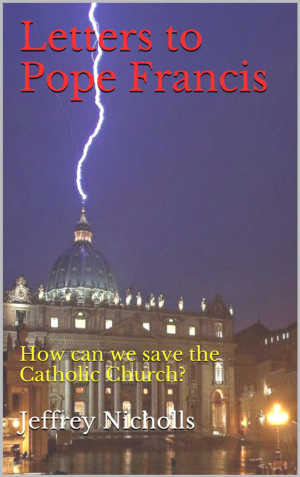
So we write the cover letter for copies of Cognitive Cosmogenesis to the Pope, the Papal Academy and the Dicastery for the Doctrine of the Faith, and this will serve as a cover for other copies sent to eg Caroline Ovington (The Australian) and my other favourite media.
Monday 11 May 2026
My letter to the Pope, the Pontifical Academy and the Dicastery for Faith is short and powerful, reproduced here, but a snag today when the Australia Post Office website said it could not post books to the Vatican. I have looked up the rules and can see no reason why a Physics Book cannot be posted to the Secretariat of his Holiness, Pope Leo XIV. Sent a copy to Caroline Ovington, the Australian and Si Gladman, Australian Rationalists.
The consequence of my proof that the universe is divine opens the door to an infinite space of theological and religious spiritualities worshipping the magnificent universe that brought us to life. This is the line I would like to emphasize in my would be life as an advocate of the real physical divinity of the world, not the ghostly fictitious world of the old time mystics.
Here is my letter to Pope Leo XIV:
Secretariat of His Holiness Pope Leo XIV, 00120, Vatican City
Re: Cognitive Cosmology: A Systematic Integration of Physics and Theology
Your Holiness.
I entered the Dominican Order in Camberwell, Victoria, Australia on 26 February 1963 soon after I turned 18. I made my Solemn Profession in 1967.
In the Order I became deeply excited by the work of Saint Thomas Aquinas and read his detailed commentaries on the work of Aristotle, including his Physics, Metaphysics and De Anima. I understood that Aquinas’s first proof for the existence of God was closely related to Aristotle’s argument for the existence of his First Unmoved Mover.
It is hard to imagine that Aquinas was not aware that Aristotle considered the world to be eternal and the unmoved mover to be part of the world, but in the days prior to science it was open to believe that the Bible was more reliable than human experience and he had no problem adapting Aristotle’s opinion to Sacred Doctrine as he understood it.
During the Second Vatican Council I was thinking about how Aquinas had developed the Christian idea of God using Aristotle’s philosophy and suggested that the Church might repeat Aquinas’s initiative using modern science in the place of Aristotle’s ancient philosophy.
Since science requires observable evidence, this idea implies the hypothesis that the universe is divine. I raised this question in an essay entitled How Universal is the Universe.
Although I considered this idea hypothetical and I felt that testing it would be a radical testament to the brilliant work of Aquinas, I was advised that I had contradicted some of the 24 Thomistic theses of Pope Pius X. On 7 March 1916 the Sacred Congregation of Studies declared that “All these twenty four philosophical theses express the genuine teaching of St Thomas, and they are put forward as tutae normae directivae” (Acta Apostolicae Sedis 8, 1916, 157).
Eventually I was required to leave the Order by the Australian Provincial, Father Jerome O’Rourke. I left on January 1968 and I believe my Solemn Vows were annulled by the Vatican, although I have no record of this.
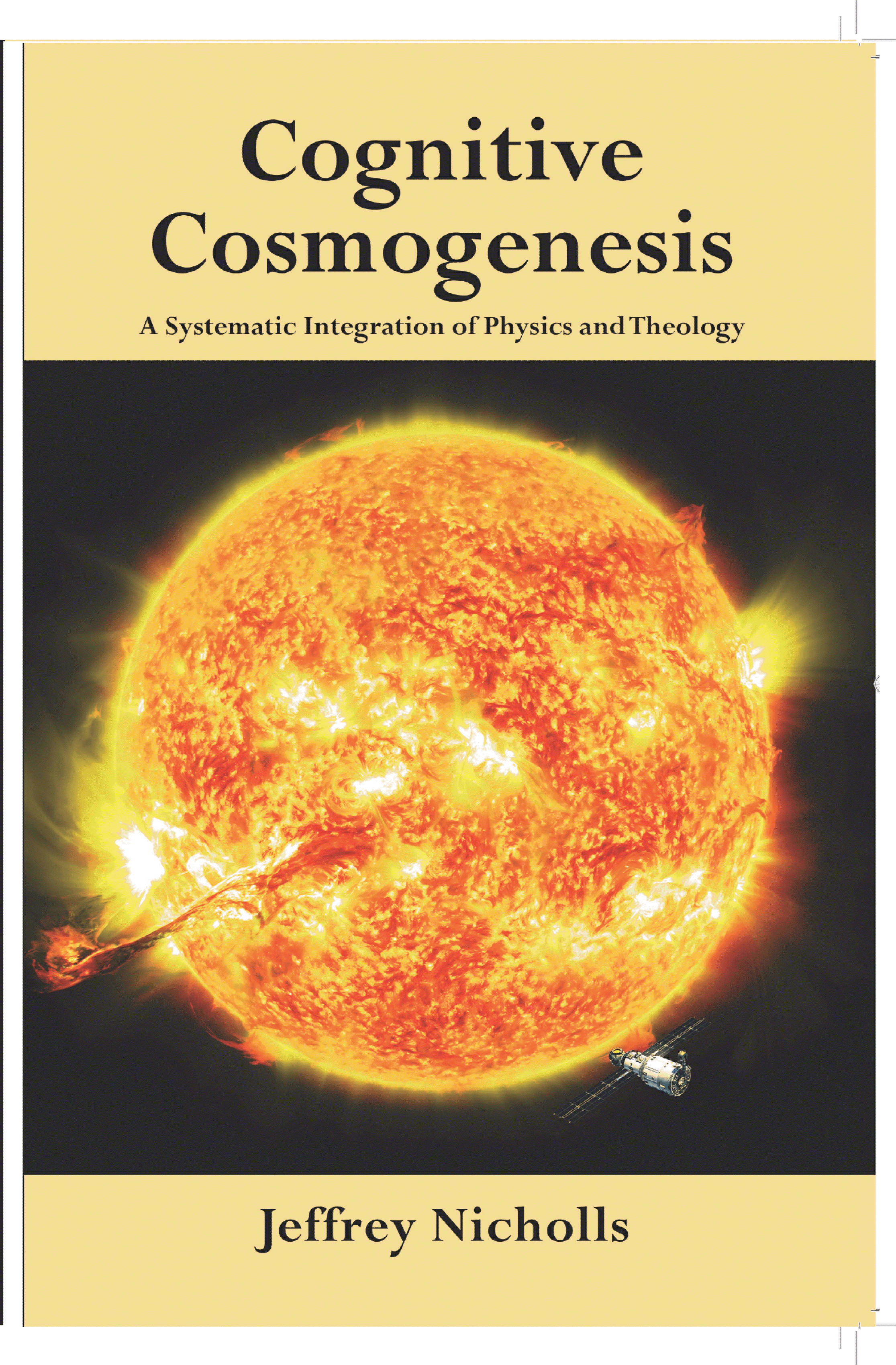
Since that time I have published Cognitive Cosmogenesis: a Systematic Integration of Physics and Theology as a preliminary defence of my position. I enclose a copy for you.
I begin with the model of god developed by Aquinas in the Summa Theologiae: an eternal, absolutely simple, omnipotent and omniscient being whose providence applies to all things.
I then raise a number of issues with philosophy as represented in the 24 Theses.
I begin with Thesis 18:
Immaterialitatem necessario sequitur intellectualitas, et ita quidem, ut secundum gradus elongationis a materia sint quoque gradus intellectualitatis. Adaequatum intellectionis obiectum est communiter ipsum ens; proprium vero intellectus humani in praesenti statu unionis, quidditatibus abstractis a condicionibus materialibus continetur.
My translation [added only on this website]:
Immateriality is a necessary consequence of intellect, and the level of intellect is measured by its distance from matter. In general, the proper object of intellect is being itself; the proper object of the human intellect in the present state of union with the body is the essences of things abstracted from their relationship to matter.
and contrast it with the modern view that has developed through the last century of scientific research in information processing. This has led us to the conclusion that information is physical. As in this text, in computers and in our minds, all information is represented by physical symbols. I feel that this shows that the omniscience of the traditional divinity is not consistent with its absolute simplicity, which excludes the possibility of physical symbolic representation
The other issue I raise here concerns thesis 22:
Deum esse neque immediata intuitione percipimus, neque a priori demonstramus, sed utique a posteriori, hoc est, per ea quae facta sunt, ducto argumento ab effectibus ad causam: videlicet, a rebus quae moventur et sui motus principium adaequatum esse non possunt, ad primum motorem immobilem; a processu rerum mundanarum e causis inter se subordinatis ad primam causam incausatam; a corruptibilibus quae aequaliter se habent ad esse et non esse, ad ens absolute necessarium; ab iis quae secundum minoratas perfectiones essendi, vivendi, intelligendi, plus et minus sunt, vivunt, intelligunt, ad eum qui est maxime intelligens, maxime vivens, maxime ens; denique, ab ordine universi ad intellectum separatum, qui res ordinavit, disposuit, et dirigit ad finem.
My translation [not included]
We neither perceive the existence of god through immediate intuition, nor can we demonstrate his existence a priori, but we can certainly demonstrate his existence a posteriori, that is through created things, led by the argument from effects to cause. For example: from those things which move and cannot explain their own motion, to a first unmoving mover; from corruptible things, which might equally exist or not exist, to a being which cannot not exist; from those things which having lesser perfections of being, living and understanding, ie live and understand more and less, to one who is maximally intelligent, maximally living and maximally being; and finally from the order of the universe to a separate intellect which orders, disposes and rules things according to a purpose.
It is obvious, if we take the view that nothing comes from nothing, that the source of the Universe must be eternal, as Aristotle and many of his contemporaries noted. The specific purpose of thesis 22 is to establish the existence of an omnipotent creator external the observable world, as required by Sacred Doctrine as Aquinas understood it.
In my book I argue that and the omnipotent initial singularity that creates the world is not other than the world of experience, but contains it.
I approach this idea by analogy with Augustine’s exposition of the Trinity, which explains the existence of distinctions within the divine simplicity.
In his book Insight, A Study of Human Understanding Bernard Lonergan SJ proposes and alternative argument for the existence of a God other than the world. He begins with the principle that the omniscient divinity is completely intelligible whereas the universe contains unintelligible observable facts which he calls empirical residue.
My book follows the Darwinian model of creation which recognises the fact that since Laplacian determinism simply repeats the past and cannot be creative, the foundation of creation must be random variation and selection. Since I apply the Darwinian model from the very beginning, an eternal omnipotent state of complete simplicity, I feel that every feature of the observable world from the smallest to the largest has been selected for its contribution to reality and therefore has meaning: there is no empirical residue. The last few centuries of scientific investigation suggest that every time we come to an impasse further research uncovers an explanation.
After a preliminary memoire of my personal experience in the Church, my argument continues to the end of the book. The key creative insight is the explosion of mathematical logic, documented by Whitehead and Russell around the beginning of the twentieth century. This led to the theorems of Gödel and Turing. These show formally that determinism as imagined by Pierre-Simon Laplace is impossible, complimenting Darwin’s discovery that the key to creation is random variation and selection.
These ideas are supported by von Neumann’s Mathematical Foundation of Quantum Mechanics and the ideas originating with Feynman and others that quantum mechanics has computational power equal to or greater than the universal Turing machine.
Faced with the problems raised by Gödel, Turing and others, David Hilbert developed a formal axiomatic model which embraces all mathematical structures that do not lead to contradiction. This stipulation is equivalent to Aquinas’s definition of omnipotence in the Summa, part 1, question 23 article 3.
From this, and the computational power represented by the axioms of quantum mechanics, we might conclude that the Universe is omnipotent, and since it represents all that exists, it is also omniscient, and so equivalent to the Thomistic theological understanding of God.
It has taken me about 60 years to write my book, and it is an imperfect first try. I therefore commend it to your theologians for further study in the hope that the ultimate development of scientific theology will do the same for human global peace and spiritual health as the development of scientific biology is doing for human physical health.
Yours sincerely
End of letter to the Pope: I have italicises the the real crux of my argument which must now be repeated and reinforced in my next work.
Tuesday 12 May 2026
I am not working on Lust-4-Life because it is not attracting me but I feel that 10 steps to the universe and quantocracy are
[page 106]
good. I need a website [and book] name [title] that excites me, somethig like procreation.com. Hard to find now all the good ones are gone. Still trying to zoom in on the next book /next website and the essay On_creation_March2026.
Books posted to Pope Leo, Pontifical Academy of Sciences and Dicastery for the Doctrine of the Faith. The Pontifical Academy of Sciences, Home page, Dicastery for the Doctrine of the Faith
The basic idea of theological unity, like the genetic unity of a multicellular body, is that it provides a fundamental language, in effect nature (as Aristotle
recognized) for meaningful communication and cooperation.
Wednesday 13 May 2026
Still waiting for a new name for lust-4-life site - too raunchy for the theology business, we need something like metaphysics.com (taken by hippies) mysticicorpuschristi? available but too catholic, but on the other hand a good description of the universe [from the Catholic POV].
My big mystery. Obviously, since nothing comes from nothing, the universe is eternal, ie no time. So where did time come from, the first created thing? As Mr Darwin knew, deterministic systems just repeat the past (ie they are eternal) so evolution of time must be a product of randomness, and its initial randomness is reflected in Einstein’s big bugbear, that quantum mechanics does not predict when quantum events like the decay of U238 occur. It is so fundamental we cannot
[page 107]
stop it, but the interesting consequence is all the consequences, ie irreversible changes in initial state of newborn. On the other hand we can stop
relative spatial motion; on the third hand, the photon [and possibly other massless bosons] appear to be, like time, unstoppable and in fact appear to be pure quantum particles, outside space and time in the eternal complex Hilbert world of quantum mechanics which allows for formal motion interpreted as the rotation of state vectors in the complex plane. Quantum state - Wikipedia
This raises the possibility that the attribution of mass to bosons in electrodynamic theory is a misstep caused by trying to interpret quantum processes using observations in Minkowski space. Perhaps we should grant Hilbert space [existence] independent of Minkowski space and proceed ‘metaphysically’ beginning the story of physics by reference to the insights of Plato whose forms play the role of quantum mechanics in the hylomorphic theory developed by Aristotle to bring Plato’s dreams down to Earth.
Rgistered moral-algebra.com as a home for quantocracy and on_creation_may2026, based on the selective power of hermitian operators in the evolution of the universe from the Aquinas—Einstein symmetry / singularity. This move looks a bit technical but I think (at this moment) that it encapsulates what I want to say more precisely than Lust-4-Line - see beginning of this entry 13/5. I first went for moralalgebra.com but a) it was taken and b) the sequence of letters alal was awkward so replaced it with the hyphen al-al, moral-algebra.
[page 108]
Next book: Moral Algebra - the Epistemological Foundation of the World ??. I have spent 60 years following my 10 year old dream, to show that the universe is god so we should love, worship and care for the physical world and our real bible. I sort of wrote the book without quite knowing what I was doing, partly reliving the bitterness my mother felt when the Church rejected her gift of me, her eldest son to preach their gospel.
Alter (2004)Although it saddened her I spent the last fifty years after I left the order in early 1968 until she died in 2016 trying to convince her that this was for the best because it has exposed to me the fundamental error of the Church — it believes in a fictitious god more or less of its own creation which it more or less inherited from the Pharaohs of Egypt via Moses who was in effect a Pharaonic secretary of state who has been given credit for writing the foundations of Hebrew and Christian beliefs in the Five Books of Moses. Robert Alter (2004): The Five Books of Moses
Now I have made this adventure into a book and am ready to start with the next one and I have come to think that the moral foundation of the world is embedded in quantum mechanics by the action of hermitian operators that strip the complex variety of Hilbert space vectors to reveal the real qualities of intelligence, agency and justice . [These] are built into all particles from elementary on up and which account for the better angels of our and all nature, the exact opposite of the two year old behaviour of Mr Trump. I hope this will come off, although it will be a bit technical.
Thursday 14 May 2026
Moral algebra - the fight against artificial intelligence slop.
[page 109]
Cognitive Cosmogenesis has won the crusade against imaginary deities invented by the Pharaohs and inherited by Catholicism. The next step is to overcome political imperialism and artificial intelligence slop with moral algebra, freeing the cosmic foundations of natural intelligence, agency and justice, the triangle of power rooted in hermitian operators, Hilbert space and quantum mechanics, true Christianity, love god, love your neighbour like a Samaritan, the parable at the root of the world. I am off into the empyrean now, rebasing the order of preachers in the heritage of Aristotle, Aquinas and Einstein. Our slogan: gravitation is the touch of divinity, we are all indigenous.
Moral algebra: a manifesto: The Catholic history of salvation is an imperialist delusion based on the dream of Helena and her son Constantine. So much of my life is now clicking into place and I am on a trajectory to die happy.
Obviously (?) the computation of AI, like computation in our bodies, takes place in the complex domain in neurons leading them to emit a real action potential into their output axon, analogous to an eigenvalue in quantum mechanics.
The time has come to give a it of serious thought to linear algebra and the nature of quantum mechanics. Quantum mechanics establishes the physical universe as a communication source by its linearity and unitarity.
Friday 15 May 2026
[page 110]
The tooth hiatus is coming to a symbolic end with a reinforcement of the Cognitive Cosmogenesis insight into physical politics and ethics codified in a newly registered domain for a website to replace lust-4-life in the leading edge of a two year plan for the next book, moral-algebra.com. Now I just have to the work: first step real Linear Algebra Done Wrong and von Neumann Mathematical foundations to bring my ongoing dream closer to Earth. This demands faith in my natural intelligence, leading back to my ‘cell’ in Watson, ACT (1966), sitting there with the typewriter my parents gave me writing an essay about the computational model of human intelligence, one of my many disagreements with the Catholic Doctrine of the immortal spiritual human soul specially created by god at conception or thereabouts. ACT Heritage Council: Signadou and Blackriars precinct eligible for registration
I have followed that long trajectory through thIck and thin since about 1965-6 and now looking forward with another 20+ years of fruitful development in the general direction of saving the world inherited from Teilhard de Chardin. Such a good feeling, but the usual question, is it all true, and the practical answer, for my own sanity, is yes, a gift from my god who spent 14 billion years making me, a very good preachable story. Pierre Teilhard de Chardin (1965): The Phenomenon of Man
They key concept in moral-algebra is the structure of the eternal initial singularity which we take from [Plato, Aristotle] the Arabs and Aquinas (De ente et essentia) describing it as the necessary being ‘bootstrapped’ by the concept that its essence is to exist, a logical proposition at the heart of metaphysics / theology. Paul Halsall (Medieval Sourcebook): De Ente et Essentia (English)
[page 111]
Rethinking Troy: how years of careful peace, not epic war, shaped this bronze age city Stephan Blum (2026_01_29): Rethinking Troy: how years of careful peace, not epic war, shaped this bronze age city
Aatish Taseer: ’Siddhartha Gautama . . . was ready to abandon his young wife and child to find the answer to the problem of suffering’. Silly.We suffer through error and the pain motivates us to correct the error, like the pain I suffer because I had all my teeth removed which will go away when my gums have healed and my prosthetics are a good fit. Aatish Taseer (2026_05_14): Life, Death and Rebirth in the Land of the Buddha
“We are seekers*, not believers a Nepali monk Anil Sakya, 65, would say to me in Bangkok. Buddhism propagated by Asoka and U Thant, who set in motion a master plan for Lumbini designed by Kenza Tange Bidari. *scientists.
Aiding peace or conflict? The impact of USAID cuts on violence. Rohner et al. (2026_05_14): Aiding peace or conflict? The impact of USAID cuts on violence
Saturday 16 May 2026
Time to pit the linearity of Quantum mechanics vs the ??? of AI. Some study needed. 1: Linear algebra; 2: How does AI work. Can you feed all the printed material in the world into a machine that comes out with internally consistent wisdom? First look: AI is a very complex system which requires massive computing resources and so is unlikely to be of any help down the fundamentally simple end of the universe, Carlos Gershenson. Carlos Gershenson (2025_12_12): AI’s errors may be impossible to eliminate – what that means for its use in health care
Ie AI is working in a wilderness and it needs real time guidance to get it right, ie
[page 112]
a lethal selection process [which is missing because it has no independent measure of truth]. In many instances scientific observations and predictions are ambiguous, like AI, and the only reliable test is the outcome. Alexandra Witze (2026_05_14): Are we really headed for a ‘super’ El Niño? What the science says
Ultimately AI, like science itself, can be no smarter than its training sets unless it has a test for correctness. In science there is pee review established by the freedom of information and reaction to information. So now I am free to criticize the Roman Catholic Church for its belief in and propagation of an obviously false and imaginary god wheres in my youth I was dismissed from the Order to this which I had professed lifelong obedience because they considered my independence of reaction as disobedient. Fortunately I live in a free world so I was not burnt at the stake of otherwise threatened with death as happened to Galileo and hundreds of thousands of other heretics murdered in the past by a militant church, and because I am enjoying a long life the rebuttal which has taken me 60 yers to formulate is now available to purchase from booksellers. Jeffrey Nicholls (2025): Cognitive Cosmogenesis: A systematic unification of physics and theology
Linear Algebra Done Right: Sheldon Axler. Focus on abstract vector spaces and linear maps. Sheldon Axler (2026_05_09): Linear Algebra Done Right (4th Edition)
So we begin to think about moral algebra and the quantum mechanical structure of the divine world established by hermitian opertors.
Moral Algebra: Hermitian Operators, Intelligence, Agency and Justice, can I make a gripping story about this ito a best seller?
We need some motivation - a very big promise - true theology
[page 113]
the creation of humanity — the story of love god and love neighbour — peace and certainty, heaven on earth is among us if we can follow the science to heaven, a paean to scientific theology analogous to scientific healthcare + endless music – the quantum mechanical symphony of the world written in algebraic meta-ethics, how good could this be if we could pursue good science, politics and all that. Cannot promise all this without proof for the existence of heaven more powerful than hell, no devil, no fallen angels, constraint on predation based on necessity, solar energy, variation, vegetarianism, cooperation, integration, limits, the mathematical ideal. Albert-László Barabási (2016_05_14): Hungary’s chance to rebuild science
Billie Eilish Everything I wanted - a book as attractive as music - my dream. A provable promise, not like the false promise of the Catholic Church, founded on the pleasure of reproduction, creation, making good, Eilish Jupiter, ie I want to offer something better than the Church offered my mother, including life and death, not omnipotent creation and eternal life. Billie Eilish: Jupiter
|
Copyright:
You may copy this material freely provided only that you quote fairly and provide a link (or reference) to your source.
Further readingBooks
Alter (2004), Robert, The Five Books of Moses, W. W.Norton 2004 ' Through a distinguished career of critical scholarship and translation, Robert Alter has equipped ua to read thr Hebrew Bible as a powerful cohesive work of literature. In this landmark work, Alter's masterly translation and probing commentary combine to give contemporary readers the definitive edition of the Five Books of Moses.
Amazon
back |
Nicholls (2025), Jeffrey, Cognitive Cosmogenesis: A systematic unification of physics and theology, Austin Macauley Publishers 12025 ' This book is a personal narrative of those events and a defense of the belief that the universe itself is divine. The central argument is that by embracing this reality and abandoning notions of supernatural deities, humanity can resolve its problems. The universe, it is argued, is self-creating, and a proper understanding of physics leads to a plausible scientific theology. The natural intelligence inherent in the universe, from cellular organization to ecosystems, far surpasses any artificial intelligence. Comprehending this natural order, the author suggests, would make achieving world peace relatively straightforward.
The book contends that modern theologians should recognize the physical world, rather than ancient texts, as the foundation for credible theology. It also addresses the historical entanglement of religion and politics, asserting that the model of creation presented herein fundamentally rejects the imperialistic ambitions that have fueled genocidal holy wars.'
Amazon
back |
Teilhard de Chardin (1965), Pierre, The Phenomenon of Man, Collins 1965 Sir Julian Huxley, Introduction: 'We, mankind, contain the possibilities of the earth's immense future, and can realise more and more of them on condition that we increase our knowledge and our love. That, it seems to me, is the distillation of the Phenomenon of Man.'
Amazon
back |
Links
Aatish Taseer (2026_05_14), Life, Death and Rebirth in the Land of the Buddha, ' I started my Buddhist journey last October at the birthplace of the Buddha in Lumbini, near the frontier of modern-day India and Nepal. I was intrigued by the fact it was a place of pilgrimage for nearly a thousand years, attracting monks, scholars and kings from every corner of the Buddhist world, before totally vanishing from view for centuries. To me, this lost locus of Buddhist sanctity was like a metaphor for the disappearance of Buddhism from India, the land of its birth and development, and the country where I had grown up. I wanted to know why Buddhism was abandoned there yet flourished in so many other places.'
back |
ACT Heritage Council, Signadou and Blackriars precinct eligible for registration, Under thr administrztion of the National Capital Deelopment Commission (NCDC) tasked weith completling Canbera as the Seat of government, Canbrra grew from a population of 40 000 to 300 000 with the population boom accelerating in the kate 1950s. On avderage, the NCDC was building a primary school eery year and a high school every second year. The Catholic population was also growing, ans the Archbishopof the Canberra and Goulbourne becaame cocerned about the Lack of Orders of Sisters and Bothers availsble o staff schools.Furthr, the Aposrolic Delegate in Australia, Archbishop Romolo Carboni, hoped for many of the religious Orders in Australin to amalgmate and to eventually base thsir heduarters in the National Capital. back |
Albert-László Barabási (2016_05_14), Hungary’s chance to rebuild science, ' Last month’s parliamentary elections ended Prime Minister Viktor Orbán’s 16-year rule, giving Hungary something more consequential than a change of government: a chance to show the world how to rebuild science after political control. With a two-thirds parliamentary majority, the new leadership has the mandate and the constitutional power to rebuild Hungary’s scientific enterprise around merit, and resistance against future interference. If Hungary gets this right, it will offer a model that matters far beyond its borders. back |
Alex Lo (2026_05_14), Beijing had already won before the Trump-Xi summit even started, ' “Who defeated Napoleon during his Russian campaign?” a professor once asked our class when I was in college. It was a trick question to check who had read their assignments. Unlike dictator of Nazi Germany Adolf Hitler in the next century, Napoleon didn’t lose; he actually won most of the major battles in Russia, much like the Americans did in Vietnam, Afghanistan and Iraq. But it was also a very deep question, the answer to which gets to the heart of the novel – and Mother Russia herself.
One answer was Russia’s General Kutuzov. Technically, he lost the crucial Battle of Borodino, which, however, sealed the fate of the Grande Armée. Overextended and without looted provisions from a burned down Moscow, Napoleon’s army that was once the terror of Europe retreated and disintegrated.
[. . .]
Washington under Trump is doubling down on fossil fuels while the rest of the world transitions to green energy, with China leading the way and dominating the markets for wind, solar and hydrogen power.
By going toe to toe with Trump over his tariff threats, “China emerged from the 2025 trade war in a position of relative strength”, wrote Henrietta Levin, a former senior official of the US Department of State and the National Security Council in a new issue of Foreign Affairs.
Under such circumstances, Xi doesn’t have to do much to look like a genius. Whether many Americans still believe Trump is making America “great again”, it seems pretty clear he is working hard to make China great again.
Like Kutuzov waiting out Napoleon, Beijing just needs to sit, wait and hope Trump gets to complete his full term before being replaced by someone more competent.' back |
Alexandra Witze (2026_05_14), Are we really headed for a ‘super’ El Niño? What the science says, ' Headlines have been proclaiming that one of the strongest El Niño weather patterns in recent decades might be starting up later this year. If a big one kicks in, as forecasts currently suggest, it could bring floods, droughts and other weather extremes to many parts of the globe, as well as potentially boost 2027’s temperatures to record highs.
But how sure are meteorologists that this ‘super’ El Niño is on the horizon?
In the past few months, sea surface temperatures in parts of the tropical Pacific Ocean have warmed more than usual, which is the hallmark of an emerging El Niño. Still uncertain, however, is whether winds and other weather factors will either ratchet up that ocean heat or temper it — and therefore weaken the possibility of a strong El Niño.
The latest forecast from the US National Oceanic and Atmospheric Administration (NOAA), released today, suggests that there is a strong chance of an El Niño developing between May and July this year, but that there is much uncertainty over its peak strength. This will become clearer during summer in the Northern Hemisphere. (El Niños typically reach their maximum from October to February.) [. . .]
Winds could have a large effect, says Emily Becker, a climate scientist at the University of Miami in Florida. Just a few days of strong east-to-west trade winds in the equatorial Pacific Ocean could cool waters and weaken a fledgling El Niño, she notes. Conversely, if the trade winds slacken, that “could really kick things into gear”, she says.
Forecasters should know more in the coming weeks, once they get past the notorious ‘spring predictability barrier’, which refers to spring in the Northern Hemisphere. During this period, it is unusually difficult for forecasts to accurately capture the weather variability that can lead to El Niño.' back |
Ayelett Shani (2016_05_09), 'Multibillion-shekel Empires and a Slave Economy': Inside Israel's ultra-Orthodox Parallel State, ' Naomi Abraham, a lawyer and economist who grew up in – but later left – the ultra-Orthodox world, asserts that Israeli society is oblivious to what really drives Haredim. '
[. . .]
You don't see my neighbors in the building, housewives with 13 children who take so-called mehadrin [gender-segregated] bus lines. You see the politicians and functionaries; they are, in a sense, already outside the community's rules. Anyone who sat with me during my years in public service had already violated community norms. Sitting near a woman is a big no-no.
[. . .]
You run a project called "On Hypocrisy," where you publish texts exposing the inner workings of Haredi society. It's a kind of mapping of the political economy, power structures and resource distribution.
I write "On Hypocrisy" for Israeli society, which for 75 years has been having the wrong argument with the Haredim. I write for the gatekeepers: the High Court of Justice, lawmakers, regulators, bank executives, treasury officials and businesspeople in general.
What do you want them to take away from your writing?
That when they look at Bnei Brak, they don't understand what they're actually seeing. I want them to understand that everything that happens in Haredi society ultimately translates into money flowing into the pockets of functionaries. This isn't about sanctity. It's a slave economy, if not outright human trafficking. I think the time has come to stop talking about ideology and start reading balance sheets and land registry records. The wheeler-dealer oligarchy running Bnei Brak isn't dealing in theology. It's dealing in real estate, land registration and shadow banking
[. . .]
By the way, the Independent Education Network is currently running a deficit of 400 million shekels. People need to understand that, until recently, they were connected directly to Merkava, the government payment system. They received funding shekel for shekel. So where did the 400 million go? I have no idea.
You're dealing with very powerful people here. Are you afraid? Have you been threatened?
I don't underestimate their ability to crush people. When I was inside that world, I was terrified of them too. But outside Bnei Brak, their threats don't carry much weight. Today I live in a world of law, regulation and proper governance. They have no jurisdiction there. And beyond that, I already feel that I've beaten them. The Lithuanian Haredi establishment built a racist and cruel system designed to ensure that a woman like me, a young Mizrahi woman, would remain invisible, poor and dependent on them.
Are your family members being threatened?
The standard tactic is to retaliate against family members in order to punish anyone who speaks out. So let me make this clear: My family has absolutely no influence over what I do and bears zero responsibility for the criticism I voice. Anyone who wants to challenge the numbers and facts I present should come directly to me.' back |
Billie Eilish, Jupiter, ' “JUPITER” is a haunting alt-pop/alt-rock song about being emotionally pulled toward someone who always felt just out of reach — like a planet you can orbit, but never truly touch.
Built around intimate vocals, cinematic production, and cosmic imagery, the song explores gravity, distance, obsession, and emotional collision. It captures the feeling of loving someone who changes your entire universe while slowly drifting further away.
From empty train rides and sleepless nights to glowing skies and endless space, “JUPITER” feels like floating through memories you can’t escape.
This track is for the people who still feel someone’s gravity long after they’re gone.' back |
Carlos Gershenson (2025_12_12), AI’s errors may be impossible to eliminate – what that means for its use in health care, ' For AI in particular, errors might be an inescapable consequence of how the systems work. My lab’s research suggests that particular properties of the data used to train AI models play a role. This is unlikely to change, regardless of how much time, effort and funding researchers direct at improving AI models.
As Alan Turing, considered the father of computer science, once said: “If a machine is expected to be infallible, it cannot also be intelligent.” This is because learning is an essential part of intelligence, and people usually learn from mistakes. I see this tug-of-war between intelligence and infallibility at play in my research.
In a study published in July 2025, my colleagues and I showed that perfectly organizing certain datasets into clear categories may be impossible. In other words, there may be a minimum amount of errors that a given dataset produces, simply because of the fact that elements of many categories overlap. For some datasets – the core underpinning of many AI systems – AI will not perform better than chance.
[. . .]
To put it more generally, what limits prediction is complexity. The word complexity comes from the Latin plexus, which means intertwined. The components that make up a complex system are intertwined, and it’s the interactions between them that determine what happens to them and how they behave.
Thus, studying elements of the system in isolation would probably yield misleading insights about them – as well as about the system as a whole.
Take, for example, a car traveling in a city. Knowing the speed at which it drives, it’s theoretically possible to predict where it will end up at a particular time. But in real traffic, its speed will depend on interactions with other vehicles on the road. Since the details of these interactions emerge in the moment and cannot be known in advance, precisely predicting what happens to the the car is possible only a few minutes into the future.
back |
Dicastery for the Doctrine of the Faith, Dicastery for the Doctrine of the Faith, Profile, back |
Emily Schultheis (2026_05_08), Ukraine’s Weirdest Front Line, ' WILHELM ARCHIPELAGO, Antarctica — Sometimes, in the middle of a long workday or as she’s falling asleep, Anzhelika Hanchuk sees her phone jolted to life by a bright notification that means Kyiv is under attack from Russian missiles.
The meteorologist is about as far as she could be from the Ukrainian capital and the conflict raging in her home country. Surrounded by the jagged glaciers and towering peaks of the Antarctic Peninsula with only a colony of gentoo penguins for neighbors, Hanchuk is leading a group of 14 Ukrainians helping the war effort in an unlikely way: by keeping its Antarctic program afloat.
“Stopping the base for even one year and then trying to restart it is simply impossible,” she said. “To stop the base for a year would mean losing it forever.”
Maintaining a permanent scientific presence at Vernadsky Research Base, the mint-green structure perched on a remote, rocky outcropping nearly 10,000 miles from Kyiv, might seem an unusual priority for a country fighting for its existence at home. But Ukrainian officials see their small polar foothold as not just a scientific endeavor, but also a crucial bulwark in their fight for survival and against Russia’s expansionist plans.
That’s because its very existence secures Ukraine a seat at the table where major world powers govern the vast white landmass entirely by consensus — giving the besieged country an important forum to draw attention to Russian aggression in all its forms. A long-term polar strategy adopted this year by Ukraine declares its Antarctic presence a “platform for protecting national interests".' back |
Helen Stenger (2026_05_11), One small country set the model for reintegrating ISIS families from Syria. Here’s what Australia can learn, ' After four women and nine children associated with Islamic State returned to Australia from Syria last week, the Australian Federal Police indicated some would be referred to community reintegration and countering violent extremism programs.
Australia is not starting from scratch. Thirty-one Australian women and children have previously returned from Syria, all but six of them with government assistance. None has been linked to criminal acts since coming home.
The pressing question, then, is not whether Australia has the institutional capacity to support these returns, but what makes reintegration succeed or fail.
This is where Australia can learn from the lessons of dozens of other countries that have repatriated women and children linked to ISIS. [. . .]
One country that has done a better job – and has received far less attention – is Kosovo.
When Kosovo repatriated more than 100 of its citizens from Syria in 2019, it became the first country in the world to establish a government department dedicated to rehabilitating its returning citizens. The justice minister declared the government would not stop until every citizen had been brought home.
This department within the Interior Ministry provides medical and psychiatric support, counselling, housing, social services, vocational training and free legal advice to returnees. It also includes female religious leaders from the Islamic Council of Kosovo, who play a central role in working with women and their communities.
What stands out about the Kosovar example is the deliberate work to reduce stigma that returnees face.
The government’s official narrative was that Kosovo had a responsibility to care for its citizens and reintegration was the best approach to public safety.
And before Kosovar citizens returned, civil society organisations and authorities engaged extensively with communities to address people’s concerns and reassure them that safety was a priority. Religious and community leaders were also involved to counter stigma directly.' back |
Laplace's demon - Wikipedia, Laplace's demon - Wikipedia, the free encyclopedia, ' In the history of science, Laplace's demon was a notable published articulation of causal determinism on a scientific basis by Pierre-Simon Laplace in 1814. According to determinism, if someone (the demon) knows the precise location and momentum of every particle in the universe, their past and future values for any given time are entailed; they can be calculated from the laws of classical mechanics.
We may regard the present state of the universe as the effect of its past and the cause of its future. An intellect which at a certain moment would know all forces that set nature in motion, and all positions of all items of which nature is composed, if this intellect were also vast enough to submit these data to analysis, it would embrace in a single formula the movements of the greatest bodies of the universe and those of the tiniest atom; for such an intellect nothing would be uncertain and the future just like the past could be present before its eyes.'
back |
Lynn S. Neal (2026_05_11), 'Devil Wears Prada 2’ shows how Christian imagery circulates in unusual ways through the fashion industry
, ' At the world premiere of “The Devil Wears Prada 2,” actress Meryl Streep leaned into her character’s devilish persona. She wore the character’s signature sunglasses along with long black gloves and a flowing red leather cape from Givenchy’s Winter 2026 collection.
Streep’s outfit, though, is a small moment in a much larger story – one in which Christianity and fashion have been intertwined for centuries, sometimes as adversaries, sometimes as collaborators.
While neither of the “Devil Wears Prada” movies revolve around Christianity, the invocation of the devil taps into an older moral rhetoric. For centuries, fashion was cast as the troublesome, if not villainous, enemy of a pure and spiritual Christianity – a symbol of putting material desires before holy ones. For example, 18th-century cleric and founder of Methodism John Wesley urged his followers to show their faith by dressing “neatly” and “plainly.”
Yet Christian imagery has come to shape the industry in profound ways. As a scholar who researches the relationship between Christianity and fashion, I have traced how Christian imagery circulates in surprising forms. The devil, for instance, occasionally appeared in fashion advertising to suggest sin, sensuality and transgression.' back |
Original sin - Wikipedia, Original sin - Wikipedia, the free encyclopedia, 'Original sin, sometimes called ancestral sin, is, according to a doctrine proposed in Christian theology, humanity's state of sin resulting from the Fall of Man. This condition has been characterized in many ways, ranging from something as insignificant as a slight deficiency, or a tendency toward sin yet without collective guilt, referred to as a "sin nature," to something as drastic as total depravity or automatic guilt by all humans through collective guilt.
Those who uphold this doctrine look to the teaching of Paul the Apostle in Romans 5:12-21 and 1 Corinthians 15:22 for its scriptural base, and see it as perhaps implied in an Old Testament passage Psalm 51:5.' back |
Paul Halsall (Medieval Sourcebook), De Ente et Essentia, English Text: 'This translation follows the Leonine Edition of Aquinas' works, vol. 43 Sancti Thomae De Aquino Opera Omnia 368-381 (Rome 1976).: Prologue:
A small error at the outset can lead to great errors in the final conclusions, as the Philosopher says in I De Caelo et Mundo cap. 5 (271b8-13), and thus, since being and essence are the things first conceived of by the intellect, as Avicenna says in Metaphysicae I, cap. 6, in order to avoid errors arising from ignorance about these two things, we should resolve the difficulties surrounding them by explaining what the terms being and essence each signify and by showing how each may be found in various things and how each is related to the logical intentions of genus, species, and difference.' back |
Presumption of Innocence - Wikipedia, Presumption of Innocence - Wikipedia, the fee encyclopedia, ' The presumption of innocence is a legal principle that every person accused of any crime is considered innocent until proven guilty. Under the presumption of innocence, the legal burden of proof is thus on the prosecution, which must present compelling evidence to the trier of fact (a judge or a jury). If the prosecution does not prove the charges true, then the person is acquitted of the charges. The prosecution must in most cases prove that the accused is guilty beyond a reasonable doubt. If reasonable doubt remains, the accused must be acquitted. The opposite system is a presumption of guilt.
In many countries and under many legal systems, including common law and civil law systems (not to be confused with the other kind of civil law, which deals with non-criminal legal issues), the presumption of innocence is a legal right of the accused in a criminal trial. It is also an international human right under the UN's Universal Declaration of Human Rights, Article 11.' back |
Quantum state - Wikipedia, Quantum state - Wikipedia, the free encyclopedia, 'In quantum physics, a quantum state is a mathematical entity that represents a physical system. Quantum mechanics specifies the construction, evolution, and measurement of a quantum state. Knowledge of the quantum state, and the rules for the system's evolution in time, exhausts all that can be known about a quantum system.
Quantum states are either pure or mixed, and have several possible representations. Pure quantum states are commonly represented as a vector in a Hilbert space. Mixed states are statistical mixtures of pure states and cannot be represented as vectors on that Hilbert space, and instead are commonly represented as density matrices.
Common examples of quantum states are the wave functions describing position and momentum, finite-dimensional vectors describing spin such as the singlet, and states describing many-body quantum systems in a Fock space. ' back |
Rohner et al. (2026_05_14), Aiding peace or conflict? The impact of USAID cuts on violence, ' Abstract
Less than a week after its inauguration, the second Trump administration issued a blanket stop-work order for the United States Agency for International Development (USAID), the largest national humanitarian donor. The social and political effects of abrupt aid withdrawal are poorly understood, especially in fragile states where relief is a key safety net. We provide quasi-experimental evidence on the shutdown’s impact on subnational conflict across Africa. Leveraging historical exposure to USAID programs, we show that conflict increased sharply after the shutdown in areas that previously received the most support. The increase spanned incidence and severity, including armed clashes, protests, and riots. The effects appeared immediately and persisted for months. Inclusive local institutions substantially mitigated these harms, underscoring vulnerability under weak governance and the capacity of institutions to buffer humanitarian and economic shocks.' back |
Rule of Law - Wikipedia, Rule of Law - Wikipedia, the free encyclopedia, ' The rule of law is a political ideal that all citizens and institutions within a country, state, or community are accountable to the same laws, including lawmakers and leaders. It is sometimes stated simply as "no one is above the law". The term rule of law is closely related to constitutionalism as well as Rechtsstaat. It refers to a political situation, not to any specific legal rule. The rule of law is defined in the Encyclopædia Britannica as "the mechanism, process, institution, practice, or norm that supports the equality of all citizens before the law, secures a nonarbitrary form of government, and more generally prevents the arbitrary use of power".' back |
Sheldon Axler (2026_05_09), Linear Algebra Done Right (4th Edition), ' You are probably about to begin your second exposure to linear algebra. Unlike your first brush with the subject, which probably emphasized Euclidean spaces and matrices, this encounter will focus on abstract vector spaces and linear maps. These terms will be defined later, so don’t worry if you do not know what they mean. This book starts from the beginning of the subject, assuming no knowledge
of linear algebra. The key point is that you are about to immerse yourself in serious mathematics, with an emphasis on attaining a deep understanding of the definitions, theorems, and proofs. back |
Stephan Blum (2026_01_29), Rethinking Troy: how years of careful peace, not epic war, shaped this bronze age city, ' Archaeology often speaks loudest when something goes catastrophically wrong. Fires preserve. Ruins cling to the soil like charcoal fingerprints. Peace, by contrast, leaves no single dramatic moment to anchor it.
Its traces survive in the ordinary: footpaths worn smooth by generations of feet; jars repaired, reused and handled for decades, some still bearing the drilled holes of ancient mending. These humble remnants form the true architecture of long‑term stability.
Troy is a textbook example. Archaeologists have identified nine major layers at the site, some of which are associated with substantial architectural reorganisation. But that isn’t evidence of destruction. Rather it simply reflects the everyday reality of a settlement’s history: building, use, maintenance or levelling, rebuilding and repetition.
Instead, I argue that Troy’s archaeological record reveals centuries of architectural continuity, stable coastal occupation and trade networks stretching from Mesopotamia to the Aegean and the Balkans – a geography of connection rather than conflict.
The only evidence for truly massive destruction that can be identified dates to around 2350BC. Against the broader archaeological backdrop, this stands out as a rare, fiery rupture – one dramatic episode within a much longer pattern of recovery and continuity. [. . .]
Reexamining Troy through the lens of peace shifts attention away from moments of destruction and towards centuries of continuity. Archaeology shows how communities without states, armies, or written law sustained stability through everyday practices of cooperation. What kept Troy going was not grand strategy, but the quiet work of living together, generation after generation.
The real miracle of Troy was not how it fell – but for how long it endured. Rethinking the cherished narrative of the Trojan war reminds us that lasting peace is built not in dramatic moments, but through the persistent, creative efforts of ordinary people. back |
Stephan Blum & Stefan Baumann 92026_05_13), Why was an Egyptian mummy stuffed with a fragment of Homer’s Iliad?, ' Archaeologists have found something unexpected inside a 1,600-year-old Roman-era Egyptian mummy: a fragment of Homer’s Iliad. It wasn’t placed beside the body, but inside the mummy’s abdomen. But the real surprise isn’t just where the fragment was found. It’s how it got there. To understand, we must go back – to the Iliad itself, and to what it became in the Roman world. [. . .]
Across the Roman Empire, educated elites learned Homer as part of their schooling. They quoted him in speeches, analysed him in classrooms and used him to signal cultural authority. To know the Iliad was to speak a language that others across the empire understood.
A senator in Rome, a teacher in Asia Minor or a student in Egypt could all draw on the same stories. The poem created a shared frame of reference – one that allowed very different people to situate themselves within a common past. [. . .]
Across the Roman Empire, the Iliad circulated as a living text: copied, taught and read. Egypt, one of Rome’s most important provinces, was no exception. Yet here, Homer circulated within a cultural landscape that differed in important ways from the Greek literary world in which the poem had first taken shape.
For Roman observers, Egypt often appeared as a place where antiquity was materially preserved as well as remembered – through temples, monuments and practices that emphasised continuity with the past. At the same time, it was a deeply hybrid society, where Egyptian, Greek and Roman traditions interacted in complex ways.
Homer was among the most widely copied authors in Roman Egypt – read and taught as a marker of education and cultural belonging and deeply embedded in everyday literary culture.'[. . .]
Its most enduring insight is therefore this: the past is not something simply preserved, but something continuously made and remade – through the stories, practices and materials that carry it across time.'
back |
The beautiful Game (2024 film) - Wikipedia, The beautiful Game (2024 film) - Wikipedia, the free encyclopedia, ' The Beautiful Game is a 2024 British sports drama film directed by Thea Sharrock and written by Frank Cottrell-Boyce. The film stars Bill Nighy and Micheal Ward.
The squad of English homeless footballers, including the talented but troubled striker Vinny, are led by their coach Mal, to compete in Rome at the global annual football tournament, the Homeless World Cup.' back |
The Pontifical Academy of Sciences, Home page of The Pontifical Academy of Sciences, 'Founded in Rome on 17 August 1603 as the first exclusively scientific academy in the world by Federico Cesi, Giovanni Heck, Francesco Stelluti and Anastasio de Filiis with the name Linceorum Academia, to which Galileo Galilei was appointed member on 25 August 1610, it was reestablished in 1847 by Pius IX with the name Pontificia Accademia dei Nuovi Lincei. It was moved to its current headquarters in the Casina Pio IV in the Vatican Gardens in 1922, and given its current name and statutes by Pius XI in 1936. Its mission is to honour pure science wherever it may be found, ensure its freedom and encourage research for the progress of science.' back |
Thomas Keegan, Inside Porton Down: what I learned during three years at the UK’s most secretive chemical weapons laboratory, back |
Wesley Widmaier , After an opaque summit, China and the US want to work together again. That might not be good news for the world, ' This week’s summit between US President Donald Trump and Chinese President Xi Jinping heralds a different sort of G2. On Friday, Trump claimed the countries had struck some “fantastic trade deals”. But anyone hoping for details of such deals – on tariffs, rare earths or Iran – was left disappointed on Friday afternoon.
Whatever may have transpired, US–China cooperation no longer automatically implies positive spillover effects for the rest of the world. Instead, in 2026, the G2 appears, at best, to be a private bargain between two great powers, imposing hidden costs on those outside, looking in.
The Trump administration has ushered in a noticeable shift in how the US views its economic interests: no longer premised on shared liberal values, but on spheres of influence among great powers. The key question, therefore, is not whether the US and China can cooperate. It is what kind of order their cooperation will produce.
An older economic contrast is useful here.
In the wake of the second world war, the Western bloc (led across the US, the United Kingdom, and Western European states) was united by a shared commitment to a Keynesian global order (under the Bretton Woods system) that sought freer trade in goods while preserving national economic autonomy.
In contrast, the Eastern bloc (led by the Soviet Union) organised trade through what was called the Council for Mutual Economic Assistance (Comecon), trading many goods between countries through planned barter arrangements, instead of for cash.
The irony for the present day is that the Trump–Xi agenda looks more like the old Eastern bloc’s approach.
In this light, the clearest sign that a G2 may be working outside the G20 or larger rules-based order is not that Washington and Beijing are talking. It is the range of issues that may be managed, tying together such concerns as tariff relief, airplane orders, rare-earths access, chip restrictions, Taiwan and Iran.
In each of these cases, it’s reasonable the two countries would want to coordinate their policies. But together, they point to a new global order where two superpowers increasingly call the shots in their own interests.'
back |
|