Notes DB 94 - Theory of Peace - 2026
Sunday 20 September 2026 - Saturday 26 September 2026
[page 285]
Sunday 20 September 2026
Everything begins with our consciousness of one another and our consciousness of ourselves both of which are consequences of communication which we see in primordial terms as the source of space driven by lust-for-life. From these little things big things grow and we apply this algorithm to the universe.
[page 345]
And we may see this coming from our diurnal cycle of sleep and wakefulness, reproduced in my daily cycle of going to sleep with a problem, a form of declining mental health and waking with an answer, a new picture of health. I am inclined to extrapolate this cycle to the whole universe, sleeping in eternal symmetry, waking with a purpose here called lust for life which serves here as an answer to all our problems, going from the dark nothingness of unconsciousness to the awaking of love, awareness of self and others, and on with the day’s business writing this stuff primarily for my mental health and the religious aim, based on theological science, of exporting mental health to the rest of the world, particularly to those so upset with themselves and their environment that they turn to violence, ranging from domestic violence to war. Embodied in the personalities of imperialists who see large scale killing as the path to power and seek semblance of personal peace, based, like the Trumps and Putins of this world, on implementing their personal delusions. The news, beginning with the cartoons, a catalogue of contradictions, exposing nonsense.
For this means exposing the delusion of continuity which lies hidden in sleep, the connection between night and day represented at the fundamental level by the qubit, two orthogonal states connected by mystery, the root of calculus, zero/zero, action at a distance.
Global theology is a common denominator based on global religion which comes as love god (the denominator) love one another (the numerator) the personal point of the lust for life. Sunday Age. Dilin Yasa (2026_09_20): When Nerida’s husband took up a new hobby, she was annoyed at him – and herself, Aishwarya Lakshmi (2026_08_18): A Hindu soldier and a Muslim poet show how religious identities overlapped in 19th‑century India
[page 346]
Inching forward, each day a few new words, embracing one idea like last Saturday decoding a quantum vector using “logical” quanta of action as operations in the execution of a piece of software. The hermitian operator serves to delete the complex bridge between two logical states formally represented in a generic qubit, the foundation of Minkowski space.
Host key verification failed; so edit ~/.ssh/known_hosts, delete all and connect again and new one downloaded.
Why aren’t I working? I should be finishing cl4l03_quantum. Instead I am watching Derek Jarma’s film Wittgenstein and I promise to go to work after the movie. Derek Jarman (1993): Wittgenstein es una película de 1993 del director Derek Jarman.
Wittgenstein: “In desperation I built a small house on the fiord and started to write notes on logic. Here at least I feel I am solving things. Tractatus logico-philosophicus: it combines logical symbolism with religious mysticism.
Limits to language; and what it is to have communication with one another.
To acquire a language is to imagine a form of life. Its what we do and who we are than gives meaning to our words.
There are no genuine philosophical problems. Philosophy is just a byproduct of misunderstanding language. A movie of Wittgenstein quotes,
“Salvation is the only thing that concernsd me. Philosophy is a sickness of the mind. Felt shame after sex with Johnny.”
This soul is a prisoner of his own body. There is no private meaning.
[page 347]
“Unlike lonely Descartes, I want to talk about our life together.”
A model for 13 steps.
Wilderness.
“If a question can be put at all, it can also be answered”.
13 Steps:
1. Beginning
2. Hilbert
3. Quantum
4. 2D Fermion and boson
5. Energy
6. Particle properties
7. Minkowski metric
8. Einstein / initial / QM prior to space
9. Lagrangian
10. Gauge theory
11. Electrodynamics
12. Strong
13. Electroweak
14. Stable / left handed / few antiparticles / (what is the fitter) /the present.
Monday 21 September 2026
L4L principles
1. Initial singularity
2. zero entropy, zero energy
3. Heuristic of simplicity
4. Constraint by contradiction
5. Variation and selection
[page 348]
cl4l05_energy.html: Von Neumann’s proof of ergodic theorem and H-theorem. Where do we introduce free will, the fall and the Catholic Church. Perhaps it goes in the entropy section. John von Neumann (1929_05_10): Proof of the Ergodic Theorem and the H-Theorem in Quantum Mechanics
Cartan page 36: A Hermitian matrix can always be transformed by a unitary matix in such a way as to make it diagonal with real elements. [Bought Dover 1981, $30]
Tuesday 22 September 2026
Vivid dreams of new cheap house near U of A but no realty. Coffee as usual and on with the dance. New aaPrinciples section [in L4L] derived from CC book principles and have decided at last that initial symmetry is an empty complex mind capable of reflection a la Brouwer to make abstract Hilbert space, bringing me into sync with traditional theology / spirituality, simplifying the marketing maybe on bluesky, although sounds a bit twee.
DJIA and NASDAQ looking good.
Navier-Stokes has pointd out another infinity in calculus.
Following the development of the newspapers that I read, the home page of L4L is becoming an almost endless scroll developing the creative steps in the universe in the 14 (? steps) [Stations of he Cross]. (There will be no mention of Original Sin, Redemption).
Apocalypse and all that rubbish, just occasional jokes about Catholic Dogma, Infallibility and general stupidity and falsehood as we go along and the same for quantum field theory and continuity, pointed out in the 14 principles.
[page 349]
The meaning of money gives us a way to distinguish between formalism and reality.
Is now the time to get behind my book and hype it into a best seller. See comment in the Telegraph (2026_09_22). Occasio-Cortez: ‘where can I do the most good?’ Stephen Meyer (2026_09_22): Science is proving Richard Dawkins and the New Atheists wrong
My comment:
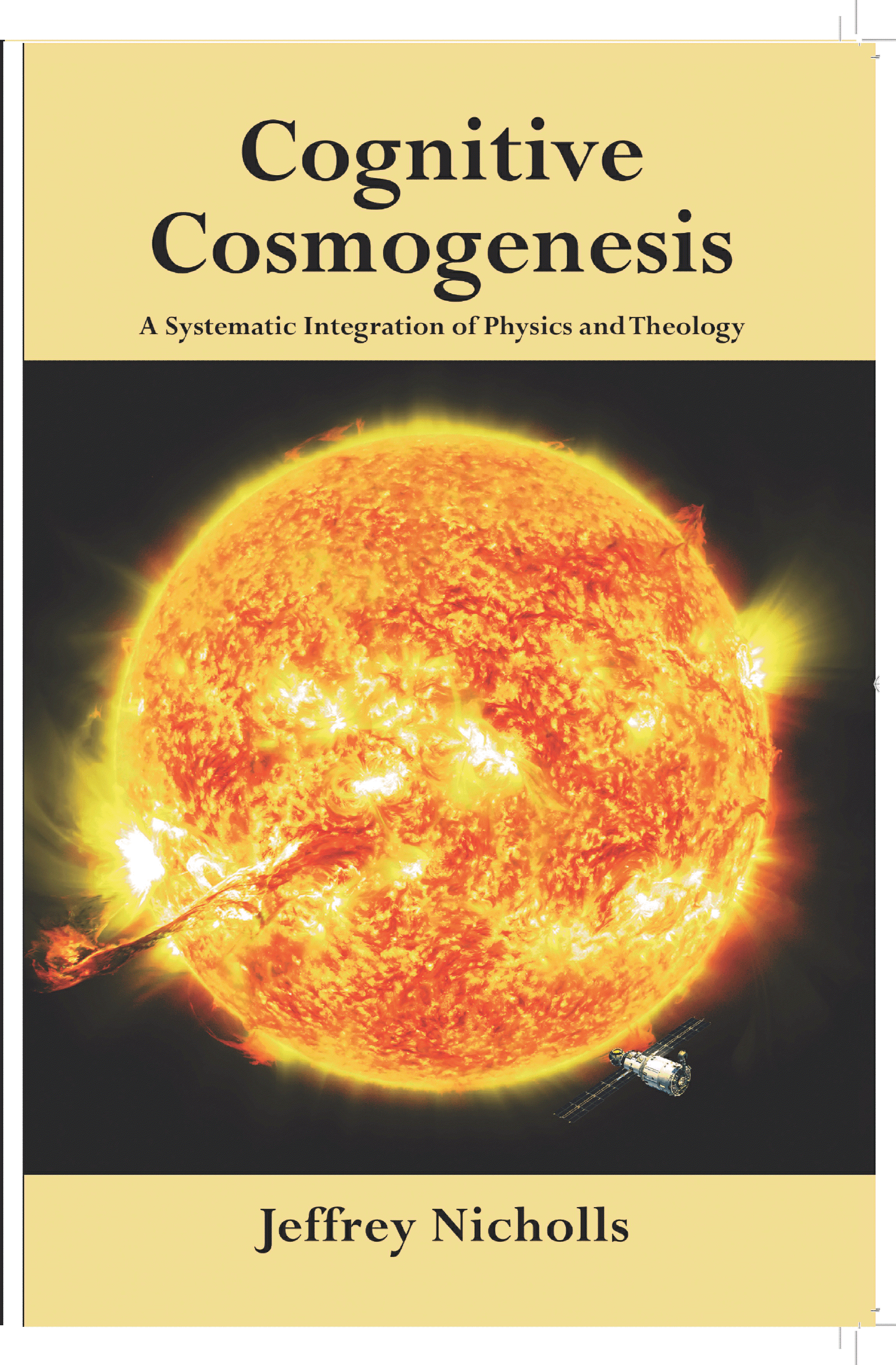
God exists, of course, and always has, as long as there has been time. God is, obviously, identical to the universe. The Australian Dominican Order threw me out about sixty years ago for making this suggestion. Now I have finally written the book and neutralized them. Buy a copy of Cognitive Cosmogenesis: a Systematic Integration of Physics and Theology to get the real story. So far I have stuck rigorously (de facto) to my solemn vow of poverty. Buy my book, cheap at any price, and make me rich in my old age. Jeffrey Nicholls (2025): Cognitive Cosmogenesis: A systematic unification of physics and theology
How do I get the motivation to do another book? - first get an idea [L4L?]
Principle 3: explains why we call the book Cognitive Cosmogenesis. Given that the world works like Plato and Aristotle and the rest of us, first an idea, form or plan and then inject work and energy to make it the real thing.
Wednesday 23 September 2026
Letter to Robert Crotty [and quick reply, very cheering, expressing interest, also “very emeritus” 90+ yo]
Leonard Cohen: Create the world with music [make it real by dancing]. Adrian Willis & Sylvain Lebel (2024): Leonard Cohen: If It Be Your Will
What I learnt in the monastery is that if I could sing the music and relate to it I would have stayed; fortunately I seemed to be tone deaf to that sort of stuff and it was not until I began to hear the music of quantum mechanics I realized that my real god is a music lover built of music and complex numbers.
“Will I be able to sing this 100 times [chanted all the psalms 260 times over 5 years!]
Nature gets perverted in many ways, softened and misrepresented.
Work is our ground, our contact with the real.
[page 350]
Art is the art of healing a broken heart.
Thursday 24 September 2026
The urgency seems to have gone out of my writing business as I wait for my first royalty payment. Does this mean that my hidden self is happy with the idea that the Aquinas–Einstein; singularity is conscious and reflective and fit for Cognitive Cosmogenesis which seems to have been a serendipitous title for my book which arrived without any real conscious calculation, just me being my universal self, giving a strong boost to my ego as an intelligent inhabitant of the world not perverted by imperialist beliefs implicit in the divine outside creator model driven by the Roman Catholic Church. I am feeling ready to begin preaching at last after my fatal [fetal?] journey into a false faith.
Friday 25 September 2026
Summary problem of evil, RCC vs reality in cl4l04_entropy. Cstechism: Satan and the fall §§385-412. Immortslity §66, Word of God §§74 - 100.Obedience to Faith §143; Judgement §680; §290World cretd for the glory of Gd [Showoff, like Trump]
Memoir of a lone wolf. Jinkai Lin: No need to pretend. Jinkai Lin (2026_09_24): I thought ‘I don’t know’ signaled scientific incompetence. Now, I know different
[page 351]
Botanic Garden phone notes: We feel gravitation all the time; acceleration. Our favourite is gravitation, pure undifferentiated (?) energy which is both boson [potential, negative] and fermion [kinetic, positive] [Feynman total energy of the universe zero]. We then split it into fermions and bosons which are the basis of Minkowski space [maybe these particles picking up the positive and negative energy already present in gravitation as potential and kinetic, due to equivalence principle, gravitation is its own message to itself]. What Einstein’s theory does is write off the boson / fermion distinction which brings us back to the initial symmetry. He does this formally by using the tensor space which neutralizes duality through the metric that connects on thing to another, in this case time that connects energy to momentum by mapping time to space with the speed of light, c.
We are down in the weeds where the heuristic of simplicity holds sway. The field theory gravitationalists are imagining 4D gravitational bosons (spin 2) but there are no such things because gravitation has yet to bifurcate into fermions and bosons [now ??]. In gravitation the equivalence principle says fermion ≡ boson.
Now that I am making a bit of progress I no longer feel I ha to aim for a 14 hour day to have job and seven hours will so so I can relax a bit. Saving the world an be exhausting, as Jesus probably felt. An idea flashed by.What is it? L4L has hit it groove with Principles and commentary, getting down to th bottom of the universe where it is indistinguishable from divinity and taking the Roman Catholic Church and quantum field theory head on to cross the gnostic gap. Hopefully this will be the book that sinks physics into the church, my new Bible. In the beginning was the aquinas–Einstein symmetry.
[page 352]
Now it is only 7p and I have a long night of fun before me. Atmosphere. [As true now as when I wrote it 2 nights ago]
The Minkowski metric is conserved in Einstein space [so do we have ghost fermions and bosons?] which remains 4D containing light cones that explain causality which explains the precession of the ‘perihelions’ of orbits like mercury - Read MTW and apply the heuristic of simplicity to their 1000 page book whose structure comes not from gravitation per se but from the huge set of orbiting particles with momentum and energy supplies by the bifurcation of gravitation [when one is first discovering things they are very vague at the start.
Feynman page 121: does quantum formalism create energy and entropy by splitting zero energy gravitation into kinetic and potential, ie random causeless formalism in a substantial singularity creates energy and entropy at the same time when force (potential) = -matter (mass) so potential + mass = o. Feynman (2002): Feynman Lectures on Gravitation.
Saturday 26 September 2026
Looking for an avenue to propagate my divine world and am thinking that a necessary but sufficient process is to revise physics using pure quantum mechanics as a source of spacetime by the construction of fermions and bosons. Here we come to cl4l05_energy. Every time I go over QFT I see how much wronger it is the face of Aquinas’s equivalence principle that treats general relativity as a consequence of our structureless space with a coordinate free Minkowski metric, rewriting Misner, Thorne and Wheeler in the light of the heuristic of simplicity, c and the metric between the upper and lower indices in the Hilbert tensor space, grounding the whole story in reflective self consciousness ‘powered’ by logical / mathematical consistency of the Hilbert formalism. This underlines the fundamental error in AI which is constrained by the garbage in garbage out algorithm of computation bypassed in reality by the logical constraint on omnipotence whose ‘database’ [or ‘bandwidth’] is wide enough to [immediately] flag inconsistencies. A realistic AI can be
[page 353]
trained only on physical consistency. Looking for answers we must stand for a consistent base which in the case of the universe is an empty omnipotent system which can only imagine things consistent with itself which in this case is orthogonal Hilbert bases which are not orthogonal or inconsistent with the space they occupy because they are forms [which can superpose?]. Once thy become real they are individualized and each [fermion] needs a space of its own. You can superpose forms but nor realities [which makes us think that a photon is not much different from a Hilbert vector]. Realities can only communicate with bosons that can be superposed. [Bosons mapping onto one another or onto or out of fermions are the key to communication]. Fermions which cannot be superposed are the source of 3D Euclidean space so they can move around and talk to one another through a ‘field’ of superposable bosons which are in effect children of gravitation, the point at which fermions and boson are identical, a formalism whose points of reference are not [Einsteins special relativistic] railway stations but abstract gaussian coordinates. [Einstein succeeded by flying in the realm of abstraction and it works, as Hilbert vectors with the complexity processed out of them by hermitian operators drive are the operational software of quantum mechanics, made real by energy],
The gnostic gap is real, recognized by theologians but not by physicists like Einstein, who gave the same reality to gaussian formalism as he did to railway stations. From this point of view gravitation is abstract 4D spacetime without any particles which can collapose into black holes when too many particles concentrate in one ‘space’. [It is amaing how al this stuff i casputd in the mathematics. Hawking & Ellis (1975): The Large Scale Structure of Spacetime
Have I got L4L_cognitive cosmogenesis in the groove.