Notes DB 94 - Theory of Peace - 2026
Sunday 13 September 2026 - Saturday 19 September 2026
[page 285]
Sunday 13 September 2026
We assume that Step 2 has produced a Hilbert space Cn with n representing a potentially countably infinite number of orthogonal basis states. Quantum mechanics divides these staets into two orthogonal subspaces of states which are represented by the qubit written on page 332 above, which divides the subspaces of Hilbert space into [those with] symmetric statistics (bosons) and [those with] antisymmetric statistics (fermions). At a given energy the number of fermions is fixed while the number of photons is variable (Khinchin pp 80 sqq). Aleksandr Yakovlevich Khinchin (1960, 1998): The Mathematical Foundations of Quantum Statistics
[page 335]
As usual, having gone to bed depressed by Quigg due to the complexity of the subject, I wake up excited by my old friend Khinchin having reduced everything to the symmetric and anti-symmetric statistics which lie at the foundation of Minkowski space.
Back to step 4 - the network of fermions and bosons represented in the qubit to be realized in many copies in Minkowski space [ie creating the structure of Minkowski space], thousands of examples of each particles, same force, different realization, popping out of Hilbert into reality, masses of fermions, masses of bosons [all drawing energy from the bifurcation on the initial symmetry,]s in varying quantities depending on the random (but equal) energies of the fermion/boson pairs formed by this process which is a real level of variation built on the formal level embedded in Hilbert space/quantum mechanics. A question: why do forms attract energy? because it s possible, a feature of probability embedded in the ergodic principle. John von Neumann (1929_05_10): Proof of the Ergodic Theorem and the H-Theorem in Quantum Mechanics
Monday 14 September 2026
Shannon (1948): detailed coverage of entropy in communication. Communication is a problem in spacetime which is not present in quantum theory in Hilbert space where everything is superposed and the presence of hermitian operators weeds out the moving complex forms to isolate the real observable forms. How does this mechanism apply to the purification of Hilbert space by the action of quantum mechanics eliminating crosstalk, ie the complex bridges between orthogonal bases which act as noise from a communication theoretical point of view. Claude E Shannon (1948): A Mathematical Theory of Communication
[page 336]
One (ie me) would like to see a connection between hermitian operators in QM as error correction in communication since hermitianoperators eliminate complex numbers from Hilbert space. Is a complex number an error, a point somewhere between real numbers [a form of noise between discrete operators measured by the quantum of action, corrupting the stepwise organisation of processes in the world]?
Jon Ronson, Viking: “The constant quest to understand things I do not understand”. I am a worker, he writes, and his own anxiety about who he would be without his work to define him is the key to the book. Alexander Howard (2026_09_13): It’s a strange time to be a man’: in The Castle, Jon Ronson investigates the plight of unanchored men, Jon Ronson (2026): The Castle: Adventures in a World of Unravelling Men
I want to feel great power by being connected to / immersed in the world /god, rather like the pope but a true child of god, not an imperial usurper.
Tuesday 15 September 2026
Shannon, page 8 §5: Ergodic and mixed sources. “general idea is simple: ‘In an ergodic process every sequence produced by the process is the same in statistical properties’.” Or, it fulfills the full range of possibilities available to it at a given energy.
The world of fantasy created by the Roman Catholic Church is paralleled by the work of Trump in the US and represents a fragmentation of society into transactional self interest. How does Quantocracy: The universal quantum mechanical foundations of democracy and freedom combat this?
[page 337]
A proof is a logical formal structure which is discovered in a consistent universe [like Hilbert’s world of formalism] by a random process like AI, under the control of an ‘empirical’ testing process (natural selection) which gives ‘de facto’ realization to things that work in a manner which constitutes survival. We can see this process at work in the random behaviour of the Trump administration and we can interpret evil in the form of accident, disease and war as the process that terminates a dead end line of development that can be achieved a lot more cheaply by science, which includes democracy and judicial reasoning on the basis of successful histories.
Despite the enormous complexity of my brain I tend to have a one track mind so when I am working on this stuff little practical tasks become slow because I do them one step at a time rather than condensing the steps into an arranged sequence. This is in effect a Markov chain.
Chinese bureaucrats suck up to Xi Jinping in exactly the same way as US bureaucrats suck up to Trump. (2026_09_13). Chen Yixin (2026_09_13): Fully build an artificial intelligence safety barrier; Promote the healthy and orderly development of artificial intelligence
The power of a communication system is to communicate any element of a space of possible messages without error, ie it is insensitive to the contents of the products it is transmitting, except to read their address headers. [so a photon may carry any amount of energy at constant speed whereas fermions carry different energy at different speeds].
Meaning ≡ correlation ≡ mapping
[page 358]
Joshua Black: Theology and the Overton Window. We have to release Jesus of Nazareth from the Roman Catholic perversion. We need to get the politics out of theology, beginning with the Vatican, its infallibility bullshit and its inquisitorial ‘pontifical’ academy. Joshua Black (2026_09_15): How does unthinkable policy become inevitable: the OvertonWindow is one possible-answer
What is the window for scientific theology? It is the only way to make theology real, true and trustworthy, to give us spirit without borders as scientific biology has given us health care without borders, we can then become one body and one spirit all grounded on the same Earth. Lust-for-lifeLust-for-life explains creation, but we need a new name for religion, ie living in the spiritual space created by life, global physics is the substrate for global metaphysics, we need a new brand name, transcendental (?).
Wednesday 16 September 2026
Time to think about the economy in physical terms and ask why energy is conserved and money continuously inflates and is it the difference between the perfect bookkeeping of the bifurcation of energy and the dodgy practice of banks releasing more cash than their debt, something in which in the physical model mooted in quantocracy has a whiff of injustice. How do we make these thoughts come true and how are they related to fermions, bosons and Minkowski space where we find Lagrangian and Lagrangian density functions consistently retained at zero by “gauge” theory and (this seems to work) Gittins, Age Ross Gittins (2026_09_16): Feeling the pinch? Blame the pay rise you didn’t get
[page 338]
Have been reading Shannon (1948) but a lot has happened since that, see Khinchin 1953 and 1956, Dover. Going back to my 1992 Hilbert Oscillator after a 2026-1992 34 year circuit that I an revisit now in Lust for Life and the 13 steps to creating a universe derived from the physics in Quigg. An Essay on the Divinity of money foreshadows the justice element in Quantocracy, and the quantum foundation of McMillan’s E property and all of this will become motivated in the bifurcation of the empty initial symmetry into energy which converts forms into reality by executing them by analogy to the execution of software by physical computing hardware, this insight serves to justify all the work I did in Elands, finally seeing where it was leading as I thought it through in the long drives from Elands to Adelaide and back. My past was a mess but it might yet bring results and the subsequent essay on value brought a judgement on the precautionary principle. Chris Quigg (2013): Gauge Theories of the Strong, Weak, and Electromagnetic Interactions: Second Edition A.N. Khinchin (1957): Mathematical Foundations of Information Theory (translated by P A Silvermann and M D Friedman), Jeffrey Nicholls (1982_05): An essay on the divinity of money, Jeffrey Nicholls (1992a): An essay on value, Precautionary principle - Wikipedia, Jeffrey Nicholls v Director General National Parks and Wildlife Service No. 10151 of 1994
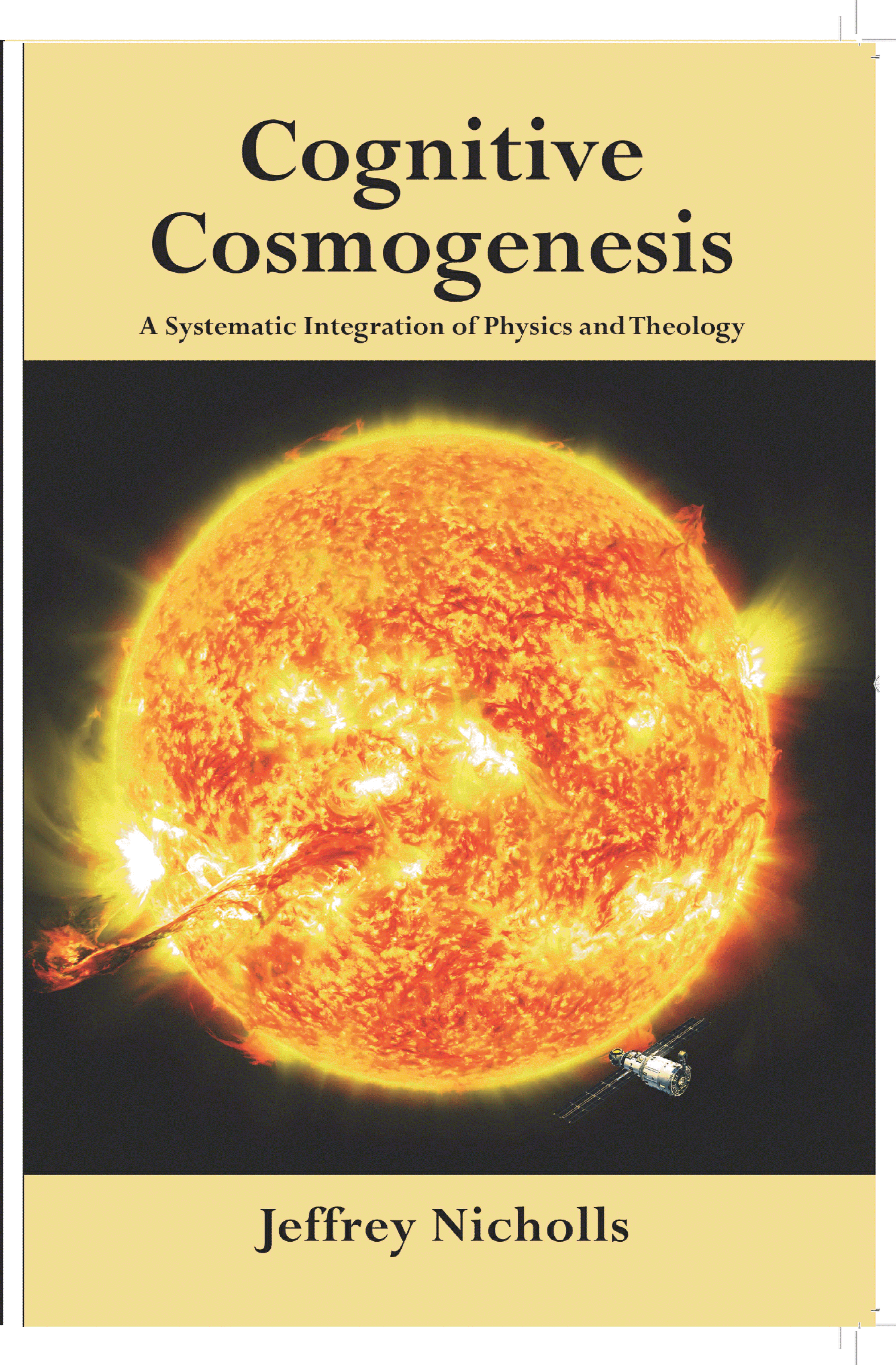
So lets look at Khinchin again in the light of fermions, boson and the primordial qubit. Money essay: logical confinement. I love my old stuff. It feels from here 30+ years later that a lot of it was forgotten but it all made it into my book in a way, the substance of a memoir. Jeffrey Nicholls (2025): Cognitive Cosmogenesis: A systematic unification of physics and theology
Money §165 “we conclude that The size of an Hilbert Oscillator depends on whether we looK at it from a spaCe point of view or a tike point of view or a mixture of both. There is an uncertainty in matching these two points of view whose unit is a quantum of action. The minimum uncertainty [§:166]
[page 340]
gives the scale of the universe. It determines the size of fudamental particles and therefore ultimately of ourselves and everything else. § Conservation of Energy and the Principle of Least Action. 1992 versions of 2026 bifurcation of fermions and bosons, universe mass = 0, fermions +x, boson −x, x + x = 0.
§178: The concept of efficient algorithm, formulated in the general space of the Hilbert Oscillator [fermion ⇆ boson] gives us a means of expressing economic efficiency and economic survival in a competitive system.
Write to Gittins: 1992 Banking Essay written after 1987 Theory of Peace.
Thursday 17 September 2026
Fixated on Cantor in those days as a model of god replaced to some degree with Hilbert’s mathematical formalism echoing omnipotence with consistency. Is the time coming for a bit of self promotion, and how do I do it - expressing my belief in the stable and creative divnity of the universe as in representativ of tested natural intelligence. Perhaps I need to get on a social medium and draw a bit of comment - bluesky. Imitate Trump.
Khinchin’s conclusion depends on ideas from Shannon, McMillan and Feinstein.
Because of noise, two different sequences of channel input may give the same channel output. We can generate distinguishability if we know groups B1 and B2 which have no common sequence and we are certain that one sequence sent can be mapped to B1 and another can be mapped to B2, ie we know what was sent.
[page 341]
Given K input sequences number of outputs should not exceed K, so L < K defines the possibility of error free transmission. We do this with McMillan’s theorem, transmitting only sequences from the high frequency group, making L small and K large. Then Feinstein’a lemma, which tells us that source entropy must be less than the ergodic capacity of the channel, H0 < C.
How does this determine the number of fundamental particles is 61, given that in QM the channel capacity is defined by hermitian operators where an operator is the channel for [transforming] vectors in Hilbert space into particles in Minkowski space, constrained by the quantum of action operating in one instant of time: one quantum of energy is one quantum of action executed in one quantum of time [a relationship embedded in the quantum mechanical equation E =hf, where h is the value of the angular momentum of the quantum (spin) in Minkowski space and f is the number of actions per second].
In a nutshell, the interface between Hilbert space (source) and Minkowski source (channel) is energy (rate of action hf). Can we make something of this: the theoretical limit of communication between Hilbert space and Minkowski space.
Clearly my route to scientific theology should follow Einstein’s course of making a physical discovery, the general theory of relativity which made him “suddenly famous” and unable to make a plausible mistake in physics again. My proposed application of communication theory to quantum mechanics, thereby neutralizing field theory, should bring me sufficient fame to market scientific theology by defending the reality of quantum jumps and the falsity of continuous field, except the unique case of particle free gravitation.
[page 342]
I have always been looking for this vision. Can I make it stick? So the question is: why 61 fundamental particles? Let us guess that the formal reality of Hilbert space does not break the continuity of the initial symmetry until the advent of energy creates particles with distinguishability, photons of different [intrinsic] energy and fermions with exclusion [and different kinetic energies]. How did I get hooked on Cantor way back in 1982-7? Because I was looking for mental space for peaceful existence. [my get out of jail card is that a quantum of action represents a vector which may exist in space whose cardinal is ℵn where n may itself be a transfinite cardinal.] Jeffrey Nicholls (1987): A theory of Peace
Friday 18 September 2026
‘Ergodic’ is a formal description hard to apply to energy in classical physics although it may apply to variation in the Lagrangian supported by gauge theory, but von Neumann shows (?) that it is natural in the digitized world of quantum mechanics, as does Khinchin is the digititized world of statistics and these observations may serve as fatal for quantum field theory in all particulate contexts but applicable (as Einstein found?) in the coordinate context of general relativity where Einstein replaced physical bodies of reference like railway stations with the formalism of Gaussian coordinates. In general mathematical logic requires the existence of discrete entities which it attempts to avoid by the doctrine of ‘limits’ to get around the notions implicit in the calculus of the continuum by the fiction 0/0. This issue may also be relevant to that of the Navier-Stokes equation [at the particulate level] Navier-Stokes equations - Wikipedia, Jason Bamburger (2026_09_17): OpenAI may have solved the Navier‑Stokes equation — but mathematics is more than $1 million trophy hunts
Living in the city with a million independent particles, many
[page 343]
with roles, like busdrivers and police persons, many more independent looking for fun in Hindley street. How do we understand this complex process, largely facilitated with alcohol and sex, ie driving forces of various specifications, all comprehended under the general rubric of particles and messages between particles, seeking input and driven to output. This is the structure which explain by physics and theology and seek to optimize by religion, law and maximization of agency and freedom constrained by justice, i.e. conservation [and sharing] of energy.
Saturday 19 September 2026
What was I thinking? My key is to write a convincing and accurate history of the universe running from its eternal and absolutely simple beginning to the present day. The key to my key is heralded in my book, Cognitive Cosmogenesis, a systematic integration of physics and theology based on the reflection of the initial singularity on itself creating a Hilbert space which evolves under its own formalism to the universal structure.
I must do this and I must also get it right, so I am going slowly, meditating on every step with nothing really to guide m but my own experience of life in this world for 82 years. Can this work be trusted? Only as it is consistent with such facts as I have learned during this time, the most basic of which is that it must be eternal since nothing comes from nothing, that it is composed of orthogonal particles like myself, that the root of creativity is randomness and the root of durability is reproduction, a reproduction of the principles at the end of my book. So a new section in Lust_4_Life, “principles”.
[page 344]
Principles, αρχεια.
How would I cast myself as making a movie about L-4-L, like a graphic book, put it together like a sequence of feelings. My guiding principle is the heuristic of simplicity while we are down in the qubit world, and the most complex step is the description of the origin of Minkowski space and the mass shell. Can my story be true? In the beginning yes but we still have big trouble with electroweak and massive bosons, left hand neutrinos and all that stuff and [must] find a way through it using Khinchin and co, all on the margin between Hilbert and Minkowski, all explained as a documentary.
If we read each component in a quantum mechanical vector as a software instruction to executed [in a certain dimension] by a quantum of action we can imagine a particle as the execution of a set of instructions. A massless boson extends these instructions over an extended wave, a compact massive fermion may process such instruction as a repeated current rather like the Qiu characerization of an electron, the execution of each step being a 2D spinor rather than simply a 1D cycle of a wave, and when we come to massive electroweak bosons we can imagine a 1D contained structure much more massive than an electron.
|
Copyright:
You may copy this material freely provided only that you quote fairly and provide a link (or reference) to your source.
Further readingBooks
Khinchin (1957), Aleksandr Yakovlevich, Mathematical Foundations of Information Theory (translated by P A Silvermann and M D Friedman), Dover 1957 Jacket: 'The first comprehensive introduction to information theory, this book places the work begun by Shannon and continued by McMillan, Feinstein and Khinchin on a rigorous mathematical basis. For the first time, mathematicians, statisticians, physicists, cyberneticists and communications engineers are offered a lucid, comprehensive introduction to this rapidly growing field.'
Amazon
back |
Khinchin (1960, 1998), Aleksandr Yakovlevich, The Mathematical Foundations of Quantum Statistics, Dover 1998 'In the area of quantum statistics, I show that a rigorous mathematical basis of the computational formulas of statistical physics . . . may be obtained from an elementary application of the well-developed limit theorems of the theory of probability.'
Amazon
back |
Nicholls (2025), Jeffrey, Cognitive Cosmogenesis: A systematic unification of physics and theology, Austin Macauley Publishers 2025 ' This book is a personal narrative of those events and a defense of the belief that the universe itself is divine. The central argument is that by embracing this reality and abandoning notions of supernatural deities, humanity can resolve its problems. The universe, it is argued, is self-creating, and a proper understanding of physics leads to a plausible scientific theology. The natural intelligence inherent in the universe, from cellular organization to ecosystems, far surpasses any artificial intelligence. Comprehending this natural order, the author suggests, would make achieving world peace relatively straightforward.
The book contends that modern theologians should recognize the physical world, rather than ancient texts, as the foundation for credible theology. It also addresses the historical entanglement of religion and politics, asserting that the model of creation presented herein fundamentally rejects the imperialistic ambitions that have fueled genocidal holy wars.'
Amazon
back |
Quigg (2013), Chris, Gauge Theories of the Strong, Weak, and Electromagnetic Interactions: Second Edition, Princeton UP 2013 ' This completely revised and updated graduate-level textbook is an ideal introduction to gauge theories and their applications to high-energy particle physics, and takes an in-depth look at two new laws of nature--quantum chromodynamics and the electroweak theory. From quantum electrodynamics through unified theories of the interactions among leptons and quarks, Chris Quigg examines the logic and structure behind gauge theories and the experimental underpinnings of today's theories. Quigg emphasizes how we know what we know, and in the era of the Large Hadron Collider, his insightful survey of the standard model and the next great questions for particle physics makes for compelling reading. The brand-new edition shows how the electroweak theory developed in conversation with experiment. Featuring a wide-ranging treatment of electroweak symmetry breaking, the physics of the Higgs boson, and the importance of the 1-TeV scale, the book moves beyond established knowledge and investigates the path toward unified theories of strong, weak, and electromagnetic interactions.
Amazon
back |
Ronson (2026), Jon, The Castle: Adventures in a World of Unravelling Men, Viking Non Fiction 2026 ' From the million-copy bestselling author of The Psychopath Test comes a twisting, darkly comic true-life story about one man, his castle, a generation of unravelling men – and a secret hidden deep behind the castle walls.'
Amazon
back |
Links
Alexander Howard (2026_09_13), It’s a strange time to be a man’: in The Castle, Jon Ronson investigates the plight of unanchored men, Review: The Castle: Adventures in a World of Unravelling Men by Jon Ronson (Viking Non Fiction)
' The ABC’s now-defunct current affairs show Q+A makes an early appearance in Jon Ronson’s The Castle: Adventures in a World of Unravelling Men.
A guest in 2024, he reflects on the show as “a delightful hour’s television with everyone being convivial to one another, no matter their politics”. That is, until there was a question about men, which he responded to with: “It’s a strange time to be a man.” He describes the response of host Patricia Karvelas (“Is it? Why?”) as the “sharpest exchange” of the program.
“I didn’t know what I meant by it at the time,” he writes. “It was a new thought for me.” He offered some quick remarks about the plight of everyday working men in deindustrialised towns and cities, everyone relaxed, and the moment passed. But he sensed there was something more to be said, “not least because so many people seemed nervous to broach it. For me, that uneasiness was a reason to head in".' back |
Chen Yixin (2026_09_13), Fully build an artificial intelligence safety barrier
Promote the healthy and orderly development of artificial intelligence, At present, artificial intelligence has led a new round of scientific and technological revolution and industrial transformation to advance in depth, and the field of artificial intelligence has become the main battlefield of global scientific and technological competition and a new track for the strategic game of major countries. The Party Central Committee attaches great importance to the development of artificial intelligence, and General Secretary Xi Jinping made a series of important instructions, emphasizing that it is necessary to "comprehensively promote artificial intelligence scientific and technological innovation, industrial development and enabling application, improve the mechanism of artificial intelligence supervision system, and firmly grasp the initiative of artificial intelligence development and governance." We must deeply study the spirit of General Secretary Xi Jinping's important instructions, unswervingly implement the overall national security concept, accelerate the construction of an artificial intelligence security risk prevention and control system, and promote the healthy and orderly development of artificial intelligence in China with high-level safety and high-performance governance. back |
Claude E Shannon (1948), A Mathematical Theory of Communication, '' The recent development of various methods of modulation such as PCM and PPM which exchange T bandwidth for signal-to-noise ratio has intensified the interest in a general theory of communication. A basis for such a theory is contained in the important papers of Nyquist1 and Hartley2 on this subject. In the present paper we will extend the theory to include a number of new factors, in particular the effect of noise in the channel, and the savings possible due to the statistical structure of the original message and due to the nature of the final destination of the information.
The fundamental problem of communication is that of reproducing at one point either exactly or approximately a message selected at another point. Frequently the messages have meaning; that is they refer to or are correlated according to some system with certain physical or conceptual entities. These semantic aspects of communication are irrelevant to the engineering problem. The significant aspect is that the actual message is one selected from a set of possible messages. [. . .]
Actually, two signals can be reliably distinguished if they differ by only a small amount, provided this difference is sustained over a long period of time. Each sample of the received signal then gives a small amount of statistical information concerning the transmitted signal; in combination, these statistical indications result in near certainty. back |
Dennis Muller(2026_09_15), Bluster and betrayal: Paul Barry probes how steel tycoon Sanjeev Gupta hoodwinked the powerful, Review: The Big Steal: How Steel Tycoon Sanjeev Gupta fooled Australia and the World – Paul Barry (Allen & Unwin)
It is difficult to read Paul Barry’s The Big Steal without a mounting sense of outrage, not just at the British businessman Sanjeev Gupta, rightly described as a silver-tongued scoundrel, but at the greedy bankers, gullible journalists, naive politicians and incompetent regulators who allowed this global scam to happen.
The story has been meticulously put together by one of Australia’s finest investigative journalists. Barry knows the terrain of corporate skulduggery well, having written two books tracing the rise and fall of that infamous Western Australian pirate Alan Bond.
All the ingredients of the Bond story are present again, only on a global scale.
Basically Gupta’s scam worked like this. He would buy a rundown steelworks, aluminium smelter or power station in a town heavily dependent on it: Whyalla in South Australia, Uskmouth and Newport in Wales, Galati in Romania. Two dozen steelworks altogether across Britain, Europe, the US and Australia. (In a sad footnote, administrators this week decided to permanently shut down the blast furnace at the Whyalla steelworks, with around 500 jobs to be lost.)' back |
Jason Bamburger (2026_09_17), OpenAI may have solved the Navier‑Stokes equation — but mathematics is more than $1 million trophy hunts, ' Last week, OpenAI shared a proposed solution to the “Navier-Stokes equation” — one of the seven renowned Millenium Prize Problems chosen by the Clay Mathematics Institute that have stumped mathematicians for many years.
Each of these problems offers a $1 million reward. If OpenAI’s solution is confirmed, this would make it only the second Millennium Prize Problem ever to be solved.
Good. I hope the Riemann hypothesis is the next problem conquered by AI.
I do not mean to convey that these famous open problems are silly or useless — in fact, the Millennium Prize Problems were chosen because of their mathematical importance. The Navier-Stokes equation describes how fluids such as water and air flow.
However, their cultural status has allowed them to grow far beyond their mathematical importance. They have become the monuments of our discipline. They were built for good reasons, are genuinely impressive, but are now obscuring the breadth of modern mathematics.[. . .]
Of course, great problems can produce great mathematics. Russian mathematician Grigori Perelman, for example, added crucial new ideas to Richard Hamilton’s theory of Ricci flow while solving the Poincaré conjecture — the only Millennium Prize Problem solved by humans.
But if the value of these problems lies in the new theories, methods, and connections produced while trying to solve them, perhaps the solutions and the trophies have received too much cultural emphasis.' back |
Jason Bamburger (2026_09_17), OpenAI may have solved the Navier‑Stokes equation — but mathematics is more than $1 million trophy hunts, ' Last week, OpenAI shared a proposed solution to the “Navier-Stokes equation” — one of the seven renowned Millenium Prize Problems chosen by the Clay Mathematics Institute that have stumped mathematicians for many years.
Each of these problems offers a $1 million reward. If OpenAI’s solution is confirmed, this would make it only the second Millennium Prize Problem ever to be solved.
Good. I hope the Riemann hypothesis is the next problem conquered by AI.
I do not mean to convey that these famous open problems are silly or useless — in fact, the Millennium Prize Problems were chosen because of their mathematical importance. The Navier-Stokes equation describes how fluids such as water and air flow.
However, their cultural status has allowed them to grow far beyond their mathematical importance. They have become the monuments of our discipline. They were built for good reasons, are genuinely impressive, but are now obscuring the breadth of modern mathematics.[. . .]
Of course, great problems can produce great mathematics. Russian mathematician Grigori Perelman, for example, added crucial new ideas to Richard Hamilton’s theory of Ricci flow while solving the Poincaré conjecture — the only Millennium Prize Problem solved by humans.
But if the value of these problems lies in the new theories, methods, and connections produced while trying to solve them, perhaps the solutions and the trophies have received too much cultural emphasis.' back |
Jeffrey Nicholls (1982_05), An essay on the divinity of money, 1 Western theological tradition conceives of god as a personal being other than the universe who creates and controls our lives. Our political system still (rather tenuously) recognises god as a source of law through royal assent and the use of oaths. Since god is believed to be other than the universe, it cannot be observed and so cannot be the subject of science as we now understand it. Our information about god comes from ancient texts revealed to chosen prophets and interpreted by churches with equally ancient roots.
2 The rise of science questioned revelation and the churches as sources of truth, but they have remained in existence because science still lacks the power to ask or answer the fundamental questions of life and death that concern theology.
3 Here I outline a new scientific theology whose model of god derives not from ancient text but from the mathematical theory of text and communication itself. I propose that this model describes the universe of our experience, which is therefore fittingly called god.
4 I then interpret this model using elements of current physical theory. These ideas are then applied to money.
5 The movement of money is an abstract representation of the the activity of society as a whole, just as the flow of momentum in space-time is an abstract representation of the physical universe. My hypothesis is that proper understanding and political control of public cashflows is necessary and sufficient to obtain peaceful civilisation.' back |
Jeffrey Nicholls (1992a), An essay on value, ' 1: We must kill to live. The question before is is whether or not to kill some fraction of the old growth forest (OGF) in the Wingham management area (WMA) in order to keep the sawmilling operation at Mt George alive.
2: Religion: Although the Environmental Impact Statement (EIS), as we have it, is a document based largely on resource, commercial and employment considerations, I believe the Commission is facing a religious issue, and will have no peace until it realizes that fact.
3: Matters of life and death are questions of religion. For those who have power over life and death, deciding what to kill is a question of value. The value system of any organism is determined by the history of its survival.
4: If the decision is good, the benefit from killing will exceed the value of what is destroyed, yielding a profit and enhanced probability of survival. A wrong judgement of value leads to the opposite result.' back |
John R. Heckman (2026_09_16), Russian team ‘misused’ Claude AI to train a killer drone on scraped Ukrainian war footage, ' A new threat intelligence report from the AI company Anthropic has revealed that a Russian team scraped Ukrainian combat videos to train an autonomous “kamikaze” drone to choose its own targets and destroy them.
Anthropic’s report was published on Sept. 10, two days before CEO and co-founder of the company, Dario Amodei, published an essay arguing that humanity must urgently “slow the pace” of AI development.A new threat intelligence report from the AI company Anthropic has revealed that a Russian team scraped Ukrainian combat videos to train an autonomous “kamikaze” drone to choose its own targets and destroy them.
Anthropic’s report was published on Sept. 10, two days before CEO and co-founder of the company, Dario Amodei, published an essay arguing that humanity must urgently “slow the pace” of AI development.
Read more: Cyber attacks? Bioterrorism? To ‘Pace the Frontier’ of AI effectively, we must improve our anticipatory thinking
The report is a 154-page account of the attempted misuse of Claude AI models for “malicious activity” between December 2025 and August 2026. It covers seven areas: cyber operations, influence operations, surveillance, scams and fraud, biological misuse, conventional weapons development and distillation.
One case, tracked as GTG-27005, describes a small, likely freelance team in Russia that used Claude’s coding tool to help build software for a swarm of autonomous first-person-view (FPV) “kamikaze” drones — the cheap, camera-guided munitions that have become one of the defining weapons of the war.
The report is a 154-page account of the attempted misuse of Claude AI models for “malicious activity” between December 2025 and August 2026. It covers seven areas: cyber operations, influence operations, surveillance, scams and fraud, biological misuse, conventional weapons development and distillation.
One case, tracked as GTG-27005, describes a small, likely freelance team in Russia that used Claude’s coding tool to help build software for a swarm of autonomous first-person-view (FPV) “kamikaze” drones — the cheap, camera-guided munitions that have become one of the defining weapons of the war. ' back |
John von Neumann (1929_05_10), Proof of the Ergodic Theorem and the H-Theorem in Quantum Mechanics, ' Abstract
It is shown how to resolve the apparent contradiction between the macroscopic approach of phase space and the validity of the uncertainty relations. The main notions of statistical mechanics are re-interpreted in a quantum-mechanical way, the ergodic theorem and the H-theorem are formulated and proven (without “assumptions of disorder”), followed by a discussion of the physical meaning of the mathematical conditions characterizing their domain of validity. [. . .]
The object of the present paper is the clarification of the relations between the macroscopic and the microscopic point of view of complex systems; that is, the discussion of the question why the known thermodynamic methods of statistical mechanics make it possible to make statements about incompletely (viz., only macroscopically) known systems that are correct most of the time. In particular, first, how the peculiar, seemingly irreversible behavior of entropy arises, and second, why the statistical properties of the (fictitious) micro-canonical ensemble can be attributed to the incompletely known (real)
system.1 And these questions shall be attacked with the means of quantum mechanics. back |
Joshua Black (2026_09_15), How does unthinkable policy become inevitable: the OvertonWindow is one possible-answer, ' Not that long ago, Australians owned many public enterprises and lived behind high tariff walls. The country ran on cheap coal-fired power. A pro-China foreign policy and a large, bipartisan migration program worked to the country’s benefit.
Today’s policy landscape would have been unimaginable to many voters 40 years ago. Most of the old state-owned enterprises now belong to shareholders. National Party leader Matt Canavan is a very lonely voice in his calls for renewed tariff protectionism.
In the face of global heating, Australia continues to experience social division over the future of its energy generation. The nation’s flagship defence policy to tackle regional uncertainty involves closer ties with old Anglosphere allies. And politicians of every hue are tying themselves in knots in a quest to lower net overseas migration.
How do policy cycles come to be, and what causes them to be remade over time? There’s a concept that could help us answer these questions: the Overton window.
To borrow a concise definition from foreign policy expert Thomas Wright, the Overton window is the idea that there is an “acceptable range of political discourse in a society” at a given time. For example, it was once crazy-brave to argue for the end of the White Australia policy – until it wasn’t.
In democratic systems, leaders and parties tend to stick within these boundaries to remain popular and legitimate. [. . .]
At its most superficial, the Overton window can be deployed to explain every one of the twists and turns above. It can be made bigger or smaller, more progressive or more conservative.
The causes of change can be anything from a shocking event to a concerted campaign of advocacy, a singular act of individual political boldness or a longer, slower process of social and cultural change.
On closer inspection, there’s not much in the way of precise explanation for how change happens. The Overton window’s magic is its ability to absorb and repurpose other models of political change without ever naming or explaining them.[. . . ]
The Overton window draws its appeal from the idea that impactful think tanks, landmark reports and leading advocates are the real change agents. The rise of the concept closely tracked the rapid proliferation of think tanks from 1990 onwards.
Such actors played a role in the national policy changes I referred to at the outset. And they’ve been major characters in the ETS story, too. [. . . ]
Media space and political opportunity are central to the Overton concept. Yet one doesn’t need a copy of The Communist Manifesto in their lap to appreciate that larger social and economic forces shape political change. Those forces are slower to materialise and harder to evaluate, but that makes them all the more important. '
back |
Kurt Sengul & Jirdan McSwiney, Make ‘em laugh: how One Nation uses comedy to normalise harmful ideas, ' The political firestorm ignited by an episode of One Nation’s satirical animated series Please Explain was one of those rare moments in Australian politics that has brought together Labor, the Coalition, Greens and the crossbench.
The July episode “Don’t Be Hastie” depicted Western Australian Liberal frontbencher and former Australian Defence Force member Andrew Hastie. In it, he’s labelled a “traitor” for testifying against alleged war criminal Ben Roberts-Smith and supporting Labor’s “evil hate speech legislation”.
This sparked a fierce response from Hastie. He called Pauline Hanson and Barnaby Joyce “lying cowards” and demanding they delete the video or explain why he and other veterans are being called traitors.
The video also prompted a spirited response from Tasmanian senator and former soldier Jacqui Lambie. She described the episode as “absolutely disgusting” and called Hanson “nothing less than a bloody coward”.
While the Coalition has wobbled on how to respond to the unprecedented rise of One Nation, Hastie has been one of the few in the Liberal Party to take the fight directly to Hanson.
But this episode reveals more than just a political scuffle. It provides a window into the role of humour in contemporary far-right politics. [. . .]
The intense and bipartisan reaction to the “Don’t Be Hastie” episode shows that while humour and satire can provide the far right with a shield from criticism and political backlash, that shield is not impenetrable.
Hanson doubled down, dismissing the reaction as a “storm in a teacup” and thanking Hastie for the added publicity. But her deputy leader, Barnaby Joyce, has distanced himself from the episode and apologised to Hastie.
Being seen to mock or denigrate Australian military veterans is dangerous territory for One Nation. Please Explain was commissioned at a time when One Nation was still a fringe minor party. The furore generated by the Hastie episode raises questions about whether the animated series is still fit for purpose.
While the cartoons have certainly helped One Nation spread its message to wide audiences, the irreverent and often deliberately offensive content may be out of step with Hanson and the party’s attempt to position themselves as a viable party of government.'
' back |
Mark Ruffalo & Matt Stoller, The Oligarchs Are Starting to Lose Their Grip on Power, ' In 2023 the two of us, one a Hollywood actor and the other an antimonopoly policy analyst, met on a Zoom call during the Writers Guild strike. We came together because we recognized the root cause of the strike: A handful of corporations were swallowing an entire industry and leaving those who work in it worse off. Netflix, Amazon and Disney were accumulating power, combining their production capacity with their enormous distribution platforms to form what could quickly become the kind of oligopolistic entities not seen in Hollywood in decades.
On that Zoom call, we talked about the consequences of consolidation for the people who make movies and TV, as well as for audiences. Mark had starred in “I Know This Much Is True,” a 2020 mini-series about how America treats mental illness, and we both wondered: Would a show like that still be made if an entity like HBO, which will come under Paramount’s control as part of this merger, were no longer free to take these kinds of creative risks?
The same question applies to “Spotlight,” the Oscar-winning movie about corruption and pedophilia in the Catholic Church, which was produced by an independent studio. Competition and opportunities for brave storytelling are intrinsically related, and we both knew that having lots of competitive outlets to produce art and lots of paths to distribute it helps to ensure that riskier, more controversial films and TV shows keep getting made. [. . . ]
Hollywood has long put out important truth-telling films, from “All the President’s Men” to the documentary “Citizenfour.” Some of the most celebrated films and TV shows — such as “The Godfather,” “All in the Family” and “M*A*S*H” — explored daring, controversial themes. Much of this content was created when film and TV functioned through open markets involving separate studios, exhibitors and distributors. After the industry allowed widespread consolidation, streaming companies began to take over. If a studio like Warner Bros. ceases to exist as an independent entity, we will lose yet another company to fund, produce and distribute that kind of art.[. . . ]
We’ve seen what happens when monopoly-leaning companies benefit from a fear that silences dissent. But our growing coalition is demonstrating that when we don’t get stuck on the sidelines, don’t bow down to inevitability and join together to fight, we can win.'
back |
Matej Lipar et al., Subdued surface expression of deep cave collapse, ' Cave systems can be difficult to recognise where karst landforms are subdued or overprinted with other landscape processes. Subtle linear depressions on carbonate platforms are commonly interpreted as fluvial or tectonic landforms, but may also mark collapse above underlying cave systems. We test this on the Nullarbor Plain, southern Australia, a stable >200,000 km² carbonate platform exposed for >14 Myr. Integrating morphometrics, electrical resistivity tomography, passive seismic profiling, cave records, cliff exposures and sedimentology, we show that kilometre-scale, shallow, sediment-filled trenches are surface expressions of vertically propagated collapse and sagging above deep cave conduits. These depressions lack integrated drainage, downstream sediment transport and sedimentological evidence of channelised flow; instead, they overlie vertically extensive low-resistivity zones, align with mapped caves and collapse dolines, and project to cliff-face exposed stratal deformation. The Nullarbor trenches provide diagnostic criteria for recognising subdued cave-collapse systems on Earth and an analogue for interpreting linear depressions on other rocky planetary surfaces.
back |
Navier-Stokes equations - Wikipedia, Navier-Stokes equations - Wikipedia, the free encyclopeia, ' In physics, the Navier–Stokes equations are certain partial differential equations which describe the motion of viscous fluid substances, named after French engineer and physicist Claude-Louis Navier and Anglo-Irish physicist and mathematician George Gabriel Stokes. They were developed over several decades of progressively building the theories, from 1822 (Navier) to 1842–1850 (Stokes).
The Navier–Stokes equations mathematically express conservation of momentum and conservation of mass for Newtonian fluids.' back |
NSW Land and Environment Court (1994), Jeffrey Nicholls v Director General National Parks and Wildlife Service No. 10151 of 1994, NSW Land and Environment Court
back |
Precautionary principle - Wikipedia, Precautionary principle - Wikipedia, the free encyclopedia, ' The precautionary principle (or precautionary approach) is a broad epistemological, philosophical and legal approach to innovations with potential for causing harm when extensive scientific knowledge on the matter is lacking. It emphasizes caution, pausing and review before leaping into new innovations that may prove disastrous. Critics argue that it is vague, self-cancelling, unscientific and an obstacle to progress.
In an engineering context, the precautionary principle manifests itself as the factor of safety. It was apparently suggested, in civil engineering, by Belidor in 1729. Interrelation between safety factor and reliability is extensively studied by engineers and philosophers.
The principle is often used by policy makers in situations where there is the possibility of harm from making a certain decision (e.g. taking a particular course of action) and conclusive evidence is not yet available. For example, a government may decide to limit or restrict the widespread release of a medicine or new technology until it has been thoroughly tested. The principle acknowledges that while the progress of science and technology has often brought great benefit to humanity, it has also contributed to the creation of new threats and risks. It implies that there is a social responsibility to protect the public from exposure to such harm, when scientific investigation has found a plausible risk. These protections should be relaxed only if further scientific findings emerge that provide sound evidence that no harm will result.' back |
Ross Gittins (2026_09_16), Feeling the pinch? Blame the pay rise you didn’t get, ' I now realise that though everyone is free to say the rise in wages has been excessive, it is not done to say the reverse – that wage increases have been inadequate. Why not? Because the bosses wouldn’t like it. For that matter, nor would the unions thank me for pointing out their failure to do their jobs properly.
So I’m indebted to the Australia Institute’s Greg Jericho for being the country’s first economist to blow the whistle. He’s actually looked up the numbers and seen that, though businesses kept increasing their prices in the first two years following the COVID pandemic – March 2021 to March 2023 – the workers weren’t game to ask for a pay rise.
Since then, the system has got back to normal and wage rises have pretty much kept up with price rises. The need for some sort of catch-up was forgotten.
As a result, by March 2023, the purchasing power of everyone’s wage was cut by 5 per cent, and nothing’s been done to reduce that cut to people’s “real” wage.
Now do you wonder why balancing the household budget has become so much harder for so many people and why the economy is weak and getting weaker?
Jericho projects that, if things continue on their present path – that is, if there’s no recession – the purchasing power of wages won’t have returned to what it was in 2023 until the end of 2036. Wow. What an enticing prospect. Isn’t it great to be an Aussie!
When the nation’s worthies preach their sermons about the need for improved productivity, the big come-on for you and me is that an X per cent improvement allows an X per cent increase in wages without adding anything to inflation. How do you get a “real” increase in wages? By improving productivity.
But from now on, any increase in real wages will be used to make up for the pay rises foregone in 2021 and 2022. Again, the boss does a lot better out of this deal than the workers do.
What the bosses and economists don’t get – or don’t want to get – is that they’ve got productivity the wrong way around. They say, “give us an improvement in productivity and we’ll increase your wages”. But it works the other way: make employers increase wages, and they start looking for ways to improve the productivity of their workers, thereby cutting the cost of their labour.
back |
Sian Cain and agencies (2026_09_14), Israeli minister threatens to strip Israeli film-makers of citizenship over Gaza documentary NAZA, ' Israel’s culture minister has called for the Oscar-winning Israeli directors of NAZA, a documentary about the country’s mass killing of civilians in Gaza, to be stripped of their citizenship, accusing them of “treason against the state”.
NAZA, which was produced by the Guardian, is named for an acronym used by Israel’s intelligence service to indicate how many civilians it expects to die in an airstrike on Gaza.
In the film, the Israeli directors Yuval Abraham and Rachel Szor spoke to 24 different Israeli military or intelligence whistleblowers who outlined the AI-powered targeting systems used to bombard Gaza that have killed tens of thousands of civilians. In one interview, a source claims that approval had been given to kill 500 NAZA in order to kill one Hamas member.
The 80-minute documentary won a special jury prize at this year’s Venice film festival on Saturday, after receiving a 25-minute standing ovation – a festival record. back |
|